Archive

Author Archives: alkegw

Make Your Own Nametag

Make Your Own Nametag

Today was the Thinking Through Genre workshop where people interested in using genre as a pedagogical resource (in all sorts of different disciplines). Before this gets buried on my to-do-list, I’ll write it up now (though I’m a bit tired, so forgive me if not everything makes sense…)

We started the day with making our own name tags and reflecting on the purposes of a name tag – it is  a nice icebreaking activity that changes the energy of the ‘registration’ period at (academic) events, allowing informal networking, getting delegates to start playing (thus telling their brains that they might need to switch gear from normal day-to-day stuff) as well as producing something fun that might even show the personality of the wearer.

And then I continued to question and play with conference/workshop conventions by handing out delegate packs not contained by the standard cloth bag (possibly with some university branding), but instead specially designed furoshiki. Let me explain… furoshiki are usually square pieces of cloth that in Japanese tradition are used to wrap things. There are different ways to tie them in order to contain differently shaped objects (for example there is a really neat way to tie up a bottle). When I started thinking about organising an event based around the idea of genre and regenring, I thought that a furoshiki would be such a fabulous artefact to embody the idea of regenring: it can be a bag or sorts, but you can also use it as a scarf, a headband or even tea towel  (I guess that depends on what material it is made out of). You can also use it as a kind of poster (I’ve always really liked the idea of printing academic posters on fabric, as this makes them so much easier to transport to conferences). But, as soon as you use it in one function, it usually loses the special aspects of the others. So if you tie it to use as a bag, you are not able to see the full design of the poster, but if you see the full design, you can’t tie it up.

So a few weeks back I set out to design a furoshiki to give to our delegates. And in order to put something meaningful on them, I raided the writings of Fiona English, our main speaker of the day, trying to see whether I could visualise her theoretical framework of regenring in a square, scarf-like way. Luckily she has a convenient table summarising the framework, where she talks about two different orientations – the material and the social – each with two different main aspects (thematic/semiotic and contextual/discursive). This was the basis for my design, and on this I also included some of the particular things to look out for as part of the analysis. I framed this with my take on genre – capital Gs in different fonts represent the idea of genre – the same content presented in different forms. The centre of the design has a ‘huddle’ of these Gs, representing the potential of the choice of form. The outside of the design has a band of these different Gs going around it, but this time one by one. In the corners, two different Gs intersect and on two corners the overlap is highlighted with the use of a colour, showing the content that would be covered in both these genres; the other two corners highlight their differences – what part of the content would be gained when deciding on one genre, and lost when deciding on the other. Gains and Losses are important when it comes to discussing genre, so I wanted to include that. (And this might all make more sense when you are familiar with Fiona’s work on regenring.)

poster

poster

I have to admit that I was a bit nervous if people would understand what I was trying to say with this, but people really liked them, so this was a great start to the day and a good way to introduce Fiona’s session on Practice, Knowledge-Making and Writing. She started out by defining genre in slightly more detail than I had done at the very start. My favourite bit of her definition was that “Genre is a naming concept which identifies the shape or framing of a text”. I think the term ‘naming concept’ is really helpful, and will definitely use this in future when I get blank stares when trying to explain what I mean by ‘genre’. She also said that “we choose genres according to the kinds of meanings and knowledge that we want to produce”, which again I think is a really clear way of getting to the heart of the matter. And when it comes to analysing genre (and possibly also genre choices we make), the most important questions we need to ask are “who is writing and WHY?” and “Who is reading and WHY?” Fiona discussed four different examples, covering appropriateness of genre, genre and the everyday, genre and knowledge (and how regenring – transforming one genre into another – can be used to produce more and different knowledge), as well as genre and choice. There was a lively discussion happening (we weren’t a big group, so we could be really interactive), and my personal favourite was the discussion of how (academic) conventions can be used to disguise nonsense, something that often happens in work of students who are not familiar enough with a particular academic genre and are trying to mimic it.

fabulous pottery model of Middleport Pottery

fabulous pottery model of Middleport Pottery

For lunch and our after lunch activity our venue became important: we were meeting at Middleport Pottery in Longport, so I had ordered Staffordshire Oatcakes for lunch – which were a big hit with the delegates – and then I had arranged for a short factory tour. (No point in coming to such a fabulous venue and then ignoring what is special about it, i.e. that it is still a working factory.) Phil, the fabulous volunteer, gave us an overview of the organisation of the buildings, and then showed us the highlights, including particularly the underglaze decoration process which makes Burleighware so special, ending up in the last bottlekiln of the site. And really the tour was part of the programme, because it then gave us the chance to think about different genre removed from texts – ways of communicating content through experiences and different ways of teaching.

board game

board game

We looked at a board game of Middleport Pottery and compared it with the tour – and also speculated on how both of these are different from the experience of working there, discussing gains and losses of genre again.

After this I shared the process of putting together Writing Essays by Pictures (you can find more details here) and reflected on how the starting point for this had been the collision of my work and my hobby of making books that pushed this forward. This was really an example of thinking through genre, as it was the formats of booklets, children’s books and then workbooks that helped me develop the final outcome.

We ended the day with delegates reflecting on how they would take this forward. Looking at the feedback there will be a lot of thinking, but also some application of new knowledge as soon as tomorrow. And as a workshop organiser, what more could you possibly want?


A Special Thank You to Richard Mellor, who took my furoshiki sketch and turned it into a print-ready design!
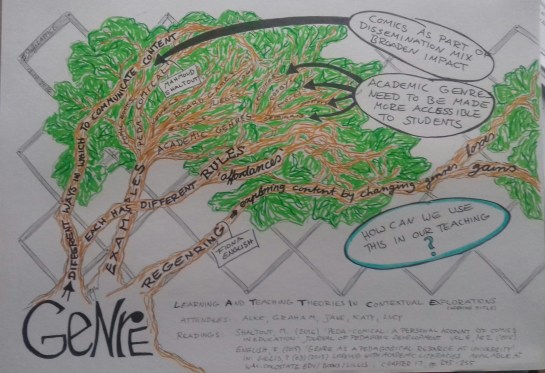

I have been trying to establish a regular get-together at Staffordshire University, where interested people have the space to share ideas they have come across and/or are using within Learning and Teaching. And as I am organising this, I got to pick our first starting point. Since I am also working on the series of Thinking-through-Genre events with Writing PAD, it is probably not surpsiring that I picked ‘Genre’ as a subject.

I had sent around two links as starting points for discussion: Mahmoud Shaltout’s ‘Peda-Comical: A personal account of comics in education’ (2016), where he reflects on the genre of comic books as a resource within his learning and teaching, as well as Fiona English’s ‘Genre as a Pedagogical Resource as University’ (2015), where she gives a short overview of some of the work in her 2011 book.

On the day I also brought Galman’s The Good, The Bad and The Data (2013) and Sousanis Unflattening (2015), as they are both examples within the comic book genre and I thought this would present a nice extension of the readings. They are particularly interesting when looking at the use of traditional narrative and visual narrative.

What I had overlooked, probably due to my established  familiarity with the subject, was that none of these actually defined the term genre in this context – and neither did I at our meeting until somebody actually specifically asked me to. Clearly I need a bit more practice facilitating these get-togethers so I can set aside my assumptions!

Let’s try to do it now: I think the easiest way to define genre as I am talking about it is that it describes different ways in which to communicate content. Each genre has different rules (or ‘affordances’), and deciding on one over another means that you possibly gain something, but might lose something else. I have previously tried to make this concept accessible in the Dress-up Doll of Formality activity.

My favourite quote that encapsulates this is by Douglas Adams, who wrote:

(…) the moment you have any idea, the second thought that enters your mind after the original idea is “What is this? Is it a book, is it a movie, is it a this, is it a that, is it a short story, is it a breakfast cereal?” Really, from that moment, your decision about what kind of thing it is then determines how it develops. So something will be very, very different if it’s developed as a CD-ROM than if it’s developed as a book. (Adams, 2003: 155f)

This always spoke to me because it makes a lot of sense to a designer. Because in a way (and this is also something we discussed briefly at our meeting), communicating content in a variety of guises is what being a designer (any type of designer, although it might be most obvious in the case of graphic designers) is all about.

And maybe this is also why I have always been absolutely fascinated by adaptations, especially cross-platform ones. Regenring (as in putting the content of one genre into another) is just another word for the same principle.

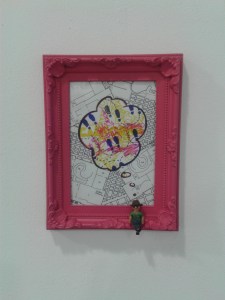
A visual representation of the 'minutes' of our meeting

A visual representation of the ‘minutes’ of our meeting

With the question of what ‘genre’ actually is (or can be) agreed on, we then proceeded to talk about the affordances it has, and how we can make use of them. The comic book, for example, is what one of us used as part of the dissemination mix of a research project to broaden its impact (find more details here). She made the point that producing a comic didn’t just get some of our Comic and Cartoon Arts students a live project to work on, but more importantly transformed some of the findings from the report into a format accessible to students, the people it might be most valuable to and who were unlikely to read neither the original report nor scholarly articles based on it because of their genre.

In a way the question of accessibility is what we probably most talked about – and particularly the problematic that comes with academic genres that are often not very accessible to students. Not just the question whether it makes more sense to ask students to communicate their research in a format that is more relevant to ‘real life’ than academic formats like the essay or research report, but also the academic genres we use within the university, such as module descriptors, module handbooks and similar, often filled with our own jargon that surely must seem like a foreign language to students. Sure, we give them a glossary, but is this the most accessible way to invite them to understand the processes and procedures of their academic life…?

…something to discuss further in our next meeting!

I’m currently writing an article. Literally while I am typing these words I should be writing on my article, but I am getting distracted by something I haven’t tried before when it comes to structuring the work, and I can’t wait to share it with the readers of this blog. (Tangential Procrastination in full swing!)

The article is sort of last minute, but it is based on research that I have done a few months ago, and some of it is based on research I have done a few years ago. (Parts of it probably go back to my PhD thesis, so make that a bit more than a decade… scary.)

I am clearly in the writing up stage of this, I have a draft to work on, but I haven’t quite figured out the structure and order of the points I want to make. I have written my key words on post-it notes and gotten an overview that way. I have highlighted the key words in my text, which is very helpful when moving paragraphs around. Nothing new so far, surely storyboarding academic work in this way is common practice by now.

But now I have done something that I have never done before… I not only added section titles, but also little descriptions. Erich Kästner used to do this in his books, many of whom I grew up with. Chapters would start with a tiny little summary of what would happen in this chapter. I don’t think there were any spoilers, but it would set up the scene and add a bit of intrigue as what was to come. It was also very handy when re-reading the book and looking for your favourite bits. I didn’t quite go as far as paragraphs, but short, descriptive subtitles. And you know what? It seems to make the writing process much easier. By just reading these subtitles (which I put in bold and italics to make them easier to find) I can check whether I am still using the order planned out with my overview, or whether I need a reshuffle to make this flow as a story (I did). A small addition to my writing process, but incredibly useful – and it might just be a way to support my students with writing the dreaded argument/main body of the text section in their essays and reports!

Kästner kept his as part of his novels, I’m going to delete mine from the article, but just so that they won’t be lost forever, here they are:

  • Section One, in which the problematic of the textbook genre is introduced
  • Section Two, which contains musings on different types of knowledge and different types of teaching that go with them, introducing a focus on study skills
  • Section Three, in which we compare academic and creative practice – and come across hidden practices that need to be made visible
  • Section Four, in which I explain why the pedagogical model needed should use the workbook as delivery method.
  • Section Five, in which I explain analogies as a way of making hidden academic practice visible, and why this called for a picture book, but not a narrative.
  • Section Six, in which I discuss some design choices of Writing Essays by Pictures.
  • Section Seven, in which I sum up and highlight the need for learning resources to be designed according to pedagogical principles, not traditional templates.

and you can read the full, finished article here.

writing-pad-logo

Come and join us on November 8th 2016 at Middleport Pottery in Longport (near Stoke-on-Trent) to find out about using genre as pedagogcial resource. The first in a series of Writing-PAD events this academic year focusing on genre(s), this day introduces a theoretical framework for exploring genres and their affordances, including a recent example of how this can work as pedagogical practice. Via a tour of this very special venue, we will not only explore a valued English Heritage site, but also use this as a starting point for playing with the idea of genre and regenring in our own teaching practices. The day will also include the launch of the recently published book Writing Essays by Pictures by Alke Groppel-Wegener.

Cost £145 : Includes the whole day, with refreshments on arrival and in the afternoon, a delicious buffet lunch, a special tour of the venue and your own copy of Writing Essays by Pictures.

Book via Eventbrite: https://www.eventbrite.co.uk/e/thinking-through-genre-exploring-genre-as-pedagogical-resource-tickets-28084047141?aff=eac2

(Draft) Programme:

10-10.30 Registration and Refreshments

  • Let’s start the day as we mean to continue by making our own name-tags – regenring a tiny part of conference/symposium tradition into something more expressive.

10.30-11 Welcome

11-12  Genre as Pedagogical Resource by Dr Fiona English

  • Fiona introduces a theory that could frame genre as pedagogical resource, updating thoughts from her book Student Writing and Genre.

12-12.30 Writing Essays by Pictures by Dr Alke Groppel-Wegener

  • Alke shares the story of the development of her recently published book Writing Essays by Pictures, an example of regenring the traditional study skills textbook into a picture/work-book.

12.30 – 1 Discussion

1-2      Lunch

2-3.30 The Pottery and beyond

  • Explore Middleport Pottery via a special tour and then use this experience to start thinking about ways of genring teaching practices.

3.30 – 4.15 Linking Theory and Practice

  • Fiona and Alke start us off using the Writing Essays by Picture books as an example to explore gains and losses of this particular regenring process to demonstrate an example of using the theoretical framework established at the beginning of the day. We will then move into the discussion of the outcomes of your genring activities.

4.15 – 4.45 Discussion of the day

4.45    End

The Speakers

Dr Fiona English is Honorary Senior Research Associate at UCL Institute of Education with a background in linguistics and language and literacies in education. Much of her research has been concerned with student writing and academic literacies, with her book Student Writing and Genre using a social semiotic perspective to explore the relationship between genre and the production of academic knowledge. More recently she has published Why do Linguistics?: Reflective Linguistics and the Study of Language with Tim Marr.

Dr Alke Groppel-Wegener is Associate Professor of Creative Academic Practice at Staffordshire University and a National Teaching Fellow. Having trained as a theatre designer but ending up teaching study skills, she became frustrated with the traditional ways of teaching academic practice, which has led her to develop her own approach being inspired by the creative processes of art and design and collated her strategies as Writing Essays by Pictures: A Workbook for students. She blogs at www.tactileacademia.com.

The Venue

Middleport Pottery is home to Burleigh Ware, which is still made on site using traditional craftsmanship. (And there is a shop where you can get your own Burleigh Ware, too). It was restored with the help of the Princes Regeneration Trust, has become a top visitor attraction and the home of The Great Pottery Throwdown.

It is a short walk from Longport Train Station, a 5 minute train ride from Stoke-on-Trent, and we would encourage participants to use public transport.

Please note that this is an old site and some of the areas are cobbled and might present a problem for people with mobility issues. It is advised that you wear sturdy shoes (no high heels) for the tour, and that you let the organiser know of mobility issues in advance, so that she can discuss your needs.

The Series

This exploratory workshop is the first in a series that will stretch through the academic year and culminate in a special issue of the Journal of Writing in Creative Practice.

Through discussion within the Writing PAD community, we know that very often lecturers, and particularly practitioner/teachers, are doing a lot of interesting things in their teaching, but they seem to lack the confidence to share this work, specifically within the academic conventions of publication beyond a description of what they are doing.

To address this, we have decided to pick the focus of Genre, Genring and Regenring for this academic year, and are organising a series of events that will provide support for this issue and culminate in one (or possibly two) special issues of the Journal of Writing in Creative Practice, guest edited by Fiona English and Alke Groppel-Wegener.

The other events in planning are:

  • a first follow-up in February 2017 which explores the traditions and conventions of academic writing. There will be speakers in the morning, which are still to be confirmed, but we are talking to Julia Molinari, Lisa Clughen and Julia Lockheart, who will explore academic writing as a genre – and discuss the changes it is going through. The afternoon will be given over to a sharing session/exhibition where delegates have the opportunity to show off examples of their genre-ing and regenring practice, either as artefacts or in a poster format. The will allow the opportunity for people to share best practice, but also to get feedback and ideas for potential research designs in order to explore their practice more and on a more theoretical level. This event will probably be held at De Montford University in Leicester.
  • A second follow-up in the form of an academic conference, either at Easter time or early May 2017. Here people can share their practice in an academic format, and those presentations could use the feedback from the conference to inform papers for the Special Journal edition. This might be hosted at Nottingham Trent University or Staffordshire University.
  • If there is interest, there are plans for a writing retreat to facilitate the writing of the papers, possibly at Nottingham Trent University.

We are currently investigating funding to keep costs down, but it might be the case that we need to break even on this. You will not have to attend all these events to be considered for the special issue, but as we are trying to build up a mutually supporting network, it would be nice if you could come and join us at as many as possible.

Dear all,

I’m glad to announce that I have finished the workbook for students I have been talking about for years and that after the ‘test’ copies produced as part of last year’s Kickstarter campaign, an extended version of  “Writing Essays by Pictures: A Workbook” (ISBN 9780957665224) is now in print… just in time for all those lovely new first years arriving at Uni!

This is very much a development of the work I have been doing for the last few years, much of it chronicled on this blog, and it uses visual analogies to lead students through the process of writing essays at University. Find out more about its origins on the dedicated page here. Mainly designed for students to work through on their own, it could also be used in led workshops and is full of creative and visual ideas for teaching information and academic skills. It is priced at a level that hopefully many students will be able to afford to buy themselves, and I hope that some of you might add it to your reading lists to help students transition to writing at undergraduate level.

Available from all normal book suppliers from this week, list price £15, currently £12.99 on Amazon (http://www.amazon.co.uk/dp/0957665229) or just £10 direct from the publisher (http://innovativelibraries.org.uk/press/thebooks/).

I am currently working with both the Writing PAD network and my fabulous publisher to organise some workshops for staff who want some more ideas how to use the material within in their teaching, which I will of course announce here once we have settled on dates.
Best wishes,

Alke

Artist’s books made by students as part of the Creative Landscapes project Lucy Brown has been working on over the past few years (see this blog post) has now made it into an exhibition! Located at the Brewery Arts Centre in Kendal it opens tonight (private view 5-7pm) and will be on until the first week in September. If you are in the area, make sure to pop by!

And for more information, check out the project’s website here.

Today I attended a BSA Sociology of the Arts Study Group‘s event entitled ‘Using the Arts in Teaching and Research’. I should say that I am not a sociologist nor do I think of myself as belonging to the social sciences, so this reflection is based on my interest in using arts in teaching and research rather than on the content of the research that was presented. As so often within the arts context, for me today was all about process.

I was treated to a really interesting day. The organisers had split up the presentations into four different sessions dealing with Using Art to Engage with Marginalised Groups, Using Art as a Reflexive Tool, Using Art in Engagement and Dissemination and Using Art in Training and Education respectively. Here are some observations I made (in no particular order, I think of these as possible starting points for more detailed posts in the future, but want to get them down while the event remains fresh in my mind):

When it comes to art and research there seems to be a spectrum at work. I haven’t quite worked out all the details yet, but this ranges from no art,  to using art to illustrate research (that could be findings or part of the process, and it could be already existing art or art specifically generated for the particular project), participatory art might be produced as an integral part of the research, this might then be interpreted by the researcher, or it might be interpreted by the participants themselves and then this will be interpreted by the researcher. And then there is art that has been produced by either researcher and participant or by both in collaboration that becomes a part of the outcome/dissemination.

Issues that these stages have to deal with include:

  • There is almost always a hierarchy between the researcher and the participants/subjects of the research, which at some stage is likely to kick in. For example at one stage the researcher might move from facilitator to the person who interprets results and writes them up – a position of power. It seemed to me that research is more true to the person creating the art if they themselves explain it/reflect on the meaning – and to use that in the analysis of the results rather than the researcher interpreting the work.
  • Depending on the set up of the research (or of the situation that is researched), participants/subjects might feel they need to present an established story (for example of a victim that gets redeemed, triumph over adversity), or might want to give a certain impression due to a (possibly hidden) agenda. Again a perceived hierarchy might complicate things.
  • It is really hard to plan and tie down a research protocol, because very often you don’t know in advance what data you will get. At the beginning participants might be concerned they are ‘doing it wrong’ and might want to get very specific instructions (and the ‘but I can’t draw’ response for drawing as part of research is a common occurrence in this context). However, certainly one of the great things about using arts-based research is that once participants feel empowered by it they often develop their own way of responding, which might be completely unexpected by the researcher. But this means that the forms in which the data comes might be surprising.
  • There were nods to thinking about working with artists – and being mindful of what that might mean for the artists, i.e. typically artists are freelance and payment through the university systems are notoriously slow, and the project, i.e. budget for the artists needs to be planned in from the very beginning, whether that is artist as illustrator, facilitator or co-researcher.

Of course we also discussed arts-based research in the context of today’s academic framework, so what exactly is practice-based research and is it becoming more accepted for submission as part of the (UK’s) Research Excellence Framework? Is it maybe easier to use this as part of an impact study? How can it be captured, and is it ok to collect and present research that is inherently subjective?

Needless to say, I came home with a lot of food for thought.


On 8th July I will be going to an event on The Body in Learning and Teaching in Nottingham (more information can be found here if you would like to join us – and if it’s too late look out for the paper attached to that site), and as preparation Lisa Clughen (who is organising it) asked participants to send her a sketch of how our body is important in our own academic practice. This is the task she sent:

The purpose of the event is to explore the centrality of the body to learning and teaching. To begin our explorations, can I ask you to email me an image that conveys a sense of how the body relates to different aspects of your learning or teaching? To stimulate your thinking, I will give you an example of a core aspect of my life as a lecturer: writing. Whenever I sit to write, I have to have at least one cup of tea ready before I sit down. It’s a ritualistic part of making my physical environment feel right for the task ahead. As I write, you’ll see me picking up the cup, enjoying its warmth, taking it to the window and drinking from it as my writing develops. Having my cup of tea is central to my efforts – my actions with the cup are fully embroiled with my writing as they provide a space for it to take shape. A cup of tea would definitely be one of my images, then – the place does not feel conducive to writing without it. What is yours?

Prompted by this I’ve been thinking a lot about the activities and things that at first glance appear to be on the periphery of (my) academic practice, but that really might be much more central to it. Maybe most important of these are the writing implements I use. Or maybe that should better be the ‘mark making’ implements, because I don’t ‘just’ write, even when in the process of putting together an academic paper. I have been on at least two (work) trips where my progress stalled due to the lack of a fountain pen. It’s not like I didn’t have ballpoint pens or pencils, markers or felt tip pens with me (and probably a selection of all of the above), but on neither of these trips I had taken my ‘good’ fountain pen. The one my parents got me when I finished my Masters that has accompanied me ever since. And it turns out that I couldn’t write anything useful until I bought a cheap fountain pen on both occasions. (I’m happy to report that I got smarter and now usually take a fountain pen on trips, even if it is just one of the two cheap ones I now also have.) There is just something about the flow of ink that makes my thoughts flow that doesn’t quite happen with the roll of the ballpoint pen.

Thinking about my academic practice and how the body plays a part in it has been quite useful, and revealing. Scribbling, ripping, cutting and pasting, spreading things out on the floor, reordering, drafting and typing are all activities that come to mind. But to me nothing seems to be more important than walking. I have realised that I have different types of walks that accompany the drafting of pretty much any important piece of writing I do, be that a crucial email, a new module handbook, a conference presentation or lecture, or even an academic paper. There is the ambling through the park to think through initial ideas; the walk of a first draft – in long strides pretty much around a block in my neighbourhood; pacing up and down my living room.

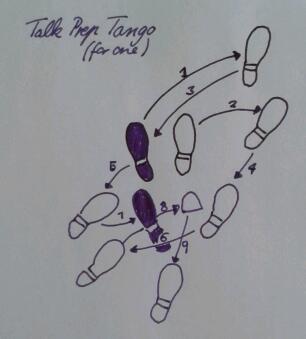
But maybe the most interesting is what I seem to regularly do when preparing a formal talk (could be for a conference, could be a more ordinary lecture): every so often I will interrupt writing my notes or slides to get up and talk to myself (sometimes in my head, sometimes out loud), pondering the right turn of phrase. This is not a time in which I walk specifically, or at least not great distances. It’s more like a fairly slow dance without music. When I’m at home it sometimes takes me from my desk to the hall or even the kitchen (I agree with Lisa there, the kettle is a very important writing ‘implement’, too), but mostly it is a few steps in one direction, then back, moving my weight from one foot to the other or from the tips to the heels. Sometimes my swivel chair becomes a temporary partner as I lean over the back to make an adjustment in the text already on screen or to pick up my trusty fountain pen to add to the notes or fill a post-it with an idea for future use. But mostly this is a dance solo, a ritual which allows me to imagine myself in front of an audience that doesn’t mind me searching for the perfect turn of phrase or starting a sentence over and over again until it is finally right and I get to the end of the argument.

Talk Prep Tango

One variation of the Talk Prep Tango


There will be a reprise of this Talk Prep Tango, usually the night before going public with the talk. This might take place at home or in a hotel room somewhere. Alas, the public performance will be much less like a dance, less searching and more like a person just talking.

[This post was drafted during a number of walks and then with a fountain pen before it was typed up. A Talk Prep Tango was not involved in its making.]

As Fiona is part of the Tactile Academia family, some of you might be interested in this talk:

Applied Linguistics Research Seminar Series Hosted by the Centre for Applied Linguistics, UCL Institute of Education, University College London

Writing, identity, learning: the affordances of genres

Dr. Fiona English

5:30 pm, Tuesday, 10 May 2016
UCL Institute of Education, Clarke Hall, 20 Bedford Way, London WC1H OAL

Most discussion about genre and writing focuses on describing and analysing the structures and functions of different genres in particular contexts, typically academic or professional, often using those analyses to develop students’ writing by showing them how to produce these genres. What I focus on, however, is what genres enable us to do, what they enable us to learn and how. In other words, I am interested in the affordances of genres.

In this talk I use examples from different phases of my work to show how I came to this particular understanding starting with writing produced by two fifteen year olds and finishing with the work of a mature non-traditional student on a Master’s programme. Each case explores what might be called genre transgression – that is using what would be considered the wrong genre for a given writing context (e.g. a play instead of an essay, a literary genre instead of a scientific one). Using the theoretical framework oforientation which emerged out of my research into student writing and genre (2011), I hope to demonstrate how the genres we use shape, not only what we write about but what we can write about and even who we can be as writers.

My aims are twofold. On the one hand I want to show that genre can be used a transformative resource in learning and teaching rather than simply as a pedagogical goal and that working with different genres offers students the chance to develop new ways of understanding their disciplinary work whether at school or at university. On the other hand, I want to promote the idea of genre choice by drawing attention to the different communicative options that genres allow.

Reference

English, F. 2011, Student Writing and Genre: Reconfiguring Academic Writing. Bloomsbury

ALL WELCOME!

Because I teach writing to art and design students, I’m not really attached to a particular subject team, which means that before this academic year I was never asked to go on study trips with the students. Turns out I have been missing out, as I realised this year when I was asked to go on not just one, but two of them.

The first one was in October, when Lucy Brown from our Graphic Design department turned some of the research she had been doing for her MA (as reported on here) into an assignment folded into a two nights stay in the Lake District. Not only did we visit the James Cropper Paper Mill, we also did a walk the students had previously planned and would subsequently make creative documentations of. It was fascinating to accompany a quarter of the students on their walk and to see them take notes in all sorts of ways – not least photographs (which they knew they were not allowed to directly use in the artists books they had to prepare as an assignment later in the term).

The second one was with a group of animation students to California in February, where we visited a number of studios and the Walt Disney Family Museum (and yes, the weather for this was much nicer than the one we had in the Lakes in October). We also popped by the Character Animation course at CalArts and were invited to take part in a Live Drawing Class with them as well as stick around for a demonstration lecture/chat with the animator James Baxter in the evening.

Thinking back to both of these trips now, I am thinking about what we ‘bring back’ from a study trip – and how best to consolidate this. There is something to be said about having the first hand experience of how something works –  explaining how paper is made is very different to walking around a paper mill in full swing with your safety glasses and ear protectors (yes, on an industrial scale that can be quite loud), just as much as having a vague idea of animation being produced in a studio system is nothing like walking around a range of different size studios and being able to talk to people who actually work there. James Baxter’s demonstration, while it was located within an educational institution, was the closest thing you will get to being in an animator’s head for 3 hours – because that is what happened – he was sitting at an animator’s desk, animated a scene and talked us through what he was thinking/doing at the time – and at the end of it he had a few seconds of film (for the sort of thing he was doing that evening, check out his blog here).

At their simplest, study trips are probably about collecting information, whether the point is to find out how certain things work or to be inspired for your own work doesn’t really matter, I guess for creatives it is always a combination of the two. But this is also the problem, because you have a few days that are really intense, and you come home having to tease out what actually happened in order to be able to make sense of all the layers of things that were going on (not unlike going to a conference for academics, I guess). It is crucial to make time to work through this, because otherwise these trips will remain as a folder of pictures snapped or maybe a few mementos picked up on the way.

That is why study trips NEED a follow-up activity for students. Both of these trips had them – the Graphic Design students all made artists books, which are now on the way to being exhibited back in the Lake District, the animation students had an exhibition at the university with some work created as a response to the trip.

And while I know that this is so important, it is sad to think about how often I don’t take the time myself to create a response that allows me to think in more detail about what I have found out after coming back from a fact-finding mission – whether it be a meeting at a different institution or a more formal conference. Who knows how much I could improve my practice if I was able to do this more than just sporadically… but then at least I blog occasionally.

Alke's California Adventure - my response to the study trip Just don't ask me what it means...

Alke’s California Adventure – my response to the study trip
Just don’t ask me what it means…

P.S.: With the study trip to California I wasn’t able to go to the HEA Arts and Humanities conference this year, but it sounds like some pretty good session were there, particularly when it comes to object learning as you can check out in this write up by Dr Paul Kleiman.