Archive

Workshops

Make Your Own Nametag

Make Your Own Nametag

Today was the Thinking Through Genre workshop where people interested in using genre as a pedagogical resource (in all sorts of different disciplines). Before this gets buried on my to-do-list, I’ll write it up now (though I’m a bit tired, so forgive me if not everything makes sense…)

We started the day with making our own name tags and reflecting on the purposes of a name tag – it is  a nice icebreaking activity that changes the energy of the ‘registration’ period at (academic) events, allowing informal networking, getting delegates to start playing (thus telling their brains that they might need to switch gear from normal day-to-day stuff) as well as producing something fun that might even show the personality of the wearer.

And then I continued to question and play with conference/workshop conventions by handing out delegate packs not contained by the standard cloth bag (possibly with some university branding), but instead specially designed furoshiki. Let me explain… furoshiki are usually square pieces of cloth that in Japanese tradition are used to wrap things. There are different ways to tie them in order to contain differently shaped objects (for example there is a really neat way to tie up a bottle). When I started thinking about organising an event based around the idea of genre and regenring, I thought that a furoshiki would be such a fabulous artefact to embody the idea of regenring: it can be a bag or sorts, but you can also use it as a scarf, a headband or even tea towel  (I guess that depends on what material it is made out of). You can also use it as a kind of poster (I’ve always really liked the idea of printing academic posters on fabric, as this makes them so much easier to transport to conferences). But, as soon as you use it in one function, it usually loses the special aspects of the others. So if you tie it to use as a bag, you are not able to see the full design of the poster, but if you see the full design, you can’t tie it up.

So a few weeks back I set out to design a furoshiki to give to our delegates. And in order to put something meaningful on them, I raided the writings of Fiona English, our main speaker of the day, trying to see whether I could visualise her theoretical framework of regenring in a square, scarf-like way. Luckily she has a convenient table summarising the framework, where she talks about two different orientations – the material and the social – each with two different main aspects (thematic/semiotic and contextual/discursive). This was the basis for my design, and on this I also included some of the particular things to look out for as part of the analysis. I framed this with my take on genre – capital Gs in different fonts represent the idea of genre – the same content presented in different forms. The centre of the design has a ‘huddle’ of these Gs, representing the potential of the choice of form. The outside of the design has a band of these different Gs going around it, but this time one by one. In the corners, two different Gs intersect and on two corners the overlap is highlighted with the use of a colour, showing the content that would be covered in both these genres; the other two corners highlight their differences – what part of the content would be gained when deciding on one genre, and lost when deciding on the other. Gains and Losses are important when it comes to discussing genre, so I wanted to include that. (And this might all make more sense when you are familiar with Fiona’s work on regenring.)

poster

poster

I have to admit that I was a bit nervous if people would understand what I was trying to say with this, but people really liked them, so this was a great start to the day and a good way to introduce Fiona’s session on Practice, Knowledge-Making and Writing. She started out by defining genre in slightly more detail than I had done at the very start. My favourite bit of her definition was that “Genre is a naming concept which identifies the shape or framing of a text”. I think the term ‘naming concept’ is really helpful, and will definitely use this in future when I get blank stares when trying to explain what I mean by ‘genre’. She also said that “we choose genres according to the kinds of meanings and knowledge that we want to produce”, which again I think is a really clear way of getting to the heart of the matter. And when it comes to analysing genre (and possibly also genre choices we make), the most important questions we need to ask are “who is writing and WHY?” and “Who is reading and WHY?” Fiona discussed four different examples, covering appropriateness of genre, genre and the everyday, genre and knowledge (and how regenring – transforming one genre into another – can be used to produce more and different knowledge), as well as genre and choice. There was a lively discussion happening (we weren’t a big group, so we could be really interactive), and my personal favourite was the discussion of how (academic) conventions can be used to disguise nonsense, something that often happens in work of students who are not familiar enough with a particular academic genre and are trying to mimic it.

fabulous pottery model of Middleport Pottery

fabulous pottery model of Middleport Pottery

For lunch and our after lunch activity our venue became important: we were meeting at Middleport Pottery in Longport, so I had ordered Staffordshire Oatcakes for lunch – which were a big hit with the delegates – and then I had arranged for a short factory tour. (No point in coming to such a fabulous venue and then ignoring what is special about it, i.e. that it is still a working factory.) Phil, the fabulous volunteer, gave us an overview of the organisation of the buildings, and then showed us the highlights, including particularly the underglaze decoration process which makes Burleighware so special, ending up in the last bottlekiln of the site. And really the tour was part of the programme, because it then gave us the chance to think about different genre removed from texts – ways of communicating content through experiences and different ways of teaching.

board game

board game

We looked at a board game of Middleport Pottery and compared it with the tour – and also speculated on how both of these are different from the experience of working there, discussing gains and losses of genre again.

After this I shared the process of putting together Writing Essays by Pictures (you can find more details here) and reflected on how the starting point for this had been the collision of my work and my hobby of making books that pushed this forward. This was really an example of thinking through genre, as it was the formats of booklets, children’s books and then workbooks that helped me develop the final outcome.

We ended the day with delegates reflecting on how they would take this forward. Looking at the feedback there will be a lot of thinking, but also some application of new knowledge as soon as tomorrow. And as a workshop organiser, what more could you possibly want?


A Special Thank You to Richard Mellor, who took my furoshiki sketch and turned it into a print-ready design!

writing-pad-logo

Come and join us on November 8th 2016 at Middleport Pottery in Longport (near Stoke-on-Trent) to find out about using genre as pedagogcial resource. The first in a series of Writing-PAD events this academic year focusing on genre(s), this day introduces a theoretical framework for exploring genres and their affordances, including a recent example of how this can work as pedagogical practice. Via a tour of this very special venue, we will not only explore a valued English Heritage site, but also use this as a starting point for playing with the idea of genre and regenring in our own teaching practices. The day will also include the launch of the recently published book Writing Essays by Pictures by Alke Groppel-Wegener.

Cost £145 : Includes the whole day, with refreshments on arrival and in the afternoon, a delicious buffet lunch, a special tour of the venue and your own copy of Writing Essays by Pictures.

Book via Eventbrite: https://www.eventbrite.co.uk/e/thinking-through-genre-exploring-genre-as-pedagogical-resource-tickets-28084047141?aff=eac2

(Draft) Programme:

10-10.30 Registration and Refreshments

  • Let’s start the day as we mean to continue by making our own name-tags – regenring a tiny part of conference/symposium tradition into something more expressive.

10.30-11 Welcome

11-12  Genre as Pedagogical Resource by Dr Fiona English

  • Fiona introduces a theory that could frame genre as pedagogical resource, updating thoughts from her book Student Writing and Genre.

12-12.30 Writing Essays by Pictures by Dr Alke Groppel-Wegener

  • Alke shares the story of the development of her recently published book Writing Essays by Pictures, an example of regenring the traditional study skills textbook into a picture/work-book.

12.30 – 1 Discussion

1-2      Lunch

2-3.30 The Pottery and beyond

  • Explore Middleport Pottery via a special tour and then use this experience to start thinking about ways of genring teaching practices.

3.30 – 4.15 Linking Theory and Practice

  • Fiona and Alke start us off using the Writing Essays by Picture books as an example to explore gains and losses of this particular regenring process to demonstrate an example of using the theoretical framework established at the beginning of the day. We will then move into the discussion of the outcomes of your genring activities.

4.15 – 4.45 Discussion of the day

4.45    End

The Speakers

Dr Fiona English is Honorary Senior Research Associate at UCL Institute of Education with a background in linguistics and language and literacies in education. Much of her research has been concerned with student writing and academic literacies, with her book Student Writing and Genre using a social semiotic perspective to explore the relationship between genre and the production of academic knowledge. More recently she has published Why do Linguistics?: Reflective Linguistics and the Study of Language with Tim Marr.

Dr Alke Groppel-Wegener is Associate Professor of Creative Academic Practice at Staffordshire University and a National Teaching Fellow. Having trained as a theatre designer but ending up teaching study skills, she became frustrated with the traditional ways of teaching academic practice, which has led her to develop her own approach being inspired by the creative processes of art and design and collated her strategies as Writing Essays by Pictures: A Workbook for students. She blogs at www.tactileacademia.com.

The Venue

Middleport Pottery is home to Burleigh Ware, which is still made on site using traditional craftsmanship. (And there is a shop where you can get your own Burleigh Ware, too). It was restored with the help of the Princes Regeneration Trust, has become a top visitor attraction and the home of The Great Pottery Throwdown.

It is a short walk from Longport Train Station, a 5 minute train ride from Stoke-on-Trent, and we would encourage participants to use public transport.

Please note that this is an old site and some of the areas are cobbled and might present a problem for people with mobility issues. It is advised that you wear sturdy shoes (no high heels) for the tour, and that you let the organiser know of mobility issues in advance, so that she can discuss your needs.

The Series

This exploratory workshop is the first in a series that will stretch through the academic year and culminate in a special issue of the Journal of Writing in Creative Practice.

Through discussion within the Writing PAD community, we know that very often lecturers, and particularly practitioner/teachers, are doing a lot of interesting things in their teaching, but they seem to lack the confidence to share this work, specifically within the academic conventions of publication beyond a description of what they are doing.

To address this, we have decided to pick the focus of Genre, Genring and Regenring for this academic year, and are organising a series of events that will provide support for this issue and culminate in one (or possibly two) special issues of the Journal of Writing in Creative Practice, guest edited by Fiona English and Alke Groppel-Wegener.

The other events in planning are:

  • a first follow-up in February 2017 which explores the traditions and conventions of academic writing. There will be speakers in the morning, which are still to be confirmed, but we are talking to Julia Molinari, Lisa Clughen and Julia Lockheart, who will explore academic writing as a genre – and discuss the changes it is going through. The afternoon will be given over to a sharing session/exhibition where delegates have the opportunity to show off examples of their genre-ing and regenring practice, either as artefacts or in a poster format. The will allow the opportunity for people to share best practice, but also to get feedback and ideas for potential research designs in order to explore their practice more and on a more theoretical level. This event will probably be held at De Montford University in Leicester.
  • A second follow-up in the form of an academic conference, either at Easter time or early May 2017. Here people can share their practice in an academic format, and those presentations could use the feedback from the conference to inform papers for the Special Journal edition. This might be hosted at Nottingham Trent University or Staffordshire University.
  • If there is interest, there are plans for a writing retreat to facilitate the writing of the papers, possibly at Nottingham Trent University.

We are currently investigating funding to keep costs down, but it might be the case that we need to break even on this. You will not have to attend all these events to be considered for the special issue, but as we are trying to build up a mutually supporting network, it would be nice if you could come and join us at as many as possible.

Yesterday I went on a little daytrip up to Glasgow. This was a fairly short notice affair after I had spotted a seminar intriguingly titled ‘Troubling the Academic Thesis – An Artist Teacher Public Seminar’ via Twitter. It promised the perspectives of Dr Chris Dooks, whose doctoral work included sound presented on three vinyl records, including sleeve notes with an essay on one side and story-board like image sequences on the other – find out more at his Idioholism website -, and Dr Nick Sousanis, whose thesis was developed and presented as the comic book/graphic novel Unflattening (Nick skyped in from Calgary). It was a really interesting conversation organised by colleagues from the University of the West of Scotland, which provided a lot of food for thought.

Maybe my favourite bit was a quote that Chris shared with us from Knowledge in Policy, a book by Richard Freeman and Steve Sturdy. In the Introduction they write:

Drawing a simple analogy with the three phases of matter – solid, liquid and gas, we argue that knowledge too exists in three phases, which we charaterise as embodied, inscribed and enacted. Furthermore, just as matter may pass from one phase to another, so too can knowledge be transfromed, through various kinds of action, between phases. (Freemand and Sturdy, 2014: 1)

This is surely to become one of the quotes I use all the time when talking about my teaching practice and Tactile Academia. I don’t know whether I agree with the three phases of knowledge they point out (I’m planning to read the book soon to find out), but what I really like about it is that it emphasises the idea, no the necessity, of transformation within knowledge and knowledge making. This is something that came up over the course of the seminar again and again (or maybe it is just something that I picked up on particularly because for me another PhD was in the mix, I am currently reading Stephanie Black’s PhD thesis on Illustration as a form of practice-led research, which highlights similar issues).

So, there is the process of doing research (in this case doctoral study of some kind), and then there is the finished product that is presented. Within the creative practices there is an ongoing discussion as to whether the academically written thesis should be a required product. I think there is a lot of insecurity about writing in particularly and there seem to be some insecurities as to whether one is (or maybe even we all are) ‘good’ enough to claim our place in the academy (whatever that might be). Very often it seems to me that writing in this case is cast as the obstacle – and usually here writing seems to mean putting together an academically written exegesis, ignoring the potential of writing as a process.

This made me think back to my own PhD thesis, which was a straight academic thesis based on some action research done through teaching, so one could argue it was practice-based, but you couldn’t really call it based on creative practice. One of the things this explored was the importance of writing for designers (and design students). While I was writing this I was concerned by a movement that seemed to try to almost get rid of writing within art and design disciplines, putting forward the photo essay and dissertation. I was concerned by this because the process of writing is incredibly useful in order to develop your thinking – as is the process of sketching (as Nick showed by sharing some of the development work of his comic not just with us at the seminar, but also in the notes/appendix section in the published book) and making other work (as Chris talked about). At one point Chris stated that a lot of the words that he wrote didn’t make it into his thesis (he decided to write a thesis to go alongside the work). I was thinking: “well, of course not!” I bet not all of the things he produced as part of his practical exploration made it onto his LPs either. This is the process, the knowledge going through the different phases – only a fraction ends up in the product to be presented. I’m a big fan of the concept of regenring (as explored by Dr Fiona English and mentioned elsewhere on this blog), and I think that works so successfully because it changes the phases of knowledge – but also because it is a process that generates more work, work that will not necessarily end up in a final piece.

So maybe the problem here is this weird ambiguity that seems part and parcel of traditional (Western?) educational systems: there is the learning that is all about the process on the one hand and then there is the ‘thing’ that gets presented and evaluated. At times these seem so apart that they could almost be called a dichotomy. Which is tragic, really.

So maybe we should try to put the process of research first and the ‘product’ (i.e. the physical outcome) last. Because the latter should develop out of the former. Don’t worry about finding an innovative or alternative way of presenting your research, find the most appropriate way of presenting the outcomes of your research. That might be through academic writing, or it might be something else. But on the way there, explore the different phases of knowledge (and here writing can be your friend!) and then see in what phase it seems to want to stay. I would argue that is what both Chris and Nick did.

Marion, one of the lovely participants in our first Thoughtbites workshop sends this account:
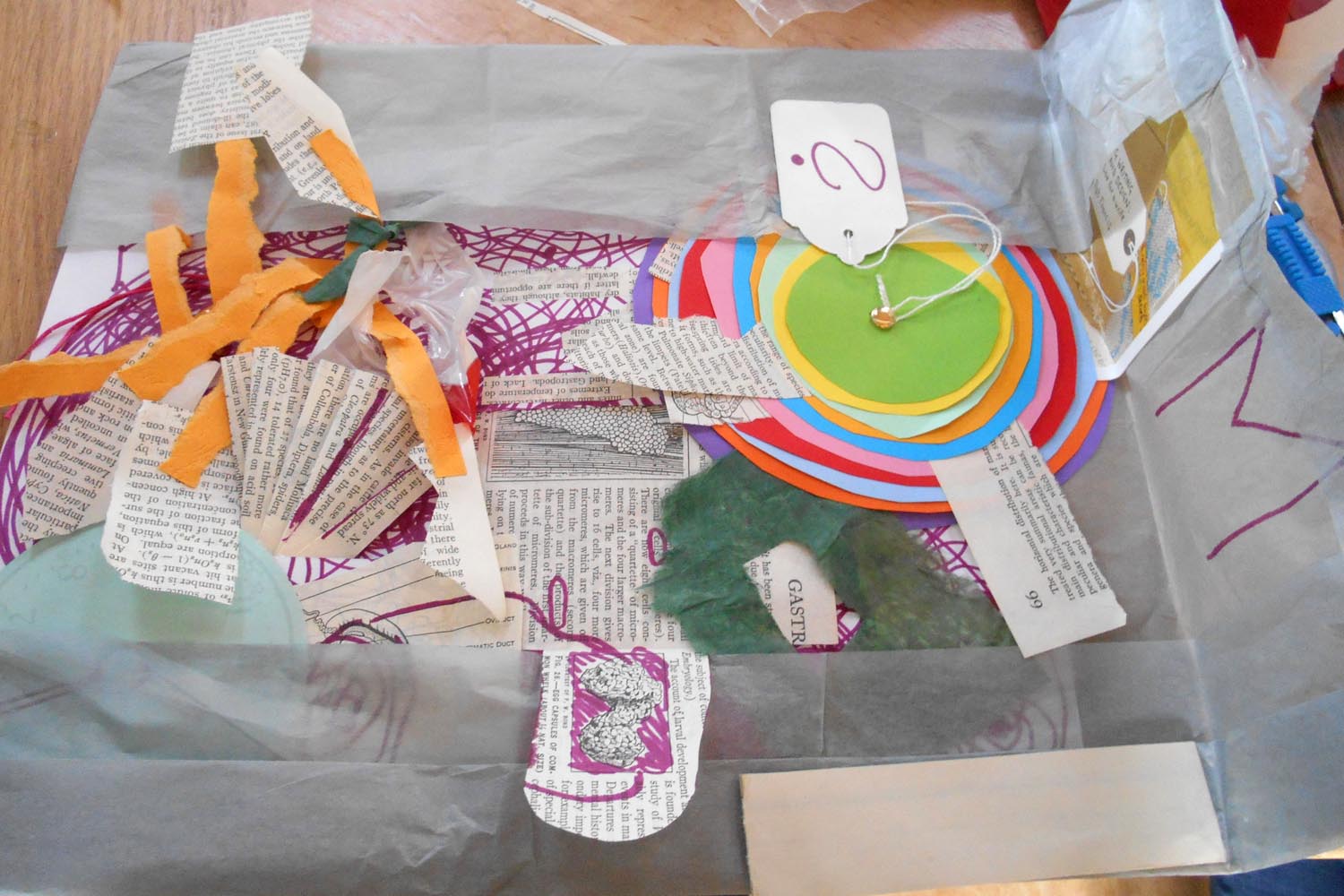
I took part in the ‘thoughtbites‘ workshop looking at ‘folds and layers’ as a method for visual-tactile note taking.

I myself have always found it very difficult to keep any notebook in a state that I appreciated it after its use or that I wanted to return to it and remind myself of what I had written.

Working with my hands and materials whilst listening I found myself beginning to relax and filter information based on what seemed important at the time. Although I felt I had hardly listened consciously, certain information became very dominant and stuck with me afterwards.

Engaging with the materials I noticed that I had used them in various ways that began to make sense to me and that I could see certain methods that I could use in the future and which also could be shared with others as a form of template.

Examples were the use of dials and circles (e.g. priorising information, looking at the ‘central’ question), icons that could serve to highlight specific information and covering/uncovering information through material layers as a way of discerning information.

Collage Workshop VMC 2015 from Marion

In my own research I have come across the functions of the right and left hemisphere of the brain which opens up an interesting perspective on memory retention through visual-tactile means and the workshop has inspired me to include these methods in the future.

In mid September, Susan and I met up at the 4th International Visual Methods Conference in Brighton to fly the flag for thinking-through-making-and-doing. While we had originally proposed a panel, we ended up running two workshops titled “Thoughtbites: Transdisciplinary cuts, folds and collage in thought and practice”. As part of that we had been commissioned by the conference organisers to author and print a little booklet that most attendees got in their conference bag (not all of them as the conference ended up over subscribed so we hadn’t printed enough).

Titled Thoughtbites – Cuts and Folds in Thought and Practice, this booklet used the work of notable philosophers as starting points for reflection and very basic activities – so people were able (and meant) to customise their own copies, and in the two workshops we used the same starting points to make, reflect on the conference so far and just provide some space for thoughts.

The first workshop used the pop-up facilitated by cuts and folds  to transform the usually flat surface to a three dimensional structure, complete with little windows to glimpse through. We were inspired here by Rene Descartes’ notion of the material world and its non material counterpart, the subjective and objective, abstract and material, mind and body. We also explored layers, inspired by Edmund Husserl, thinking about layers of meaning and how they reveal and conceal, sparking new trains of thought.


The second workshop explored the idea of tracing – and Gilles Deleuze’s suggestion that we should focus on the differences of tracings, the intentional and unintentional losses and gains, in order to reveal meaning. We also looked at Jacques Derrida and the fold as well as the moebius strip – is it possible to determine one side from the other? Does it matter?

Looking back what was most interesting was the way discussion unfolded. While some people came to both sessions, mainly people attended just one. But what was really different was the set up. The first session was done in the ‘Waste House’, a workshop space constructed pretty much entirely from recycled materials. Here we had one huge table, which resulted in everybody sharing materials with each other and a very informal conversation that included everybody throughout the 90 minutes. The second session was in a more traditional seminar room, where we had set up a number of smaller group tables. And while people were talking at their tables, the atmosphere was markedly different (though not necessarily in a bad way).

Overall it was a nice few days, with maybe some people encouraged to make some more time and space to reflecting through enjoying the process of making.

(sorry for the delay in posting this, freshers flu and start-of-term workload made it hard to blog immediately)

from Lucy Brown

I’m currently embarking on a new journey – one that seeks to navigate a way through the woods of ‘academia’. Having been teaching now for 6 years, the word has sat quietly on my shoulder whispering of its prowess and stature, yet I’ve struggled to find a straight answer with regards to how to begin to find my way through its seemingly impenetrable mass of trees. In taking up a new post at Staffordshire University earlier this year, I was determined to conquer it and with some research under my arm and a tactile approach to pedagogy in tow I set off hoping to meet a guide along the way.

Several days into my journey, I met Alke, the author of this fine blog. She writes, “the different ‘hats’ I wear – teacher, researcher, writer, designer, artist – … all weave together to one identity.” “Finally,” I say to myself, “I’ve found my guide.”

Alke has kindly invited me to contribute to this online space, and I find myself at the first stop on my map. I’ve shared this small anecdote with you all in the hope of encouraging those new to the academic landscape – it’s simply a case of one step at a time!


Walk

Walk

In 2014 I completed a pedagogic research project on the MA Graphic Design course at London College of Communication. The research discusses a tactile, visual metaphor for an increasingly prevalent issue within art and design education, culminating in a series of practical workshops entitled ‘The Non-Linear Workshop Series’.

Research Title:
Beyond digital technology: introducing undergraduate graphic design students to the non-linear landscape of the creative process.

Many undergraduate graphic design students struggle to explore the landscape of the creative process in a ‘non-linear’ way, due to the dominance of digital technology on their life thus far, which increasingly encourages a ‘linear’ mode of thought.

For example, the undergraduate graphic design creative process has a tendency to map as follows (particularly at entry-level):
A) Brief to B) Solution (via Google).

Palfrey (2010 p.6) writes, “Digital Natives are coming to rely upon this connected space for virtually all of the information they need to live… Research means a Google search… they simply open a browser, punch in a search term, and dive away until they find what they want — or what they thought they wanted.”

In my research question, I have used the word ‘landscape’ as it means ‘all the visible features of an area’, or ‘the distinctive features of a particular situation or activity’. Many entry-level students are blind to the ‘visible or distinctive’ features of the non-linear creative process, and unaware of the options with regards to how and why they should traverse its landscape. They have grown up in an age of linear immediacy — of the digital Google map that tells them where to go. The Non-Linear Workshop Series uses a physical landscape as a metaphor for the exploration of this idea.

In addition, I have used the phrase ‘beyond digital technology’ with the intention of suggesting ‘more than, exceeding, in excess of, above, over and above, above and beyond, upwards of’ as opposed to ‘on the other side of, further away than, behind, past, after or over’. I recognise the value of the Internet as a research tool, yet the Non-Linear Workshops Series aims to teach students to know how to ‘go beyond’ it.

Choice is now linked to risk (Salecl, 2013) and therefore causes anxiety. Notions of non-linear creative ‘travel’, visual exploration, wandering and at times becoming lost seem irrelevant and frightening to many, meaning that the development of a non-linear creative process is culturally challenging. A colleague of mine recently overheard a student say: “If it’s not on Google, it doesn’t exist. Everyone knows that.” The Non-Linear Workshop Series aims to readdress and refresh the methods through which the non-linear landscape of the creative process is introduced to entry-level students in an effective and relevant manner, considering the linear nature of their digitally dominated lives. Palfrey writes:

“The innovative use of technology leads to a ‘copy and paste culture — a practice that is in tension with traditional educational ethics… In order for [educational institutions] to adapt to the habits of Digital Natives and how they are processing information, educators need to accept that the mode of learning is changing.”(Palfrey: 2010, p.239)

The Non-Linear Workshop Series

The Non-Linear Workshop Series presents ‘A) Brief, to B) Solution’ as a visual, tactile, focal point, and encourages undergraduate graphic design students to question and explore how exactly they traverse from A to B, along with what their journey might look like in relation to ‘linear’ or ‘non—linear’ form.

Lines

Lines


Workshop 1 of 7: Context
The first aspect of the workshop series introduces the students to the context of the research in an appropriate, simplified manner through the group discussion of a short text and series of questions. The students are able to grasp and engage in the research proposition easily through this method, enabling them to ‘want’ to learn more through realising a ‘need’ to engage in the subject matter.

Workshop 2 of 7: Non-Linear – Define
The second aspect of the workshop series enables students to begin to unpick and understand the meaning of ‘non-linear’. The workshop begins with a brief whereby students write down their initial understanding of the meaning of ‘non-linear’, before investigating further. This enables the discussion of the nature of Google-led research through the drawing of a line within a given template. Formal definitions of linear and non-linear are then provided to conclude the session.

Workshop 3 of 7: Non-Linear – Make
The third aspect of the workshop series asks students to generate varying forms of line during a 1 day workshop. Students use varying tools and mark making methods to do this. The lines generated provide further visual impetus through which to discuss the development of their understanding of the differences between ‘linear’ and ‘non-linear’.

Workshop 4 of 7: Non-Linear – Map
The fourth aspect of the workshop series asks students to map 5 different routes on an OS map, through which they begin to explore an unfamiliar, local landscape. The aim of this brief is to generate non-linear visual form in a way that directly corresponds to a physical landscape. These forms are then extracted from the maps and digitised so as to provide further, clear visual impetus to reinforce the context and increasing understanding of the research context. This activity also provides students with a route to follow during the next workshop.

Workshop 5 of 7: Landscape
The fifth aspect of the workshop series involves a field trip to an unfamiliar local landscape. The route that the students follow will be chosen from the previous session where varying non-linear routes are mapped.

A design brief is provided at the start of the field trip which asks the students to represent the landscape in 5 different visual ways. They are asked to document the landscape as they walk their elected route in consideration of their 5 senses — sight, touch, smell, taste and sound.

“There is something about walking which stimulates and enlivens my thoughts. When I stay in one place I can hardly think at all; my body has to be on the move to set my mind going… to lend a greater boldness to my thinking.”
Rousseau (in Solnit, 2006 p.19)

Workshop 6 of 7: Creative Process
The sixth aspect of the workshop series asks students to develop a visual response to the material that they sourced and documented during the Landscape trip. The length of this workshop will vary dependent on institutional structure, unit/module requirements and the needs of the student group. The output work produced acts as impetus for discussion surrounding the ‘non-linear’ landscape of the creative process – as experienced in a physical, tangible manner.

Workshop 7 of 7: Evaluation/Review
The seventh aspect of the workshop series involves a final group crit of work produced in the previous session(s) so as to enable the students to both see and reflect on each other’s work critically. The work produced will also act as impetus when the students repeat one of the earlier briefs whereby they draw a line that they feel represents the creative journey they have taken in representing a physical landscape creatively. The drawing of this line, in comparison to their earlier ‘30-minute Google’ line will instigate discussion concerned with its change in form from straight to more complex, enabling the students to evaluate and reflect on the workshop series in relation to the development of their personal working methods. Each student will also receive a visual template for future projects through which they are able to apply what they have learnt through drawing the ‘linear’ or ‘non-linear’ nature of their creative process on any given brief.


Throughout the academic year 15/16 I will be seeking to continue to test and develop the Non-Linear Workshop Series with the aim of disseminating it to HE art & design lecturers for potential use.

If you would be interested to read a full copy of the research project, please see my blog and/or contact me on lucy[at]lucybrown.co

For references please check the Bibliography page.

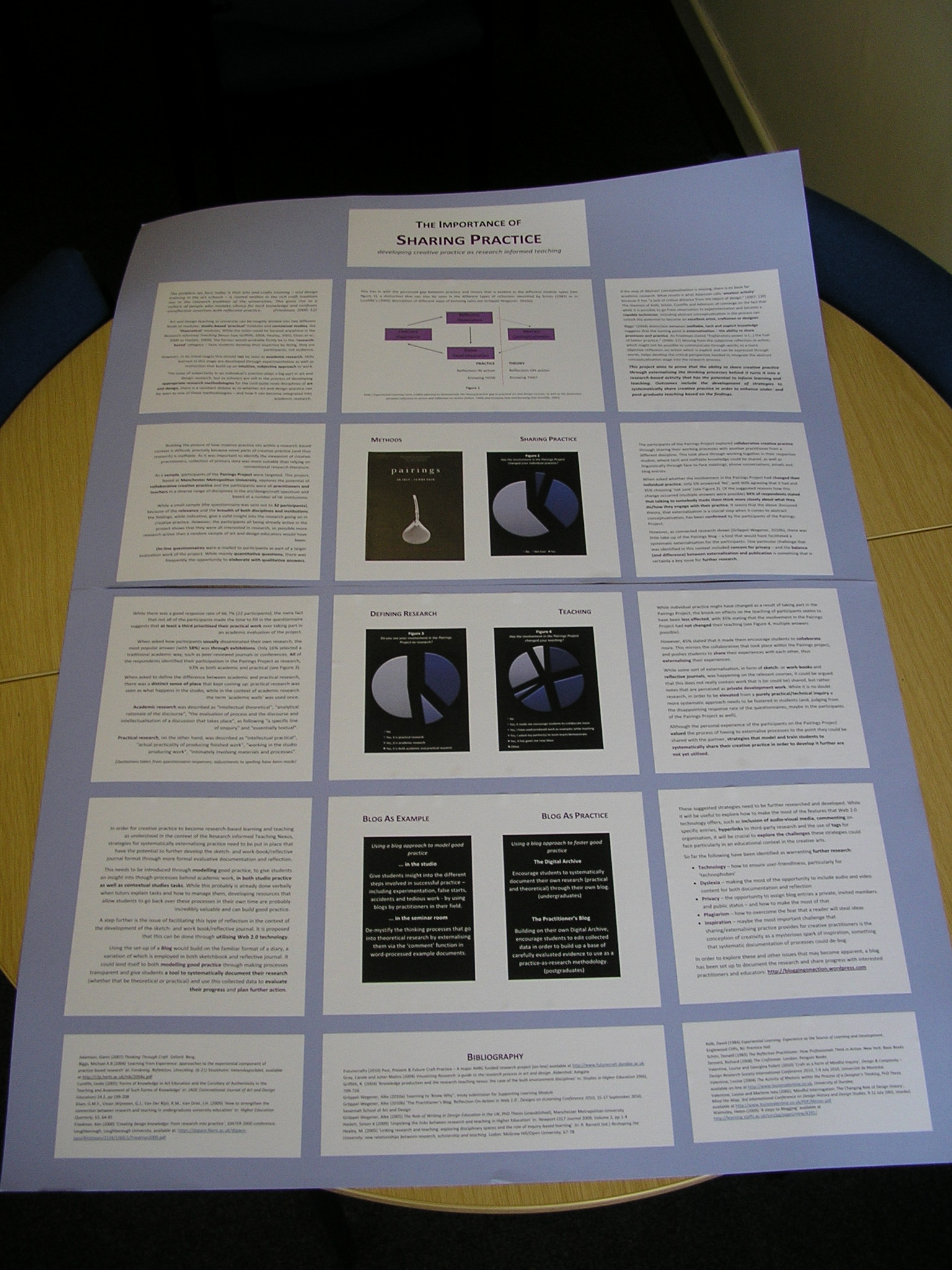
I have wanted to do a post on posters for a while. As somebody with an interest in graphic design who also did a tiny little bit of it as part of her undergraduate degree (specifically designing promotional material for theatre productions), I was always baffled by the academic research poster as a genre. The posters I have come across at conferences are often very dense affairs that are text heavy, and I have often wondered what the point of them was, as whenever I was confronted by a room full of them, my patience for reading dropped from low to non-existent. Let’s face it, a poster session at a conference isn’t really the ideal environment to read…

And then came the time when I had to do a research poster myself, as part of my teaching qualification. I had great plans to do it differently – not much text, very visual, surely that was the way to go. Alas, I stumbled across a problem: this was the only assessment for a module, and while I had about ten minutes to present it, basically the poster was where I had to prove all my knowledge of the subject.

The Importance of Sharing Practice - academic poster 2010

The Importance of Sharing Practice – academic poster 2010

So it got more and more filled up with text while my good intentions stood by feeling powerless; it felt a bit like squeezing all my findings onto an A1 sheet (or however big it was). Looking at it then, I thought this was a bad poster, but at least it showed off the research I had done. Looking at it now, I think it was a really bad poster. The feedback I got mainly was about the content, although it also stated “The graphs on the poster had a positive visual impact from a distance, however, larger fonts or at least headings would enhance the accessibility of the message.” and then “The quantity of information within the poster could be reviewed” (which I am guessing means PUT LESS TEXT ON IT).

Some time later I would come across ‘Spineless Classics’ – a company that designs whole books onto a one sheet poster by the way of pretty miniscule type. In a way research posters remind me of that, trying to squeeze your whole report onto A1 (or A0). But the brilliant thing about Spineless Classics is that they design their layouts in a way that you also end up with an image of (usually) white space that is significant to the book in some way. (You can see some examples here.) Research posters often don’t have that saving grace!

Trying to find out more about the academic research poster – and how to put together a good one – has been a bit challenging, I haven’t been able to find any good guidance beyond the basics that relates to the arts and humanities, maybe because it is more common in the (natural) sciences. But I think that this is an important aspect of practice for any research student – they might get the opportunity to submit a poster to a conference, after all, or just want to develop a visual way to show the development of their project(s).

After getting a bit of funding from my university, I was able to invite visual journalist Lulu Pinney to do a lecture and workshop about research posters for us, which was very well received, incredibly inspiring and I can only recommend. Lulu gave us a lot of practical tips on how to organise a poster, but I think the most important was her mantra to “ignite, don’t immerse”. A poster shouldn’t be a summary of your research, it should ignite people’s interest in your research. I think this is fabulous advice when it comes to designing a poster for a conference.

Unfortunately, however, this could turn out to be terrible advice when it comes to preparing a research poster for assessment. If a poster is the only thing that is assessed, you might have to design it very differently. So maybe the split personality of the research poster comes from us lecturers trying to adjust the ‘assessment mix’. At university we want to test students in different ways, and we want to give them skills that they can use ‘outside’ of the university (or, in case of the research poster, still in academia, but once they have progressed from the student to the researcher role). I would guess that only rarely can a research poster do both effectively.

I also have a theory why. I’m currently reading Daniel Keller’s Chasing Literacy – Reading and Writing in an Age of Acceleration. Keller refers to Lester Faigley’s 2006 chapter ‘Rhetorics Fast and Slow’ in Rhetorical Agendas: Political, Ethical, Spiritual, that argued that there are two different rhetorics: a “fast” one and a “slow” one. The slow one is the one we often try to instil in our students for their academic work. I want my students to read deeply, not just skim over the surface of a text, just as I want them to show deep thinking in their essays, which I expect to be re-drafted carefully a number of times. Fast rhetoric – the web-based digital images, blog posts, e-mails, text messages, instant messaging systems, websites – seems to have little room in traditional academia beyond the initial stages of research (although Keller argues that maybe it should). The tradition of the poster is part of the fast rhetoric – posters are promotional tools, they let us know about events or products, they are designed to get their meaning across in the careless glance the passer-by gives them. The research poster attempts to emulate this, but with the burden of trying to get across the slow rhetoric of the academic research project. And this is the problem. Thinking back to the time I designed that first research poster, I knew that if this was to work as a poster, it needed to be short and snappy. It needed to be utilising a fast rhetoric. I could see what would be lost in the translation. So the ideals of the fast rhetoric became replaced by the learning outcomes (this was, after all, an assignment), and a weird hybrid was created, much more like a ‘spineless’ report.

We need to be mindful of this. Not just when designing our own research posters for conferences, but also when setting posters as assessments. Should they be part of the assessment mix? Absolutely. But they cannot just be used to replace the report, unless we are happy with the level of detail that would be lost in them.

On the other hand, we also cannot judge them in the same way as traditional posters. They are designed by people with different expertise to graphic designers for a different purpose. And that is ok. In Lulu’s workshop we ‘rated’ a number of example posters (that had been done as assessments). As we were all from different disciplines (and because that wasn’t the point), we did not look at the content, but rather at their design, focusing on Impact, Structure and Legibility. When we were done, one of the participants looked at the poster with the highest score and said “but that’s not very creative”. And it wasn’t. It was pretty straight forward. But what it did do was communicating what it was about. It had impact, so that from afar you wanted to step closer and find out more. It was structured well, so you knew where to look and in what order. And it was legible, so that you could actually read the information quickly and easily. Academic research posters shouldn’t be judged by the same criteria than other posters (even if they are prepared by people with a design background), just like they shouldn’t be judged by the same criteria as research reports.

Fishscale - Poster for Cumulus Conference 2013

Fishscale – Poster for Cumulus Conference 2013

Since my first foray into designing research posters (and with the luxury of not having to them to be assessed anymore), my approach to research poster design has changed a bit. I basically design my posters on A4 and then blow them up, thinking that if it isn’t readable on A4, it won’t be readable from a short distance once it is full size at a conference. I also don’t try to put everything in there, this is not my research report or my full paper. If people are interested they can get in touch with me and get more details (if I don’t provide them with all that stuff as a handout anyway). So now I make sure I get my email address on there (which I in the beginning often forgot about) and/or a QR code leading to more information. After Lulu’s workshop I will also have more guidance to get this right and I’m looking forward to putting this into practice.

But maybe more importantly, I don’t use research posters as the single assessment of modules I teach. The one I set really is about the ‘Ignite’, and I state clearly to the students that its purpose is for me to see whether they are able to identify the most important aspect of their research – the main thing they want people to know about. And I can do that because the poster isn’t on its own, it comes with a full report of their projects.

I think this is the way forward to making research poster design better – including both slow and fast rhetorics into the assessment mix, instead of asking the academic research poster to do both. And I would bet that if we all did this, the posters at conferences would get better in a few years!

Here another event you might be interested in:

Screen Writes
A one-day symposium sponsored by LCC, HEA-ADM and the Writing PAD network.

Date: Friday, June 27, 2014
Start Time: 10.00 am
Location: London College of Communication Room T304 (Tower Block)

Background
The ‘Screen Writes’ Symposium to be held on 27 June at LCC will explore the purposes and practices of writing as practice for BA students engaged in visual communication, including graphic design, advertising and animation. The idea of a symposium has sprung from the new ‘writing and blogging’ course for Level 1 students at the London College of Communication (Mark Ingham, with Andrea Mason, Linda Stupart, Andrew Slatter and Harriet Edwards): this will be critically analysed. The emphasis more generally is on writing practices emergent from studio concerns in line with the ethos of the Writing PAD project and its subsequent network. There will be time to discuss and exchange across roles and institutions in this symposium.

The ‘Screen Writes’ symposium is intent on exploring a number of interconnected areas related to graduate attributes.  Firstly, the role of creative writings in relation to voice and identity through the daily and weekly practice of making the student’s writing public using online presences, in this case a practice/theory blog. This allows the students to see writing as going from being a fairly passive, summatively driven activity, to one that is in constant formation.

Secondly, it will explore the inherent mix that writing has with image and graphics in visual communication practices. This includes the surveying of tools and techniques employed when using online presences and how these can be used in such things as peer-to-peer learning. The idea that design and media students are writing with images will be analysed and challenged at this symposium. It will explore the possibilities of writing from images, writing with images, writing to images and writing against images. The beaten paths of these long and often debated relationships in academic writing will be taken off track to see if the cliches that surround these interactions in academia can be torn apart and reworked into more productive dynamic exchanges.

Thirdly, the potential of such practices to create a presence in social medias with a view to professional purposes, or how blogging, and indeed tweeting, can link the students to communities and prospective avenues beyond the university, will be scrutinised.  Students have been encouraged to think about their online presences in a number of ways. As a digital note book/sketchbook where ideas can be drafted, edited, reworked and published. It also made the students think about who they were writing for in a professional context.

Fourthly, the articulation of the place, and merit of such practices within the wider design curriculum will be discussed. This will be in relation to employers wanting to see, not only a finished portfolio website that is demanded by the profession and academia, but a blog type site that also show the thinking, mistakes and the processes through to the making of final works.

Programme

10.00  Coffee
10.30  Introduction to the day, Mark Ingham
11am   Writing as a creative activity for BA design (workshop,) Andrea Mason and Andrew Slatter
12.00  The pedagogy of creative writing in the context of design  (talk), Andrea Mason
12.30   Graphic design and writing, Andrew Slatter
1pm  Lunch
1.45  “eRTFs” (Enriched Text Formats) Online, continuous and present writing in Art and Design Contextual & Theoretical lessons, Mark Ingham
2.30 The Myth of Creativity: How ‘creative writing’ in arts and design courses fails as effective/affective to, Linda Stupart
3pm Tea break
3.30 Screens and writes: what kinds of intelligences? Harriet Edwards
4-5 Discussion and exchange in small group; final feedback

We have some space for participants outside LCC itself to write-up their own practice OR responses to the day, with images or as a visual essay for Writing PAD’s Journal of Writing in Creative Practice (Intellect).

Free but please book

Attendance is free of charge with preference being given to staff in HE institutions and FE colleges across the UK. Places will be allocated on a first come, first served basis. Lunch and refreshments will be provided, but travel expenses will not be covered. However, the HEA is currently running a funding scheme to support travel crossing national borders to attend events, which could be applied for independently. For more information visit the HEA UK Travel Fund.

We have 32 places available on this day.

To book a place, please email:

Dr Harriet Edwards
hedwards@csm.arts.ac.uk
(Journal Editor)

OR: Dr Mark Ingham
m.ingham@lcc.arts.ac.uk