Sue Challis sent this fascinating account of a sketchbook exchange she has had with Shaheen Ahmed and Mandy Mullowney.
Sketchbook Postal Exchange
3 Comments

Sue Challis sent this fascinating account of a sketchbook exchange she has had with Shaheen Ahmed and Mandy Mullowney.
This was the first of the Tactile Academia books I made and funnily enough I didn’t set out to do a book at all.
So here’s the story of that one:
In June 2010 I went to the Flying Start symposium held at Liverpool Hope University. This was disseminating the work that had been/still was going on in the Flying Start project, which was concerned with academic writing transition. Here I saw Claire Penketh talking about her work, and one of the things that particularly struck a chord with me was her work on reading at degree level. In her presentation she menitoned a quote from John Bean which stated that “learning to read at degree level is like learning to fish in deep waters” (2001). In her slides she made this point to her students by showing pictures of fish and likening them to certain types of reading – goldfish (a bit like emails, small and colourful), sharks (with teeth, so a bit scary, like a peer-reviewed article might be) and angler fish (just weird, like something that was written for a different audience altogether).
Now I absolutely loved this idea and built up a presentation for my students all around the idea of evaluating secondary sources by likening them to sea creatures and ordering them on a scale of academic depth. It described a number of ‘standard’ secondary sources, such as blogs, newspapers, introductory texts, academic journals and doctoral work. This seemed to go down well and alert students to the necessity of evaluating sources, something they have a problem with in my experience.
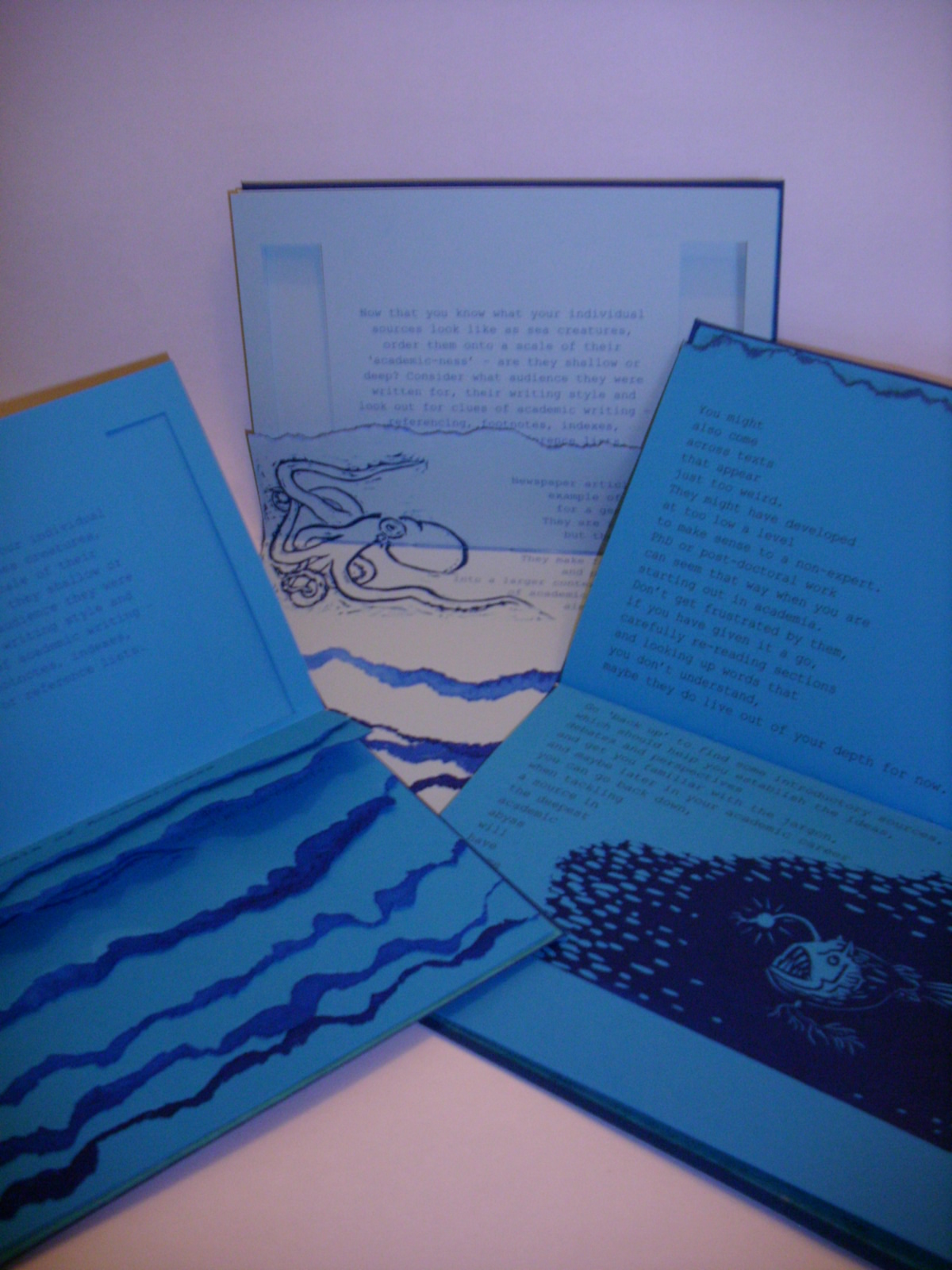
The Fish-scale of Academicness – linocut edition 2012
As I thought this was a very good way of explaining the concept of provenance to students I wanted to turn this into an Open Educational Resource, however, my slides were populated with copyrighted fish from animation, so I needed to find a way to illustrate this. And then a course on the Illustrated Book came along near me and I signed up for that with the express plan to work on the illustrations for this. And so I made a book out of it. I played about with the layout and used tear-aways to show a sense of depths. This book, with original linocuts, was done in an edition of 7 in 2012.
At the same time I thought this might be a very good way for me to explain this concept at this workshop I was organising and how nice it would be to give the delegates something special. So I also made an edition for them, which is photocopied and has drawn illustrations, but it also has the ‘torn’ pages meant to visualise the depth of the academic ocean.


This booklet was produced in an edition of 31 and given out at the Thinking through Writing and Making workshop.
The Fish-Scale doesn’t stop with explaining the concept to the students. I have also started using it as an activity. I give students excerpts of sample text from a variety of academic depths, and ask them in groups to decide what sort of sea creatures these texts would be and draw them. What is important here is that the students also are able to articulate the reasons why they decided on a particular sea creature. We then all order them in terms of their academic depths through a group discussion. I encourage students to go through this thinking process when they are using their sources, and to visualise their bibliography in terms of the depth achieved – and ask them to think about trying to ‘go deeper’ when they progress through the years.
The very small-scale evaluation I have done on this so far, has indicated that introducing the lecture coupled with the activity has resulted in students using a better range and better quality of secondary sources in their essays.
I’m currently planning a research project to test whether this would work with students from other universities and disciplines. Maybe as part of this I will actually get around to making that Open Educational Resource. If you are interested in collaborating on this, please get in touch!
As the people who have come to my workshops know, I have gotten into the habit of making and giving out little booklets. I call them ‘tactile academia books’ (which sounds a bit grand), and I thought it was high time to post a few details about them.
I thought I would start with The Land- and Seascape of Creative Practice. This wasn’t the first one I did, but it was based on an idea that I had a long time ago and on a concept I have been using to explain what I do for quite some time. And in a way it explains my take on academic and creative practice – and the relationship between them.
So here the little story behind this book…
When I started teaching at uni, I joined an Art & Design department as an academic looking after the first year study skills provision. Very much a Writing in the Disciplines approach, I was tasked with running modules that would teach studio-based art, design and media students how to research and write for an academic essay. And I found myself quite often in the position of having to explain to other colleagues how what I did fit into the individual programmes, and how it did work that my students ranged from 3D Design to Animation, from Fine Art to Film Production.

Art, Design and Media Islands in my teaching ca 2008/09
What I started using was the image of islands, each representing a separate discipline, but each connected in a way through an ocean, that could be seen as ‘Contextual Studies’ (the historical and theoretical stuff that is somehow outside of the making).
While it is, like any visual analogy, a fairly simplified model, I think this shows the relationship between the realm of the tangible outcome, the islands, on the one hand, and the more theoretical thinking, the ocean, on the other. (The Study Skills bit I always thought of as somewhere in the shallows around the islands, linking the practical and the theoretical approach to a specific discipline.) It also made me think about the ntaure of words as an outcome, which can be a bit like water: they can be shallow or deep, they can be watered down, but above all they are fluid.
This image stayed with me and when I encountered Artist’s Books and thought I might be interested in making some myself, I used this as the starting point of my first foray into screen printing, making an accordion fold book called Contours.
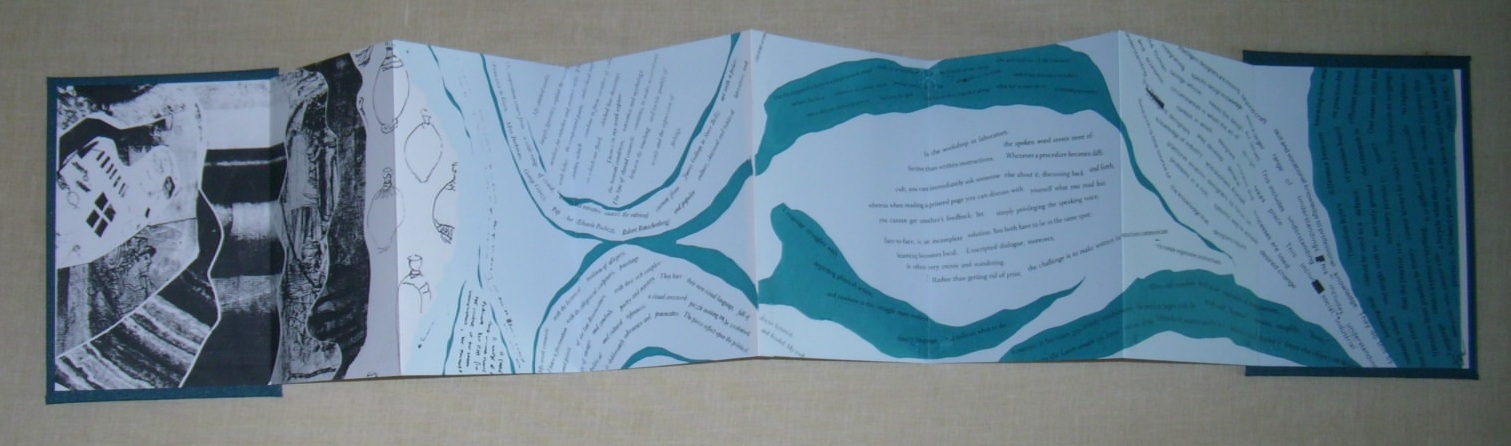
Contours 2011
The idea was that it would show a part of that initial map idea, but visualise the thinking in more detail. So the island bit used images – pictures of finished artefacts inland, then images of word in progress, maquettes, and finally sketches where it came to the ‘beach’ – while the ocean bit used words – hand-written notes in the shallows, then artists statements and more and more theoretical (and later on abstract) texts on craft.
While Contours is a plan view, I always wanted to make a sort of elevation, because that would visualise the idea of shallows and depth more. It took me a while to find the right technique, but last year I was on a printing course where we made scratch negatives, which can result in printing plates, which are very fine and detailed, almost like engravings, and here I was able to make this image, which I think shows the land- and seascape of creative practice.
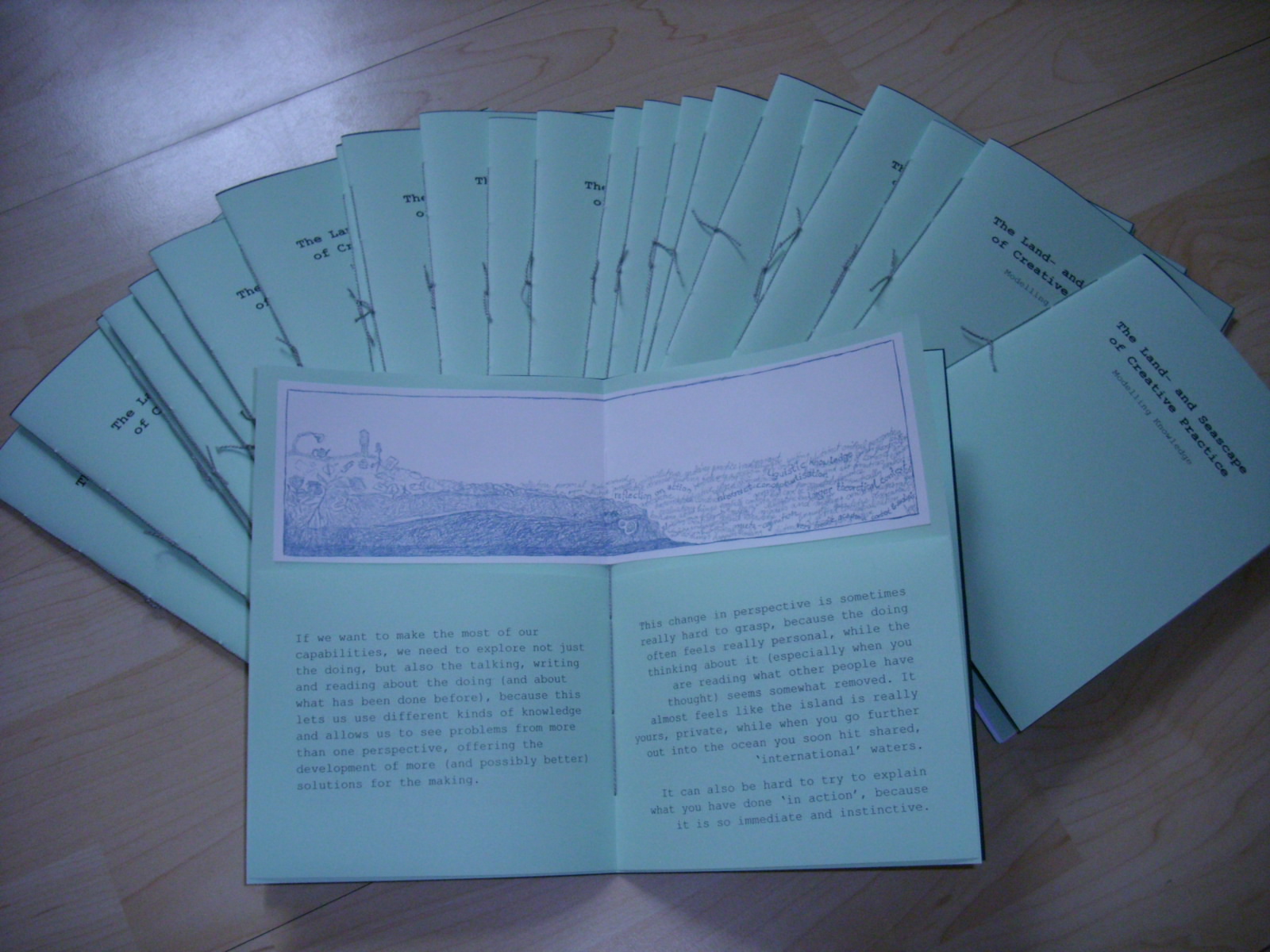
The Land- and Seascape of Academic Practice 2012
a tactile Academia book
This print has become the centrepiece of this particular booklet, The Land- and Seascape of Creative Practice. Subtitled ‘Modelling Knowledge’ it aims to explain the relationship between creative practice and theoretical thinking – and does so by not just introducing the islands analogy, but also mapping Donald Schon’s notion of reflective practice and Michael Biggs’ differentiation of experiential feeling and experiential knowledge onto it. it aims to make the point that there is a synergy between the making and the theory – and that it is useful (if not crucial) to be able to engage with both for the best results in either.
The booklet itself was made in an edition of 73 and given out to participants of the second day of the Teaching in Practice event. All of the copies include an original print of the map artwork. (And I still have some copies, so if you would like a copy, get in touch!)
It is my pleasure to announce the next of the Writing in Creative Practice Workshops. This time we want to specifically explore layers of meaning and will be hosted by the University of Chester on 26th March 2013. The official HEA annoucement and booking form can be found here.
Just before Christmas, Elizabeth (our host) and I got together to think about some of the visualisations and structures that can be used to show layers – and we tried some of them out.
We took sentence diagramming as a starting point. I had recently looked through When will the book be done?, a catalogue of the books published by Granary Books up to 2001, and had particularly liked What the Ambulance Driver Said by Jane Wodening (1998) , which uses a diagrammed sentence. After doing some research we decided to give it a go and to diagram the Sennett quote used in the workshop proposal:
Every good craftsman conducts a dialogue between concrete practices and thinking; this dialogue evolves into sustaining habits, and these habits establish a rhythm between problem solving and problem finding. (Sennett, 2008:7)


While the inspirations had looked a bit like the roofs of houses, our version reminded me more of a mountain range, so I then used the subclauses to make up a sort of tunnel book.

the layered subclauses as mountain ranges
Meanwhile, Elizabeth explored both tunnel books as well as layering with transparent paper.
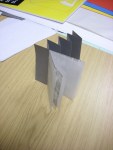
Overall it was a great day (far too short, of course), which has given us some good ideas, I think, of what to explore during the workshop itself.
As I mentioned the intriguing sounding Documentary Drawing Masterclass in a previous post, I thought it was only fair to share some of what I was thinking about on the way home…
Well, firstly, it was a great day facilitated by Julia Midgley, who has documented everything from archaeology projects to hospital processes – and also sometimes draws at/for conferences. (That in itself is, of course, very interesting as it links really closely to the reflective bookmaking I have been known to go on about.)
Julia gave us some great tips as to how we could loosen up as part of a warm-up, and especially things to think about to make people less precious about the outcomes of a drawing, which allows us to focus on the energy of the situation rather than on the artefact ending up on the sheets of paper. So consider drawing with both hands at the same time, for a result full of energy (and in my case lots of cross-hatching), not allowing yourself to look back at the paper once you have started drawing, or doing an ‘etch-a-sketch’ by not allowing yourself to let your drawing implement leave the page until you are done.

warm-up drawing made with charcoal on a stick using both hands to draw at the same time
We also talked about considering the paper you are using – and how much more effective a drawing can be if it is backed up by ephemera – a timetable as the background to you documenting a journey, with added tickets, for example.
Another thing that we explored was cutting out pictures of people and collaging those together – but turned over, so that we would concentrate on the shape that the human body creates. I have to admit that I didn’t really have time to do this during the workshop, but I was thinking about my previous post and thinking about how documenting workshops can sometimes be tricky if you don’t have the permissions of people to use their photographs. I also think that sometimes then the picture becomes about the people, rather than about the workshop. but what if you just used the silhouette of your participants…? I think this way we could end up with another really interesting ways of documenting a workshop. Something I will attempt to try out soon.
However, what I am probably most excited by is the way I used documentary drawing as a research method in the afternoon. Julia had given us a brief, parts of it was “By closely observing visitors to the Gallery what can the reportage artist discern about the activity of looking at art?” So I found myself sitting in the Tracing the Century exhibition and in the beginning I was randomly sketching people.

some typical poses observed
I found some typical poses, for example there is almost a standard way that men hold their arms behind their backs when looking at art. I and my fellow documentary drawers complained to each other that people never stand still long enough. I decided to ‘follow’ a group around, sketching them whenever they paused in front of art, to see how they interacted – and found that there was an opinion maker, who tried to move the group by moving herself and almost dragging the others with her, while another one seemed to be really interested in the art and tried to linger in front of certain pieces.
And then I started tracking visitors’ journeys along one specific wall. Comparing these drawings I realised that people tended to either stop at artworks or at the labels. So I am now wondering whether this form of observation is something I could use to get my students a bit more excited about primary data collection for their research. I think I spent less than an hour in the gallery, but can’t help thinking that this could be turned into more rigorous data gathering, I could develop rules, such as really try to sketch where the visitors stop and pause; the longer they pause, the more detailed/black/intensive the sketch of them should get; trace the ‘motion lines’ on the floor to capture where they come closer or step-away from the work (later put in corresponding motion lines following the whole bodies); prepare a standard background on which to sketch, so that the data can be more easily standardised (possibly superimposed). From this (and a suitable sample), it could be determined whether there really is a distinction between pictureviewers and labelreaders; it could be found out which group is bigger; and possibly whether one spends more time interacting with the art.
I made a little book transferring my sketches onto transparent paper to illustrate my mini-findings, which I might show students to get them to consider documentary drawing within their research. As you can see I was very inspired by the workshop and will be doing more documentary drawing for sure!
Just to let you all know that the Journal of Writing in Creative Practice has just published a short article by Pat Francis and myself where we share tips of how to put on a good (writing) workshop. This collaboration has come out of the Writing in Creative Practice events we have been working on together, which have been well received by participants, so if you are interested in putting on workshops like those yourself, whether for staff development or for student, this might be helpful.
A tip which isn’t included because it occurred to me after we sent this off (as a bonus for the readers of Tactile Academia):
Sort out the documentation beforehand
Just like it is important to gather feedback from your participants, it is important to be able to document the workshop. The most common form of doing that is probably taking photographs. If you are doing the workshops as part of your normal teaching routine this might not be as important, although good documentation can certainly help you demonstrate your good practice in an appraisal or interview situation for example. If you are doing the workshops as staff development or for an external funder this documentation becomes really important, as institutions like to show off what they have done/funded.
Whether you are running sessions yourself or ‘just’ organising, it can sometimes be difficult to remember to take photographs. So, nominate somebody to do it for you, maybe your institution has an official photographer who can pop in or you can get a photography student for the duration for a few quid (include this in your budget) and the work experience. Take the time to think about what you want the photographs to show in advance and discuss this with your photographer (or have a list if you are doing it yourself so that you don’t forget in the heat of the moment) – do you want shots of people arriving, materials, of the speakers, or work in progress, of certain activities and/or finished artefacts? The more you think about it beforehand, the more useful the photographs will be for you afterwards.
The article can be found in Volumen 5 Number 2 of the Journal of Writing in Creative Practice, pp. 291-300
Sue posted a comment to the Take a little button post that recommended a TED presentation, which is fabulous. It made me think about not only that the genre of communication needs to be thought through rather than just going with a standard (whether that be PowerPoint or the academic essay to name but a few), but also about ways of learning in a kinesthetic way.
A few years back I was at a workshop led by Dr Colin Beard on Experiential Learning, where he suggested some strategies of making students more aware of issues by making them move (something I have done in class that was inspired by this was giving students example sources and with discussion forming a ‘line-up’ representing how academic those sources were).
Just recently at the ISSOTL 2012 conference I attended a presentation by Joy Guarino of Buffalo State College, State University of New York, titled ‘Kinesthetic Learning in the College Classroom’, where she pointed out that kinesthetic and tactile learners are often punished in a classroom, where students are traditionally expected to sit still.
She suggested the International Learning Styles Network as a source of more information and also the ‘Students Don’t Learn from Lectures’ Piece for Time by Salman Khan. And no, we didn’t sit for all of the presentation, but actively explored ways of experiencing different concepts.
While checking out the Tate Liverpool website to find out more about the ‘Tracing the Century’ exhibition, I came across a workshop they offer on documentary drawing on 19th January 2013. While it might be a bit too focused on the connection of documentary drawing to war artists for my taste, I am intrigued, especially because I know that there is a lot of drawing going on when it comes to documenting and reflecting within academic research.
I’ll be there…
The workshop at the University of Northampton was yesterday and it was another very enjoyable (if intensive) day, where some really interesting projects were discussed.
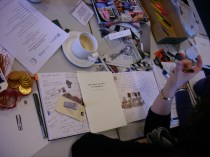
the reflective journalling starts
After our already customary icebreaker of making name tags, I started us out with a really short introduction to reflective bookmaking, based on work developed with my colleague Sarah Williamson.
Will Hoon, who had organised the day on the Northampton side, then told us about his work integrating contextual studies with practical design projects. Particularly fascinating was some student-led research that made them ‘remove the spectacle’ of advertising by taking out the visuals of advertising from the cityscape allowing the focus on just the slogans. Will also talked about how the quality of dissertation research and writing improved once 20% of the mark became allocated to the designerly presentation, speculating that the editing process the students are used to in their designs also made them edit their writing more carefully. He ended by showing two short film clips student groups had made that explained how to research and write an essay – and told us of his plans to use these films in teaching the new intake of students next year.
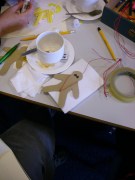
if a Tweet was an outfit – the Gingerbread Mankini
After Will it was my turn (again) to explain ways of visualising hidden academic practice. As the day was concerned with genre and re-genre-ing, I had decided to focus on The Dress-Up Doll of Formality, which is a little fun activity designed to get students to consider different ways of communicating information by thinking about the concept of ‘dressing for the occasion’. In groups participants were encouraged to design an outfit to fit a genre pulled out of a hat (in the end we had Radio News Programme, Advertising Billboard, Children’s Television Programme and Tweet) and dress up a cardboard gingerbread man (well person). I also talked briefly about alternative ways of presenting research (some of which can be found on this blog) and the 2D Challenge, which was part of my PhD research once upon a time.
After a lovely lunch, Will’s colleague Louise Bird shared her research with us, making a clear link between her practice, her teaching and her student’s projects. I was particularly fascinated by the notion of the mantelpiece as a cultural repository and Louise’s use of the shape of squares as a genre, as well as the artist’s books her students produce as part of their research.
The last speaker of the day was Fiona English, who drew the threads of the day together by talking about using genre as a pedagogical resource. She particularly highlighted a new case study, where an MA student had presented her reflection on a practical project as a transcript of a (fictitious) radio interview. Allowing us to listen to the student’s thoughts about this was of reflecting was a particularly poignant end to the formal part of the day, as it literally gave the student the last word.
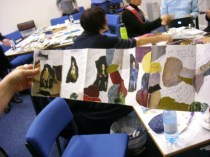
one of the finished books at the end of the day
The following brief discussion showed how well the different examples that had been showcased throughout the day fit together, and it seemed like some participants were inspired and gained confidence in thinking about genre as a way of practicing theory.
This week Pat and I met up in Falmouth for the Annual Learning and Teaching Conference hosted by the Centre for Pedagogic Arts-based Research (PedARe). PedARe actually was launched on Wednesday night at a lovely celebration at the Maritime Museum, where a lot of networking was going on amidst the sails of various vessels with mulled wine and mince pies (and some cheese, too).
The coference itself kicked off on Thursday morning with a thoughtprovoking keynote by Professor Anna Craft from the University of Exeter. Titled ‘Possibility Thinking and Creativity’, she talked about the quiet revolution that might/will be coming to education through the combination of possibility thinking and creativity, particularly in digital youth.
I was very interested in the concept of ‘meddling in the middle’ – giving students support through enabling a place for uncertainty at some point during the process of learning. Anna also made the point that wise possibility thinking had the potential to be both gear and game changing, because it challenges what is through asking ‘what if?’ or imagining things ‘as if’. This is particularly the case when combined with the 4 P’s of digital possibility thinking: Pluralities, Possibilities, Playfulness and Participation, which potentially results in creative empowerment and wise, humanising creativity.
As Pat and I went to prepare the first of our joint sessions, it struck me how much these 4 P’s also applied very much to what we are doing, although we are not employing digital means. Pat’s session was conceived as a ‘warm-up’ for writing, giving a very brief overview of some of the methods she uses to get studnets unblocked when it comes to writing. Most of the first couple of activities she suggested were fast and furious, the latter ones could be developed over a much longer amount of time. Unfortunately we didn’t really have the time to enjoy and explore as much as this needs, but some stimulating conversations were started that hopefully will lead to participants giving this a go once they are back at work.
The session I led over lunch focused on using visual analogies to illustrate the hidden academic practice that so often gets overlooked by students. This talk featured The Butterfly Challenge, The Land- and Seascape of Creative Practice, The Underwater Iceberg, The Fishscale of Academicness and the analogy I am currently working on, The Dress-up Doll of Formality. (I promise that one of these days I will get around to posting details of all these here!)
Both of our sessions got a really good response, but at the end of it both Pat and myself were so exhausted that we couldn’t make a useful contribution to the World Cafe session that was the closing session of the event. At the very end Carolyn Bew from the HEA sgared with us her impressions of the event as drawn on her iPad. Overall it was a very enjoyable day.
In the evening some of us went for a drink, where we discussed some ideas for the future. Particularly useful for Pat and myself weas an idea we then turned into an abstract for the upcoming HEA conference in Brighton. We will propose a workshop showing the different starting points a simple button can provide, an idea that came directly out of doing our two sessions. We don’t see each other that often (actually this was only the third time we had met) so it is really nice to see how fruitful these meetings can be if there is a bit more time involved than just the workshop itself! And true to form, over breakfast this morning we were discussing an idea for a workshop in Kent, triggered by the process of editing our abstract. And on the way to the train we were talking about the special issue of the Journal of Writing in Creative Practice that I will be hopefully editing soon, and that gave me a good idea to the direction that could take….
It was a fantastic event all round, the recordings of the sessions that will hopefully be up on the PedARe website soon will be well worth checking out, especially as there was too much on to see everything!
 Tactile Academia