We have been working hard on the programme for the workshop on July 2nd – here’s a preview: (There are still some places left, if you are interested, send an email to tactileacademia[at]gmail.com)

Programme

(as this is going to be a very hands-on workshop, this might change slightly)


10:00 Registration and Refreshments (Make your Own Nametag icebreaker)

10:30 Welcome

10:40 Writing Creative Practice / Material Thinking: towards academic publication.

            (Introductory lecture: Nancy de Freitas)

11:40 Small group work part 1 – see ‘what to expect’ below.

13:00 Lunch

14:00 Genre and Academic Writing

            (Alke Groppel-Wegener)

14:45 Small group work part 2 – see ‘what to expect’ below.

15:30 Refreshments

15:45 Reporting back – see ‘what to expect’ below.

16:30 Summarising – see ‘what to expect’ below.

17:00 end


What to expect


·         A lecture: to orient the session.


·         Handouts: will be circulated at the workshop.


·         Provocations: will be set for individual and small group work – tone of voice, audience, and shape.


·         Small group work part 1: writing plans – structure/schema; writing abstracts with clarity and keywords.


·         Small group work part 2: clarity of concept; image text intersections; concluding and making sense; fearless editing.


·         Collegial critique: for personal growth and improvement.


·         Role models: finding one.


·         Reviewer perspective: sitting on the other side.


·         Reporting back: group plenary discussion for sharing insights.


·         Summarising: feedback session to take stock of what we need to do better.


What to bring


1.             Bring your own laptop or iPad, etc. if possible.


2.             Bring one of the following:


·         An example of recent writing

·         A full draft of a research paper in progress

·         One completed draft of a previously published paper

·         A title/idea for a new piece of research writing – a potential paper you are thinking about.


Hope to see you there!

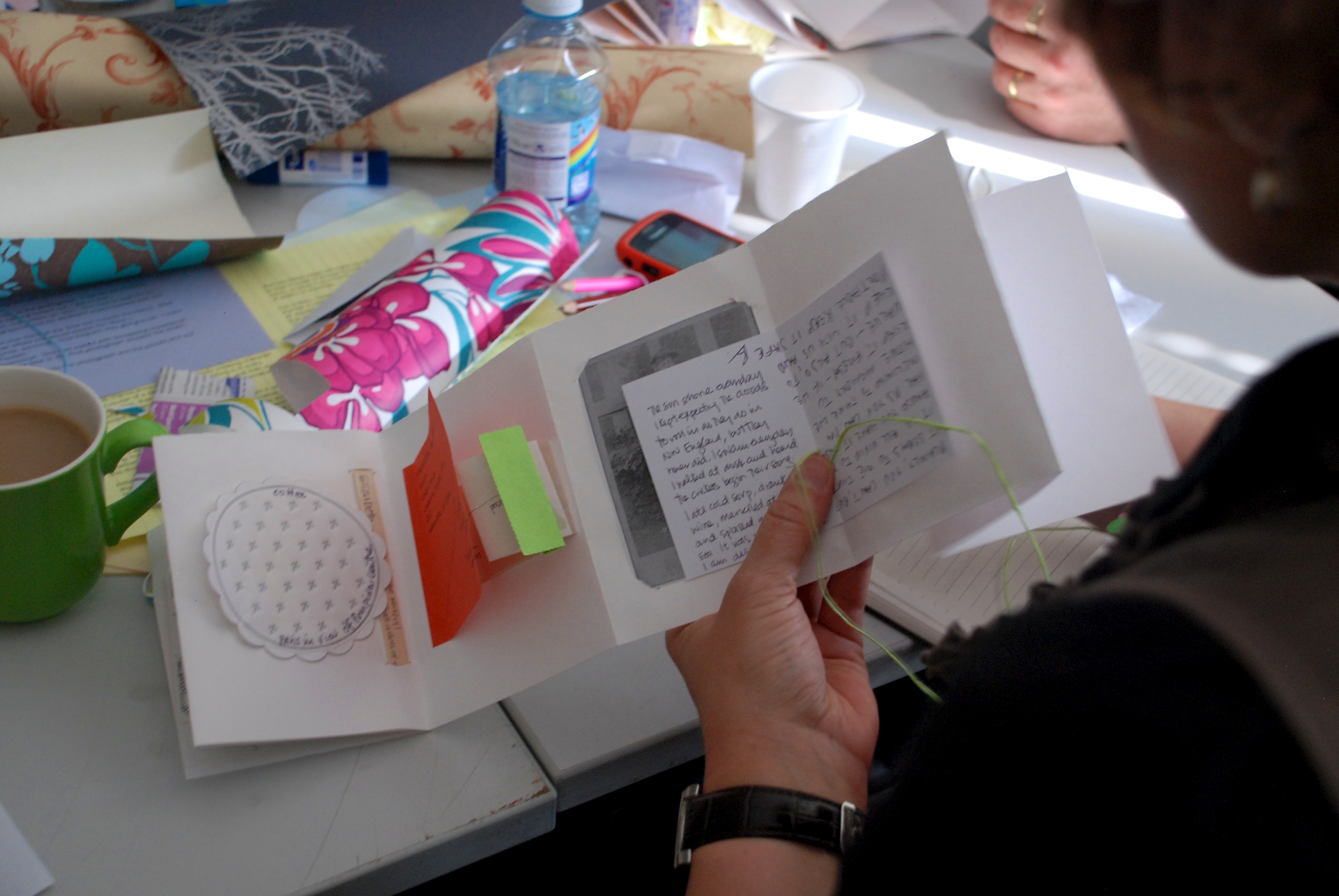
dsc_ 78On 2nd July 2013, Staffordshire University will be hosting another one-day workshop in the Writing in Creative Practice series. Since starting this series, which developed out of the work of the Writing-PAD network and has been supported by the Higher Education Academy, we have mostly shared best practice and allowed some space for exploration to link to engaging our students in writing for Higher Education in the creative disciplines. To find out more about what we have been doing, explore this blog, particularly the ‘workshop’ category.

This up-coming workshop will focus not on students’ but on our writing, and how we can turn it into writing for academic publication. Therefore it is aimed at members of staff who want to publish in this very specific context for the first time (or just more); it would also be suitable for post-graduate students within art, media and design.

dsc_ 309Nancy de Freitas, Associate Professor at AUT University, New Zealand and Editor-In-Chief of Studies in Material Thinking, will share her expertise of writing in the context of material thinking practices, introducing workshop participants to methods and insights on good structure, clear writing and elegant style when talking about research, processes, images, objects and spaces. There might also be the opportunity to discuss the genre of academic writing – and review this as currency within the creative, studio-based disciplines. This day is meant as a day of starting points, sharing tips to get (academic) writing projects on the go. It would be helpful if participants come with a particular writing project in mind.

The attendance of this workshop is free of charge to all those interested in the workshop topic, with preference being given to staff working in HE institutions and HE in FE colleges from across the UK. Places will be allocated on a first come, first served basis. Lunch and refreshments will be provided, but travel expenses will not be covered.

For more information or to book a place, please get in touch with Alke Groppel-Wegener (tactileacademia[at]gmail.com).

And, if you are interested in following this up with a more immersive experience where you can actually get some writing done, check out the related Pedare Weekend Writing Retreat  at Falmouth University.

Another fortnight, another get-together to talk about our portfolios for the HEA fellowship accreditation. This time we talked about A4 – Develop effective learning environments and approaches to student support and guidance.

At Fellow level we need to give evidence of our debelopment of a learning environment, for example

  • examples of an online environment
  • mentoring or tutoring plans and notes
  • photos of equipment, exhibitions, etc. in a relevant setting

At Senior Fellow level we need to give evidence of our managing the development of learning environments and support, for example

  • organising personal tutoring
  • setting up online environments
  • organising exhibitions, placements, etc.

We talked about how we support, set up and manage both online environments  for modules (and particularly the tools here that go beyond the mere information delivery of putting up lecture slides, for examples the use of discussion forums, blogs, wikis) and also resources (different ways of accessing our in-house research collection) as well as the ‘old-fashioned’ not quite as virtual environments we create – and why sometimes the one is more appropriate than the other. Actually we thought what would probably be an important factor in our annotation of our individual examples would be exactly this explanation – why did we choose to set it up this way, with reference to the content and skills we teach, and the type of students we interact with.

We ended by having a little chat about the references. Each of us needs to references, which should be provided by somebody who knows our teaching, so we thought about who we could ask.

Next time: A5 – Engaging in continuing professional development in subjects/disciplines and their pedagogy, incorporating research, scholarship and the evaluation of professional practices.


There are exciting developments with what I call the Fishscale of Academicness. You might have come across this before at one of my talks – or through my little booklet (which is described here).

There are two exciting new things happening – my colleague Geoff Walton and myself are working on a chapter on this for an open-access book on information discovery journeys. We have been having a number of meetings about this in the last few weeks, and I am happy to report that it is progressing nicely. We are trying to combine what I already have as written for the little booklet with a commentary on information literacy and information discernment, that locates this in an academic context. Most recently we have been working on ways of how to combine the different texts/images, here some of our working drawings:

We are hopeful that we have worked it out!

The other exciting thing is that we have been given some funding by the university to produce at least two different ways of delivering this – a hard-copy and a digital one, which we want to use to test this further with students in the coming academic year, hopefully in different departments and possibly at different universities.

Let me know if you are interested in taking part in this further research!

Through booking forthcoming events, I also get to catch up with people who came to previous workshops – and I of course always ask whether they were able to put anything into practice since then, or whether they went away inspired.

Well, today, Sara Eaglesfield got in touch. She was at the second workshop in Stoke last year, and says that

During the summer I created a series of workshops for our first year students which combined my multiple intelligences research with some collage-making-sticking ideas I’d picked up from our day in May (we have since got through incredible amounts of glitter).

And she also sent this Poster she made to disseminate her research, to share it with all you lovely blog readers. She is very interested in taking this research further, possibly in a collaboration, so if you think this looks interesting, please do get in touch with her at Sara.Eaglesfield[at]bucks.ac.uk

Thursday, 13th June:  (free) workshop at Middlesex University

Within the art and design academy we witness few of the expanded possibilities that lie between writing practices and the object. This workshop will combine theoretical and practical approaches to consider different writing-object relationships, including: writing about objects, writing as an object, writing to generate objects, etc.

This day-workshop will examine different relationships between writing practices and the object in art and design.

We write about objects, we produce writing as objects, we write in order to generate objects and sometimes we write in spite of objects, yet within the academy we rarely witness many of the expanded possibilities that lie within the relationship.

Our workshop will take a theoretical and a practical approach to exploring these possiilities, so we will schedule sessions which theorise on these themes but also sessions which allow for practical, hands-on experience. We will also allow time for reflection on themes raised in the sessions and for discussion.

Papers will investigate topics such as the use of writing as a means of generating design; the role of intuition within object-focused writing practices, and its relationship to formalised writing norms; ways of drawing on art and design practices in writing, such as the use of making in writing instruction with art and design students.

Speakers at the workshop will be both external to Middlesex University and internal, and the day’s activities will involve the University’s Museum of Domestic Design and Architecture and its collection.

You can find abstracts for the various sessions here: Writing & the object – topics. For more information, please get in touch with Peter Thomas (p.thomas[at]mdx.ac.uk) and to book, please check the information on the HEA events page.

Kaye Towlson (of De Montfort University) sends the following report:

Report, feedback and future planning:

Kaye Towlson and Carol Keddie delivered a well received and inspirational workshop entitled : “New ways of seeing” to 10 students from a wide range of disciplines including Housing, Multimedia Design, Cardiology, Biomedicine, Youth and Community Development, Health Studies, Nursing, Human Resources and Fine Art. The group included Undergraduates, Postgraduates and a Phd Research student. All students participated fully in the activities and engaged with tasks from the word “Go”. There was also much peer to peer learning going on as students discussed the different visual learning techniques as they performed the given tasks.

Students enthusiastically embraced new visual planning and thinking techniques such as the image enriched mind map created using collage techniques, dressing up the “doll of formality” (Groppel-Wegener 2012)with selected keywords and images derived from their mind map.
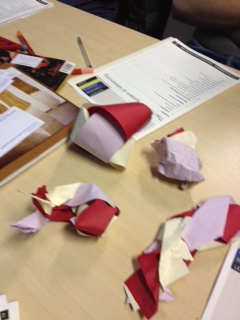
jumble of plaits

jumble of plaits

They enjoyed forming a research plait by combining the assignment question, selected keywords and references of relevant journal and book resources identified through searching the library catalogue and relevant research databases. This information was recorded onto three separate strands of paper given at appropriate times in the workshop. The plaiting together of these three essential elements of the planning and research process simulates the knitting together of this information into an evidence supported argument in the form of a completed assignment. (Amended from Francis 2009)

Students were then introduced to the University of Creative Arts Creative Cycle which maps the route of the creative cycle from the initial interest through to submission and post submission reflection on all the learning inputs, tasks and skills acquired. Students were asked to create their own road map for the successful completion of their chosen assignment starting from the initial assignment allocation through the planning, inputs and activities culminating in the successful completion and handing in of the assignment. They were asked to illustrate the roads map with images (doodles/sketches or collage)  to identifying tasks, to add emoticons to reveal how they would feel at that point of their journey and maybe chart the ups and downs, twists and turns experienced on the route.
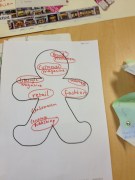
doll with keywords

doll with keywords

Feedback from the session was very positive; students commented particularly that they liked the mind map and the journey map, others particularly liked the doll (”especially cause I was relating keywords and assignment to a person”).

Many said they intended to use mind maps in future

Other comments:

 “Thank you it was inspiring”

I liked: “the ways teached to divide an assignment into smaller pieces”.

“The creative aspects of the session absolutely BRILLIANT!”

I liked…. “The atmosphere and the context”

I am going to …..”Continue to mind map my work this way before I begin an assignment”.

“Fantastic!”

I would like to see….”more like this please! New tips on ways to work effectively”.

“Please do more courses such as these as a Phd student I have found it really useful and will be attending many more”.


Future development:

The intention is to offer this workshop again and to utilise some of the techniques within curriculum based teaching. IT is also intended to offer this workshop to LRS Librarians and CLaSS and to ask them to bring a selected assignment question with them from one of their areas of responsibility.

To expand visual learning, thinking and planning techniques applicable to information/digital literacy and offer other workshops.

To feed experience and feedback from today into ongoing Teacher fellow project.

Reflection…….. To investigate scope for utilising similar visual techniques to encourage reflection in student learning, both during the assignment path and also after. To reflect on tasks and skills completed, their effectiveness, areas for amendment and improvement, areas of transfer.


The workshop intended to stimulate creative thinking and planning and to introduce students to non-traditional visual techniques that they can utilise through their course. It is safe to say that these learning  outcomes were met.


Kaye Towlson 12/2/13