I too attended the workshops and found them to be really useful. Many of our ‘direct entry’ students up here in Scotland have little or no experience of critical theory when they come to us from an HND course, so engaging with academic writing can be extremely challenging, even more so if they are dyslexic, as some are.

I hope to work with our Effective Learning tutor this coming year, when we offer a summer school for these students. I’ll take what I learned from the day and expand on some of the excellent ideas from Pat’s workshop, I’ve already suggested that they buy her book, as I have. It will be my companion all through my PhD. It’s rekindled my love of John Berger for a start!

 The collage workshop in the afternoon, I found particularly difficult to engage with; this is my own doing and no fault of the workshop itself, which was excellent, offering as it did, convincing references and arguments as to why collage is good for reflective thinking. Trouble is; this is what I’m doing as part of my qualitative inquiry for my own research; using collage to think, to articulate what I can’t say out loud, sometimes because I just don’t know but other times, it’s because it’s just too hard to find the words, let alone say them.

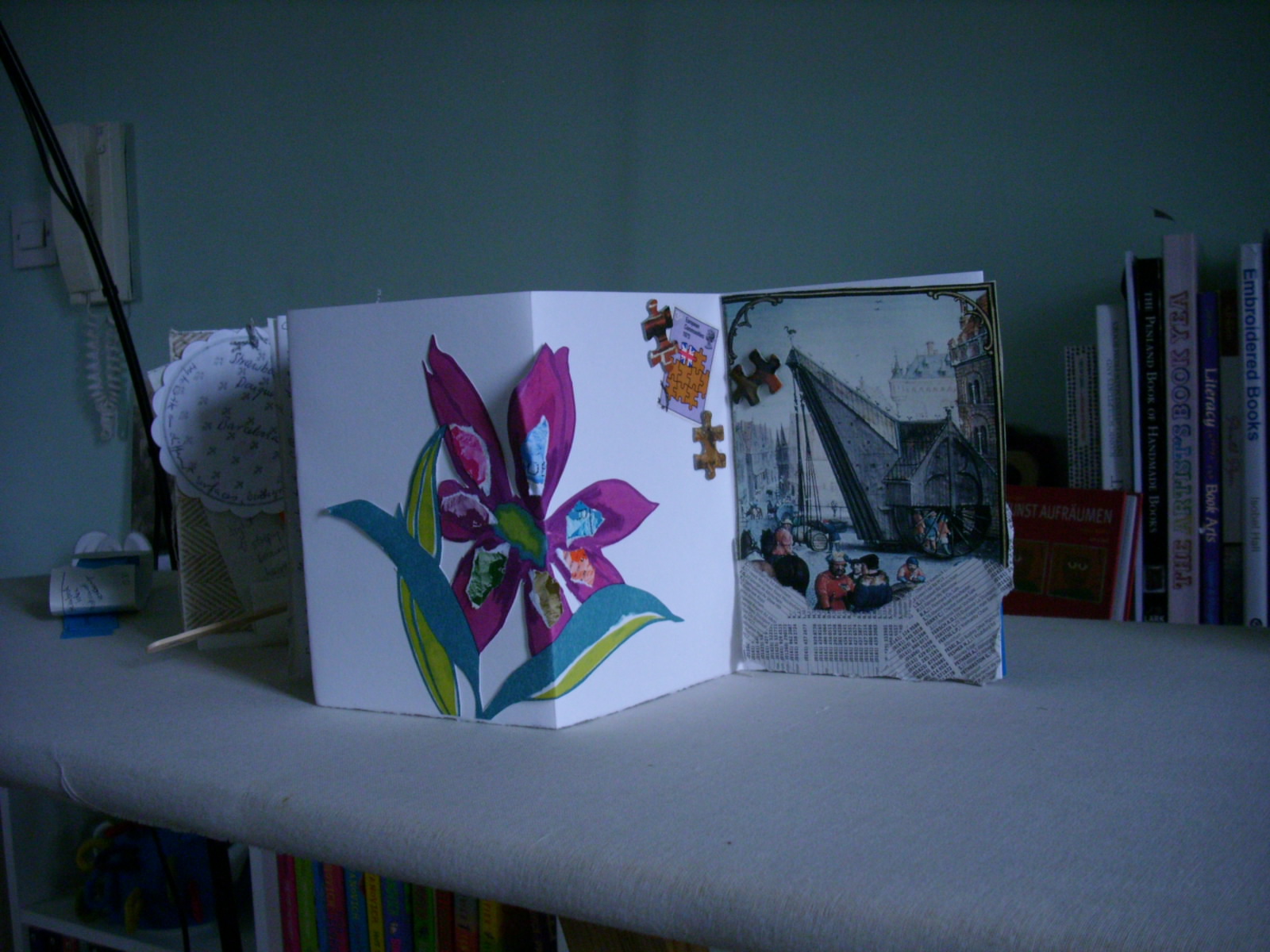
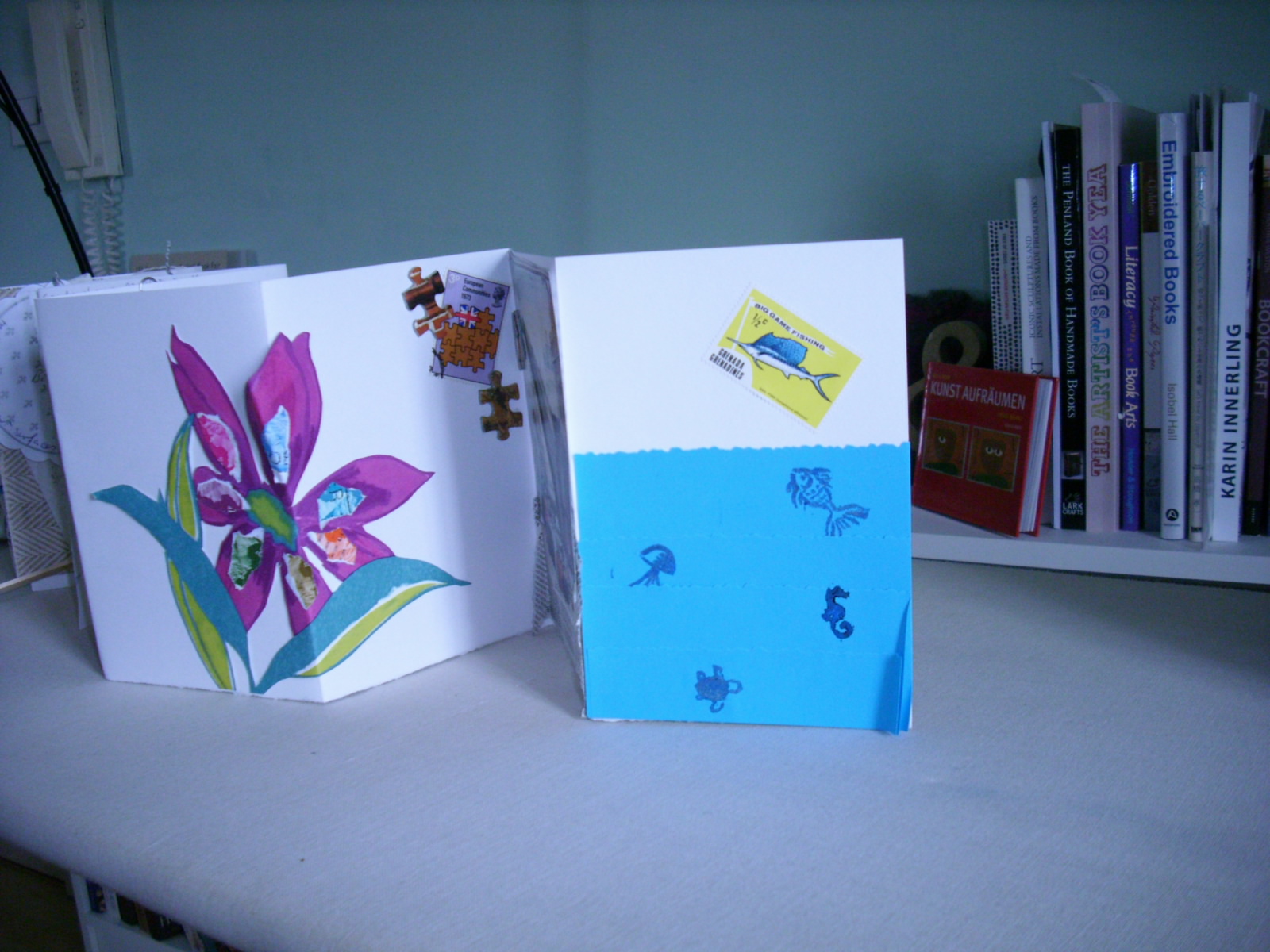
 So, because this method of reflection is embedded in my poor brain, I found that I couldn’t just ‘go with the flow’ and enjoy it, I took it far too seriously. So much so that I took scissors to my concertina book, cutting into its form, almost deconstructing it. (there’s a paper in there somewhere!)

Deconstruction

But all was not lost, I came home and reflected on my response and this has fed into the research. So maybe I did engage with it after all but not in the way intended? It was heartening to watch all the delegates immerse themselves in their collages; you should do it more often guys!

 I came back up to Scotland invigorated and inspired, hopefully I will be able to pass this feeling onto my students and they too will benefit from some lateral thinking.

Thanks folks!

Alison F Bell

Artist & PhD candidate

University of the West of Scotland.

Ayr.

National Centre for Research Methods (Uni Soton) are holding a conference at St Catherine’s College, Oxford University 2-5 July

http://www.ncrm.ac.uk/RMF2012/home.php

Thought some of you might be interested, I’ll be attending on Wednesday when visual methods will be discussed in various ways throughout the day….can’t pass up an opportunity to hear Gillian Rose speak as Key Note!

Elizabeth, Uni Chester

I attended the HEA-ADM supported workshop Writing in Creative Practice: Thinking through Writing and Making organised by Dr Alke Groppel-Wegener at Staffordshire University 29 March 2012. It was a very inspiring and thought-provoking day and very relevant for my lecturing as a graphic designer supporting students in their critical analysis of the place of historical and contemporary design within culture and society.

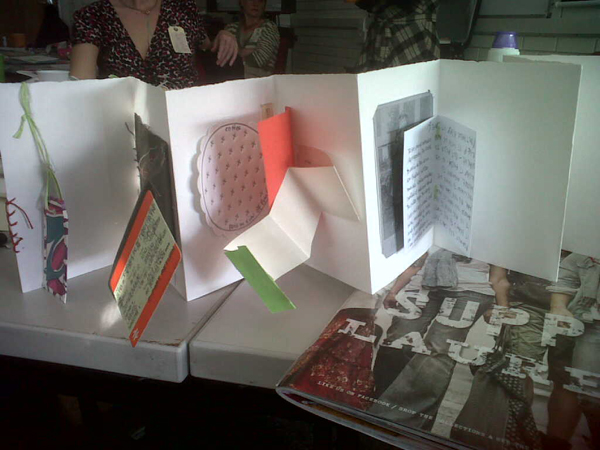
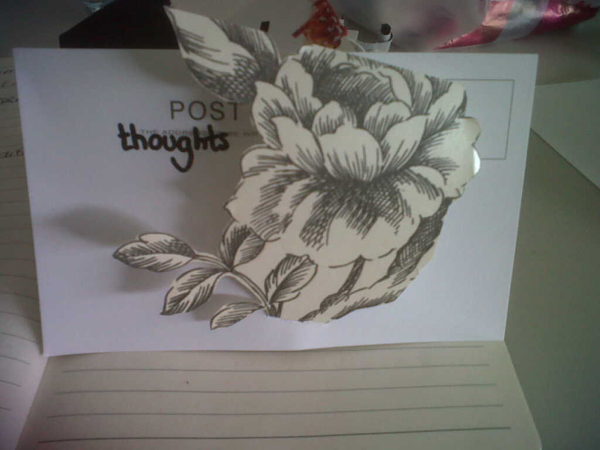
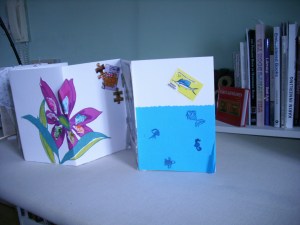
These artefacts were developed during the workshop, the book represents the process we engaged in through Pat Francis’ reflective exercises with supplied texts, images and objects. The second artefact was an attempt by me to express through collage my gratitude to Alke, Pat and Sarah Williamson.

Book of Reflection and Inspiration


Thank you card


This workshop has inspired me to continue more deeply finding a way to support my students to own their research, to better link to their practice, and to learn tactile tools to get them through the inevitable rough patches associated with writing, reflecting, researching and evidencing to develop coherent arguments. Pat’s techniques were key to giving me confidence in developing my own workshops with students, I now have concrete proposals I can make to my colleagues as we plan for next year’s curriculum.

I am also pursuing this subject for my PhD, only just begun (!), and looking at the role of making in cognitive and aesthetic development in art & design students.  Sarah Williamson’s excellent presentation on this very point left me with a number of sources (I’ve already found a few!) and a sense that “I am not alone” and that “I stand on others’ shoulders” in my inquiry.

On reflection, it is the last point that I came away from the day feeling most grateful about: here was a room full of like-minded individuals, with so many skills and experiences that I can now collaborate with as I get stuck into my research. As I left the workshop I was already looking forward to the next one!

Elizabeth

University of Chester, Lecturer in Graphic Design Theory & Practice

I attended Alke’s workshop, Thinking through Writing and Making and it really inspired me to think differently about my research.  I am a PhD student in the Geography department at Staffordshire University and my project is about mapping creative networks in Stoke-on-Trent.  As part of my field work I asked 30 participants to make a map of their network while narrating the story of what they were doing over the five year period 2007-2011.  They had one flip chart size piece of paper and four pens.  I was surprised at how easily people took to the exercise and how little I needed to direct or prompt which meant that I was doing a lot less talking than if I had gone down the more orthodox qualitative route of semi-structured interviews.  I found the process of map-making seemed to lead them naturally to reflect on their processes and to uncover their own insights.  When I heard about the workshop I thought it might give me a few ideas of how I could integrate the map-making side of the data into the thesis.  I wasn’t sure exactly how it would help but I was very keen to think about it creatively.

Although I found all the exercises very enjoyable the most important thing I took away from the workshop was Sarah Williamson’s presentation on ‘the value of making for thinking’.  In my research I had seen the practical value but I didn’t know how I was going to validate this in my methodology.    Sarah provided a list of references that backed-up my intuitive leaning towards these sorts of techniques.  I was aware of the literature on participatory methods but before the workshop I would have said that my understanding was academic.  As I made my own art-book and reflected on my learning journey, I had both the experience and realisation that what was going on for me would have been going on for the participants in the map-making exercise.  After the workshop I felt that ‘research-making’ opens up a much more creative world for thinking about and doing research. 

Linda Naughton

Another conference that might be of interest is this year’s Writing Development in Higher Education international conference to be held at Liverpool Hope University, July 2-4th. The theme this time round is ‘Enacting thoughtful pedagogies and inclusive values in writing development’.

I am happy to report that my abstract has been accepted and that, pending staff development funding, I’ll be there to talk about my current research.

So the workshop mentioned in the previous post went off without a hitch, and while everything is still fresh in my mind, I thought I would post an account of my perspective. (As I was the person who had the idea and organised it I am possibly a bit biased, so keep that in mind when reading this.)

How do you describe a day full of inspiration and exciting company in just a few lines? As I don’t want to give you a line-by-line account of what happened (which probably isn’t that interesting), I am going to keep to one of the devices that we used to engage our delegates – reflective book making.

Back in December I had met with Sarah Williamson of the University of Huddersfield and she had introduced me to this idea – she asks the attendants at a conference for her post-graduate students to reflect on the papers given in a visual way making their own concertina books over the course of the conference. When starting to plan my workshop I was keen to use this idea, and with Sarah on board as one of the speakers, we started delegates off giving them a long paper-strip to use as they saw fit throughout the day.
Thinking Through Writing and Making Workshop Book
Alke Groppel-Wegener, 2012

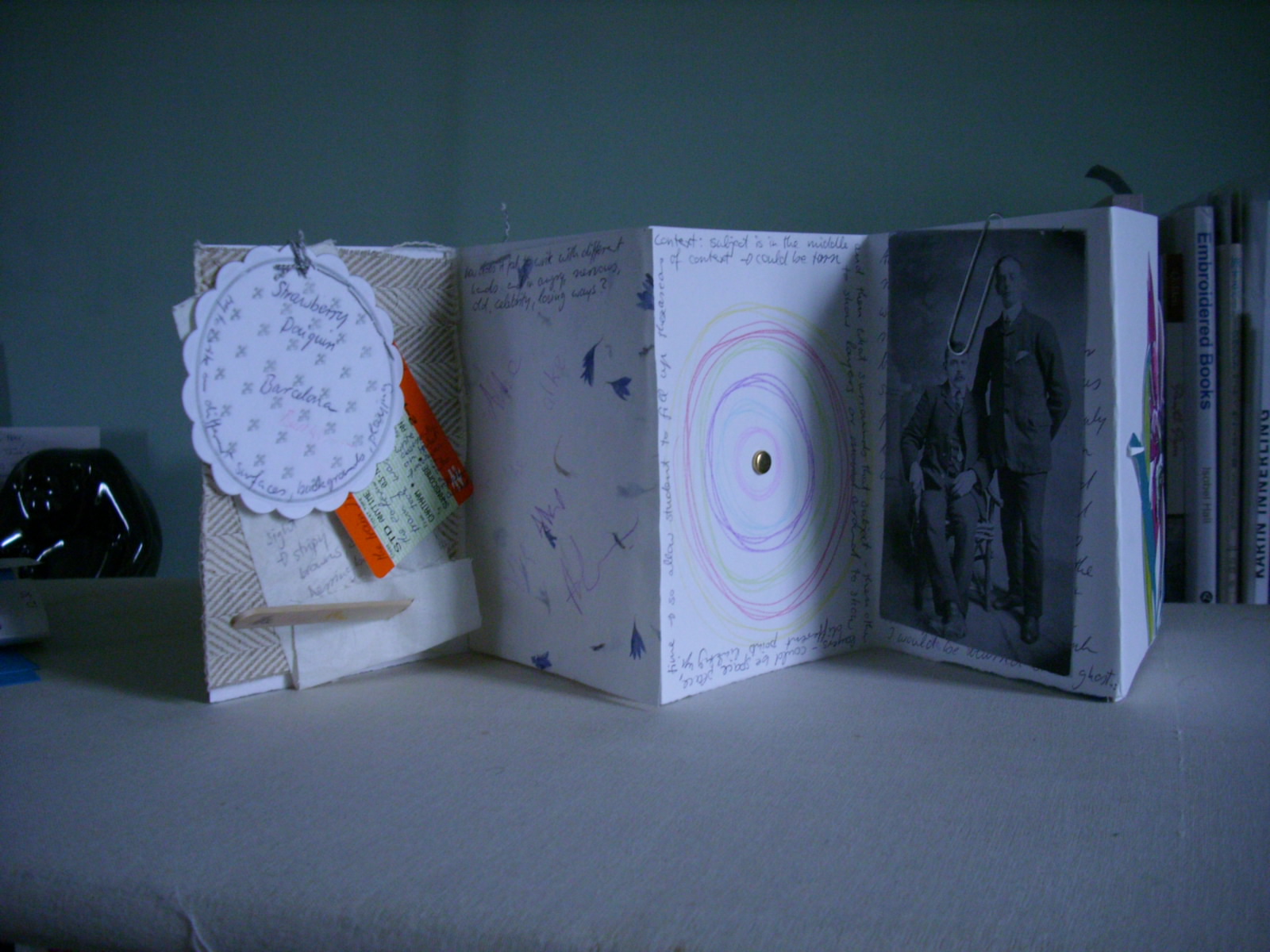
Here are some images of mine, and what they remind me of…

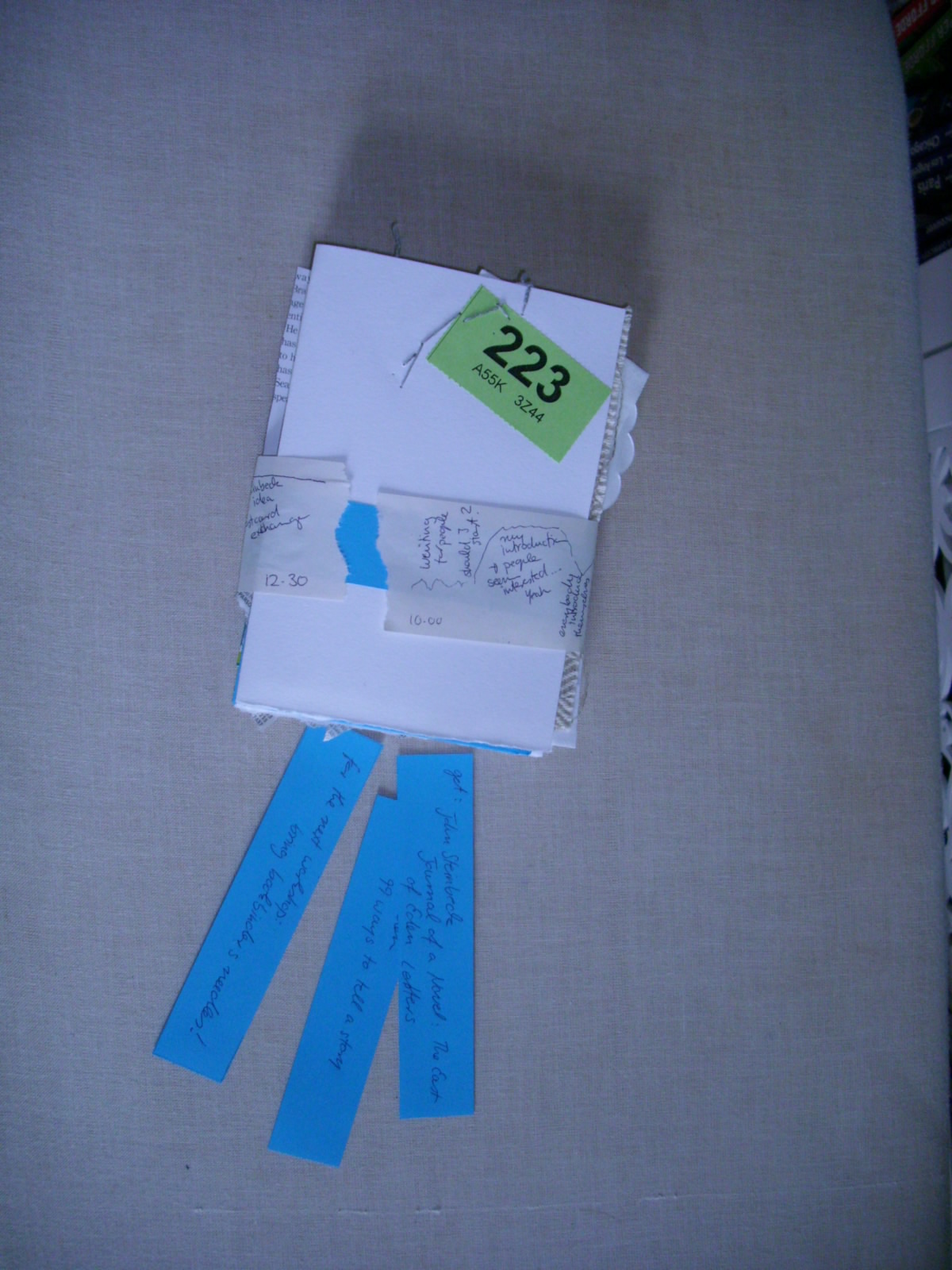
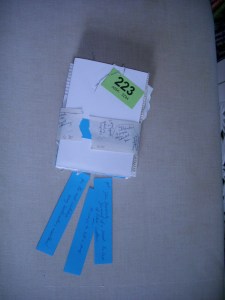
While still a bit plain from the outside – something I want to work on a bit more in future – it is hard to contain, bursting with ideas. I used the ticker tape describing the journey of the first session as a belly band, but had to extend it slightly. Some thoughts are leaking out, which actually are reminders for me which will find their way into  my diary to be acted on later:
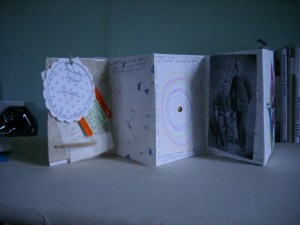
Thinking through Writing pages

The first session of the day was led by Pat Francis, who treated us to some of the activities from her trasure chest of things to do in order to develop reflective writing. (You can find out more about those in her book Inspiring Writing in Art and Design: Taking a Line for a write.) So the first few pages of my book are filled up with her warm-up exercises and then ways to get people writing (like the use of objects or photographs as starting points). This was really enjoyable and I picked up some ways in which I could improve some of the exercises I do to get my students to start putting pen to paper.

What I particulalry liked and will definitely integrate into my own practice is the idea of the concentric circles to visualise context. This is something I find my students struggling with, and using circles of different colours and sizes to show how things relate to each other seems like a really simple way to get this across and allow the students to explore this further.

Thinking through Making pages

After lunch it was Sarah’s turn to talk about her work with collage as a reflective tool. The pages in my book (again a bit sparse, I do want to draw a bit of a background to this) show that I was really thinking about this as letting the thoughts and ideas ‘bloom’. One of the things she highlighted was how many people (researchers and people experiencing this strategy alike) use the physical act of making in order to develop their ideas – it gives the thinking time to grow, which is a real strengths.

I added little faces into my petals to show two other ideas – on the one hand how putting things onto paper allows you to see your work from different perspectives – literally, but also through different frames of mind. I think this is particulalry important, and much easier when doing something visual rather than something written, words tend to pin meanings down (which of course is their strengths, but it is important that this pinning down isn’t too soon in the thinking process). The other idea about the faces is the point Sarah mentioned about having a ‘critical friend’ with whom to talk through what you have done. In a way this is then putting it into words, allowing you to find your topics, issues and possibly discovering more in the process (not unlike I do now as I write about this for all you out there). The other page is mostly taken up by an illustration I found in my pack. these were randomly distributed and I discovered this wheel people were walking in (like an oversized hamster wheel) in order to move some barrels. This very much reminded me of the team, how for me the day was very much about finding like-minded people that might be interested in pulling at the same string than I do.

I also glued in some jigsaw pieces. I had decided to include jigsaw pieces in the packs (everybody got some random ones, like with the book pages), because I think that they are a good symbol of the integration of writing into practice – they might be separate techniques, but if they fit together they make a larger whole. So I was really surprised that in my random stamps in my pack I found a stamp with a jigsaw design on it! Serendipity clearly told me to include that in my book design.
Fishscale page representing my talk

The last speaker of the day was myself, so while I didn’t really do any collaging, etc. while that was on, I thought I should at least represent it in my book. Also Jennie, a lady sitting at my group table, had found a stamp of a fish in her pack and thought I should have it, so I thought I definitely should include that. So this page is basically made at home after the event with some stamps I made for the little blue books I gave everybody to take home. It is all about the Fish-scale of Academicness, which I will elaborate on in a future post.

So far the back of the book is empty, but I hope I’ll get the chance to fill this up later on.

Once I get the photos back from the workshop I’m hoping to post some more of the made books here – if you were there and want to add your own account, just let me know!

Thank you again to everybody who came and helped make this such a good day!

Starting from the research I had done on/for the ‘Getting Your head Around Academic Writing’ workshops, I thought I should take this further and see whether anybody else in the HE community (and beyond) might be interested in this. I got in touch with some people who are working on similar things and then thought that it might be nice to organise a workshop to get a larger number of people together and explore these subjects.

After proposing something to the Higher Education Academy, I was granted funding to run a workshop at Staffordshire University, click here for more details.

After my first musings on this subject (which can be read here), some decisive action was called for and I decided to run a number of workshops open to students to see whether my (at this stage very vague) ideas made sense to others.

Planned as originally four workshops (although we revised that to five) held during November 2011 (sorry for not getting a chance to write this up sooner), I opened this to all the students I was teaching/supervising in that term (which included first years, third years and MA students), as well as all the third year students that were in the process of researching and writing their ‘Design Project Report’ – a substantial research report. I also invited two recent graduates who were both thinking about continuing with a Masters.

Although some 250 students were approached, only four showed an interest and in the end only one of them, a third year Animation student, was able to attend all five sessions. The two graduates were also regulars, one attending three of the five, the other all sessions.

The workshops were focusing on the concepts of focus, relevance, academicness, context and structure, with projects being introduced during the weekly hour. While I had thought that we would be able to make together, it soon turned out that there simply wasn’t enough time, so the sessions ended up more as a show and tell, with participants showing what they had done during the week and then me introducing the new activity and showing examples. Here are some examples of participants’ work:

This slideshow requires JavaScript.

While this was of course a very small sample size, the feedback of the participants was positive (I had asked them to fill in questionnaires each session), they thought the sessions and activities were both fun and useful. One of the recent graduates urged me to integrate some of the sessions into the curriculum, saying this would have helped her immensely with her third year research project.

The third year student who attended regularly and was very engaged with the making activities, she always had something to show she had done during the week, improved her mark from a lower 2.2 to a mid 2.1! While there is of course no way of proving that this was due to the sessions, I believe it shows that the simple fact of engaging with the subject matter more can make a significant difference when it comes to academic work.

Due to the feedback, I have since included some of the activities in both first and second year undergraduate modules, which are still in progress.