
One of the things I particularly wanted to explore at the second workshop in Stoke-on-Trent last year was genre, and why academic writing specifically seems to be such a problem for students. Yes, there are the students who ‘don’t like to write’, but in my experience a lot of students also come to university safe in the knowledge that they KNOW how to write, because they learned it at school. And it is difficult for them to understand that they now need to write at a different level – and for a different purpose.
I was talking about this with my colleague Jane Ball, who works at our study skills centre and was scheduled to do one of the presentations at the workshop, and she mentioned the Concscious Competence Model/Ladder/Matrix. In brief, if you are learning skills you go through four main stages:
- Unconscious Incompetence (You don’t know that you don’t know)
- Conscious Incompetence (You know that you don’t know)
- Conscious Competence (You know that you know)
- Unconscious Competence (You don’t know that you know, because you have internalised the skill)
(Some people argue that there is a fifth stage which is akin to either mastery or coaching, but I don’t want to make this more complicated here.)
Now I think that this is a really good model, but one of the problems with it, is that there are some tongue twisters in there and it becomes really complicated to try to talk about the difference of concious incompetence (which is the stage I would like my students to be at) and unconscious competence (which is the stage most of them seem to think they are at, due to them not paying attention to what I am trying to teach them when it comes to essay writing), because frankly the terms all sound so much alike. So we needed some better terms, and possibly a little visual to tie this together. And we came up with the lifecycle of a butterfly – and that is what The Butterfly Challenge became about.
So the trick is to be aware of what stage you are in for each skill you encounter. Are you at the egg stage (blissfully unaware of anything going on around you – and not really caring)? Are you a caterpillar (hungry for knowledge you realise you don’t yet have)? Are you at the crysalis stage (knowing all the rules and quietly practicing applying them all)? Or are you indeed already a butterfly (having internalised all the rules to the point where they are second nature to you)?

different types of butterfly representing different genre
This becomes particularly tricky if a transferable skill is concerned, because you might not be aware that the rules have changed. (And I think this can often be the problem with my students.) Surely once you know how to write, that is it? Well, here it becomes important to understand the concept of genre – not all written pieces are the same. There isn’t just one type of butterfly, there is one for writing text messages and one for writing academic essays, and they are not necessarily exchangable. But because some students are not aware of that, they think that they are a butterfly (or in the crysalis) as far as writing is concerned, when really they are only at the egg stage for the writing they have to do.
When I presented this idea as part of the talk I did for the Staffordshire University School of Education conference, this seemed to particularly strike a chord… at a different level. Not of undergraduates coming into Higher Education, but rather of graduates continuing on at Masters and PhD level. There also, academic writing (and other research skills) takes a ‘step up’ (in the case of PhD work quite dramatically), and students are sometimes not aware of this. Indeed, somebody in the audience said that when she was working on her PhD it felt like she was a butterfly who got slowly torn apart… In order to avoid this sort of student experience, it might be well worth to introducing the students to this model at the beginning of their courses.
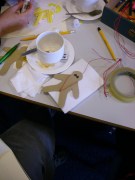
A possible activity to go with this would be to get the students to make butterflies out of copies of different types of texts, and then put them together on a museum type tray complete with labels that identify the specific rules the different texts have to adhere to. (I developed this as an activity a bit, I thought washing pegs might be good for the body of the butterflies, but then never actually used it as the idea of using a paper doll came along and seemed to make more sense – see The Dress-Up Doll of Formality, to be blogged about soon.)
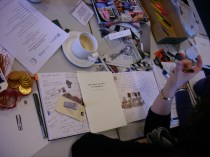
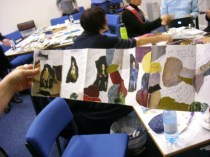
(This booklet was made in a preview edition of 31 handed out to delegates at the Writing in Creative Practice: Integrating Writing into a Studio-based Curriculum workshop, each with a pop-up butterfly in the middle.)
 Tactile Academia