Archive

Author Archives: alkegw

It might be a bit too early to start thinking about dissemination, but today a (fairly early) call to this conference landed in my inbox, maybe something to think about…

Making – an international conference on materiality and knowledge

The Making, Materiality and Knowledge conference aims to provide an outlet for international and interdisciplinary knowledge production within Making Disciplines/Making Professions/Making Education.

The active and creative aspect of the word Making is the centre focus, and the first key-concept of the conference. The making of something in something, a material, renders a focus on the physical and material aspects of making. Materiality is as such the second key-concept of the conference. The third key-concept of the conference, knowledge, emphasizes the need of understanding the making process as both a knowledge based and a knowledge generating process.

Organised by the nordic Research Network (Nordfo), this conference will take place in Notodden, Norway in September 2012, abstracts are due March 15th 2012.

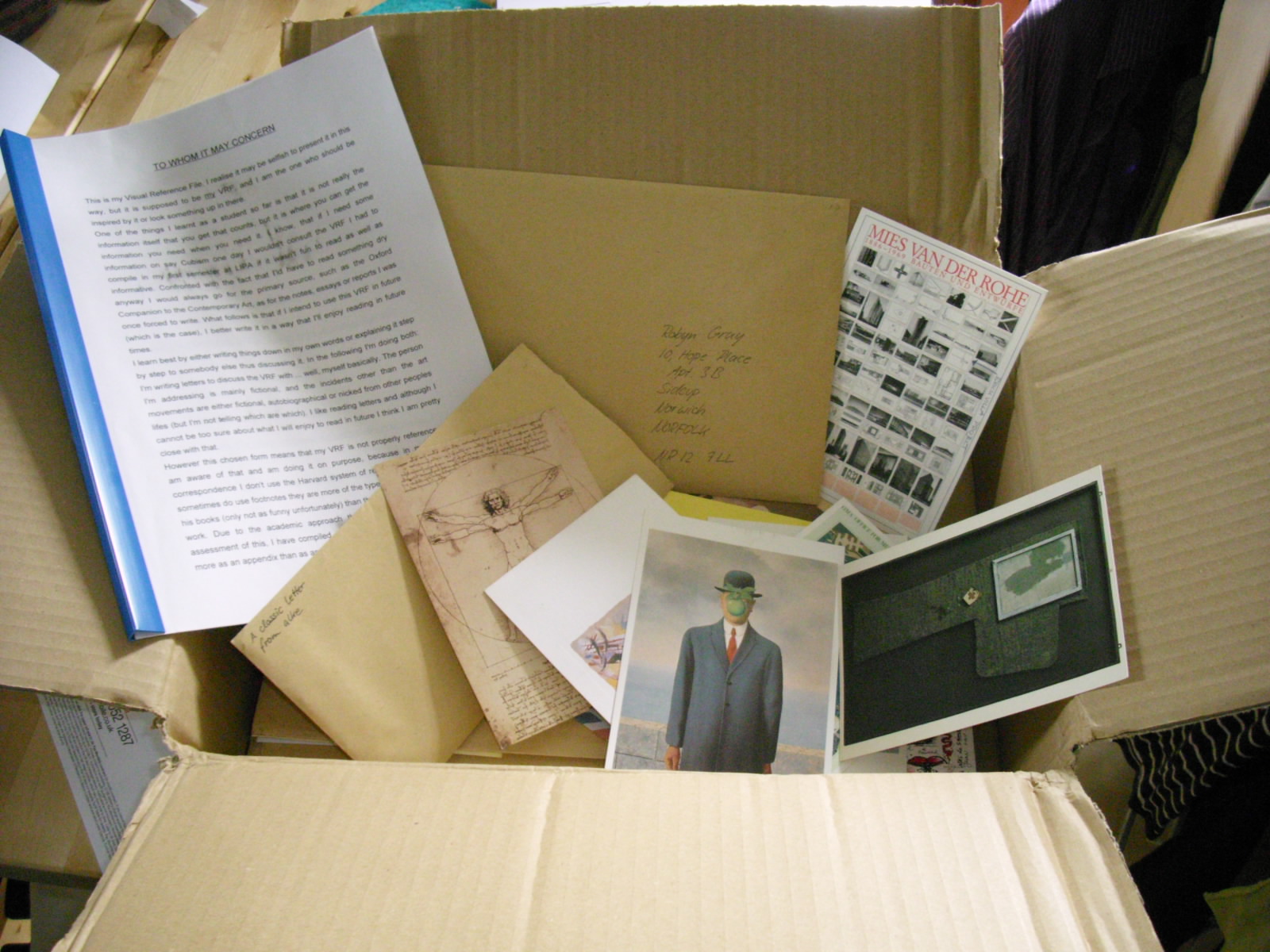
In my first year as an undergraduate student of Performance Design I had to put together a ‘Visual Reference File’. I don’t quite remember the details, but we had a number of ‘isms’ to research and find certain examples representing architecture, fashion/costume, jewellery, art and possibly a fifth catergory which I don’t quite remember. We also had to explain the philosophy behind the (art) movement. The idea, as the name said, was that we should refer to this initial body of work and build on it in our practice – and most of my class mates did put together actual files. I, however, really didn’t like the idea, because I didn’t think I would ever look up anything in this, so I had the choice of just doing it as straightforward as possible (with the knowledge that I would never use it and that it would be just for the sake of the assignment) or comiing up with a way of presenting it that would make me use it in future.
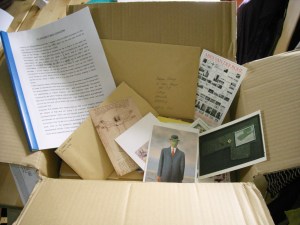
Visual Reference File

What I handed in was a parcel filled with letters and postcards, written to an imaginary friend, explaining the different movements and showing examples. This was accompanied by an appendix of sorts: a document explaining my reasons for presenting it in this way, a bibliography, and a list of academic references.

This was the explanatory text (just as it was with spelling mistakes and interesting punctuation, maybe I should point out that I am not a native speaker of English):

“To Whom It May Concern

This is my Visual Reference File. I realise it may be selfish to present it in this way, but it is supposed to be my VRF, and I am the one who should be inspired by it or look something up in there.

One of the things I learnt as a student so far is that it is not really the information itself that you get that counts, but it is where you can get the information you need when you need it. I know, that if I need some information on say Cubism one day I wouldn’t consult the VRF I had to compile in my first semester ar LIPA if it wasn’t fun to read as well as informative. Confronted with the fact that I’ld have to read something dry anyway I would always go for the primary source, such as the Oxford Companion to the Contemporary Arts, as for the notes, essays or reports I was once forced to write. What follows is that if I intend to use this VRF in future (which is the case), I better write it in a way that I’ll enjoy reading in future times.

I learn best by either writing things down in my own words or explaining it step by step to somebody else thus discussing it. In the following I’m doing both: I’m writing letters to discuss the VRF with … well, myself basically. The person I’m addressing is mainly fictional, and the incidents other than the art movements are either fictional, autobiographical or nicked from other peoples lifes (but I’m not telling which are which). I like reading letters and wlthough I cannot be too sure about what I will enjoy reading in future I think I am pretty close with that.

However this chosen form means that my VRF is not properly referenced. I am aware of that and am doing it on purpose, because in my private correspondence I don’t use the Harvard system of reference and although I sometimes do use footnotes they are more the type Terry Pratchett uses in his books (only not as funny unfortunaterly) than the type you find in academic work. Due to the academic approach that probably stands behind the assessment of this, I have compiled a bibliography, but this should be seen more as an appendix than as an integral part of the file.”

Looking back on this now (as an HE lecturer myself) a number of things are probably noteworthy.

It was clearly written BG (Before Google), as these days I would start my research on the internet (and expect my students to do the same).

I must have been paying some attention to learning outcomes and assessment criteria, hence the appendix, but I realise that this would have been spectacularly inappropriate if teachers had wanted to test my academic writing skills. (Indeed I sometimes tell my students about this particular assignment of mine and warn them that it would not have passed in the study skills module I am teaching – but only because here the academic essay is a named outcome, and in a way the point of the module.)

In a way I was successful with my intentions. Even though I don’t use the file to reference art movements (at the moment), that is because that is not the sort of work I do (at the moment) – I am not working as a theatre designer as I was trained to – it is one of the undergraduate assignments that I have kept through five house moves and that I do still go back to to look at and read every once in a while, that the odd postcard keeps getting added to, and that is now housed in a different parcel, because the original one was falling apart.

In my own experience of teaching academic writing to undergraduate students in a number of creative practice disciplines (i.e. students who have a ‘practical’ component that is studio based) there seems to be a certain reluctance by the students to invest into writing in the same way as they do into subject specific skills.

This is actualy something I researched into further as part of my docotral thesis, which was all about the role of writing in undergraduate design education in the U. One of the findings was that students do not seem to see writing as a skill that needs to be practiced, but rather something almost instantenous: you write it and then it is done, so then you hand it in. The idea of re-writing bits, editing others out, going out to do a bit more research, overall all the preparation work and the honing of this as a skill – all things the students would do if the outcome is something studio based, whether thrown pot or animated film – is one that does not seem to occur to them, because they see it as removed from their practice.

As part of my PhD I introduced some assignments to students of Three Dimensional Design at Manchester Metropolitan University that were aiming to link their practice to written tasks, and were located in the studio rather than on the Contextual Studies/History of Art and Design side. These were not academic essays, but rather were meant to accumulate into a reflection on their practice, actual and aspirantional. Some details can be found in this case study written for the Writing PAD network.

Recently I have been thinking about exploring the idea of making in order to ‘get your head around’ more academic processes/research/writing a bit more – especially in the context of making artist’s books. More details about this project as it develops.

Thinking about this has made me realised that I have used little strategies like that in my own work (as a student and since then) to order thoughts or turn content into something more tangible (will probably post some examples on this blog in future categorised as ‘Alternative Presentations’).

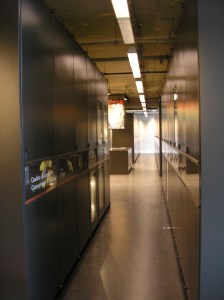
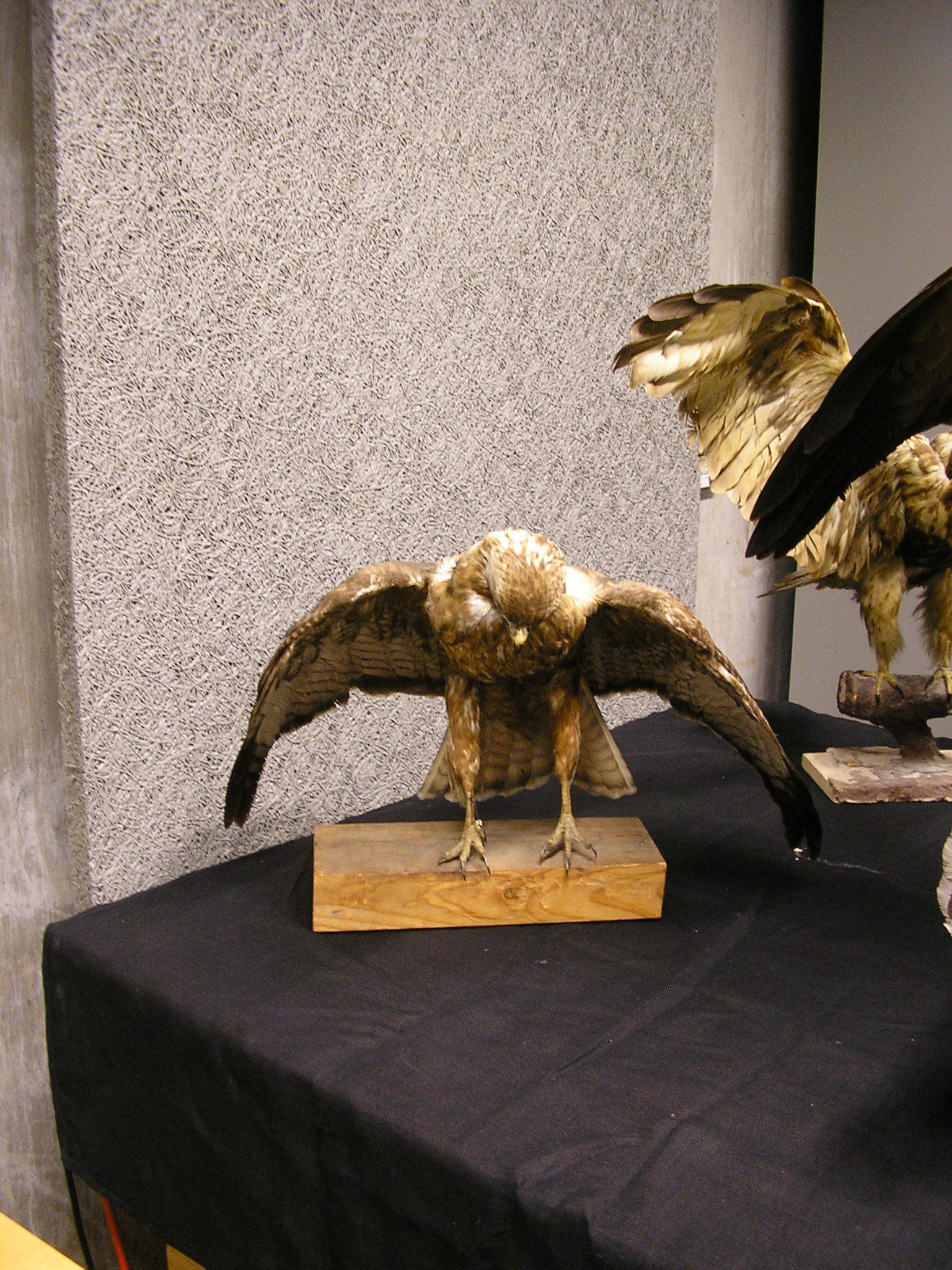
On a recent trip to Vancouver I visited the Beaty Biodiversity Museum , which is a very interesting museum in that it is also a (working) archive. Hidden away under the largest blue whale skeleton on display in Canada is what at first glance looks like a (albeit stylish) bunker, but is really storage for specimen. Most shelves are fronted in black, but some have integrated glass windows to allow visitors to see the collected objects, depending on their type pressed, stuffed, contained in boxes or in jars. This not only shows the objects, but also gives an insight into how they are stored and worked with. The interpretive text is interspersed with these displays, while there is also a ‘band’ of text that goes along the shelves and gives information on the different relationships of the specimen.

basic set-up

objects on display

storage boxes


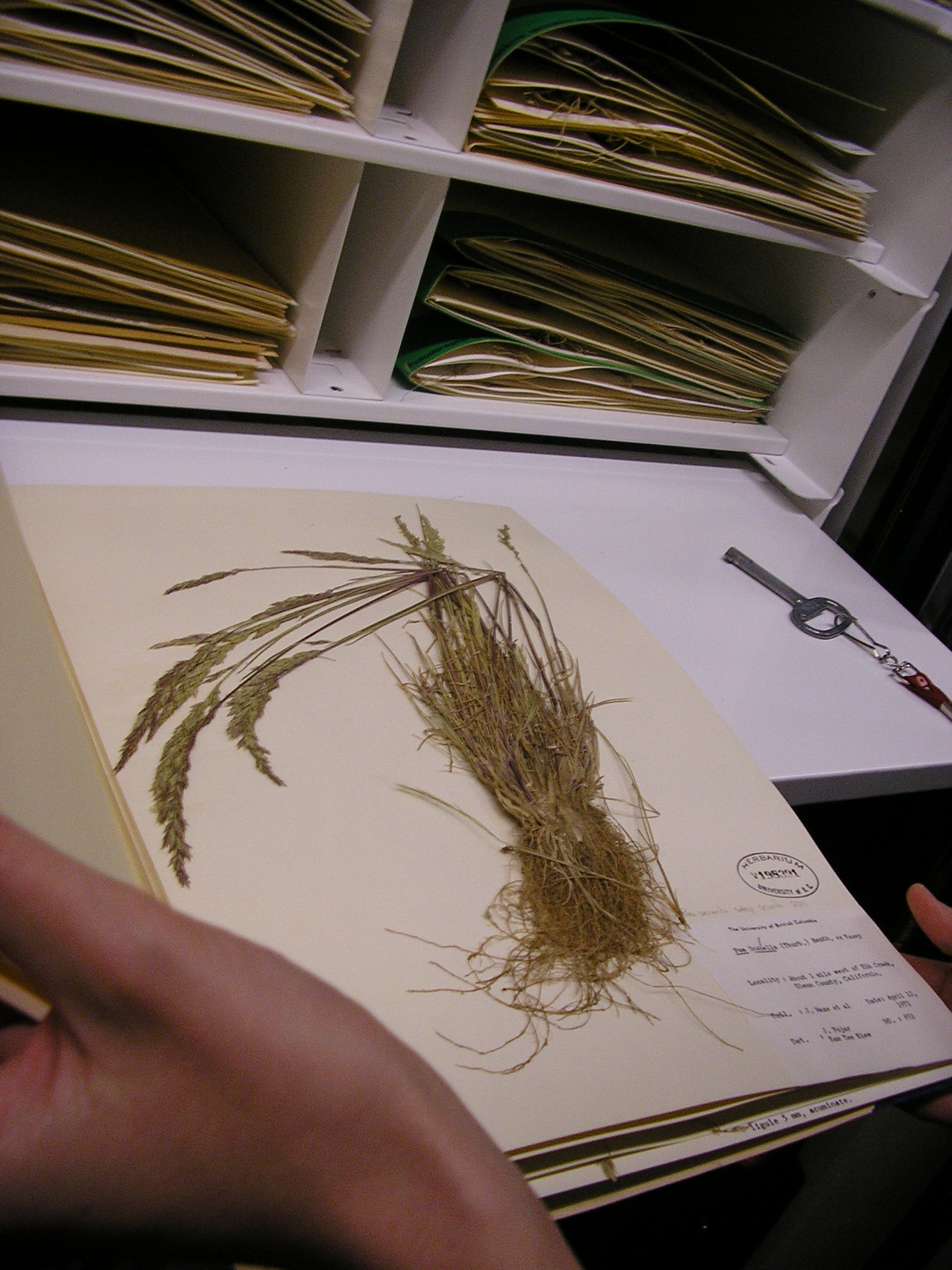
While I was there a member of staff from the University of British Columbia, where the museum is located, was accessing some of the specimen by unlocking one of the cabinets and showing that it really did contain hundreds of examples of pressed flora.

archive in action

There was also a treasure hunt for children, the last

in the discovery lab

station of which was a discovery lab, where the specimen could be seen outside of their glass cases.

Overall a fascinating museum well worth a visit!

A while back I interviewed my colleague Ruth Waterhouse about her use of the Betty Smithers Design Collection. Ruth (newly retired) taught Sociology and felt that integrating objects in her teaching brought another dimension to her discipline.
Here are my written up notes:

Ruth W first used the Design Collection to support teaching at adult education level outside of the university, particularly for a course where the changing nature of women’s fashion was discussed and put into context with the culture of the time. She first used garments for illustration purposes only to show the changes in fashion in a chronological way.
As the garments came from a handling collection, she also encouraged handling and this turned out particularly successful in a session with older women groups when discussing World War II and connected fashions. The tactile experience of the handling seemed to trigger memories of the participants’ own experience, in the first instance particularly through materials. As the group was made up of women who could remember similar garments, they were very knowledgeable about using these materials. Ruth states that she got a better response in this handling session than she got from lecture-style talks, because the garments triggered an emotional response and stimulated reminiscence. The participants were delighted in being reminded of these objects, not just visually, but through a tactile exploration, and this in turn stimulated discussion which contained a lot of oral history. It created a unique atmosphere and engagement.
The success of this session gave Ruth W the idea to use the Design Collection resources more at the university level and she included it in the ‘Dedicated Followers of Fashion’ module which is an option on the Sociology degree at Level 5 (she has used it in this context for the last five years). To begin with there was one session done by Ruth Brown, at the time keeper of the Design Collection, which publicised it and told students about how they could use it themselves. However, in following years they began tying it into the subject matter more, with Ruth W doing a lecture that was immediately followed by a session with Ruth B with a rack of fashion that gave a spread from the earliest items in the collection through to the 1990s.
At one occasion Ruth B dressed up in Edwardian garb, turning the clothes from the hanger into a worn dimension, and the students were asked to reflect on the role of clothing and what it reflected in life.
Ruth W states that sociology is often a very abstract subject. Examples make it more concrete. Touching items and feeling the weight of them make it easier to ask yourself what it would have been like to wear them. It makes it easier to explore whether they might have been constraining or constricting. Examining their construction close-up allow a judgement of their quality, their price and the effort it takes to maintain a wardrobe at the time, for example making it easier to understand how Edwardian clothing sustained a servicing class through the laundry, mending and pressing that was necessary to keep them wearable.
While it is very successful to use the objects from the Design Collection for that particular module, Ruth W thinks that it is the only one of the ones she teaches and knows of, that it would be appropriate. Her colleagues in sociology don’t use it as far as she knows, although she says there might be material that could be found in the archive’s collection of magazines that could relate to the ‘Deviant Bodies’ module which is concerned with sociology of the body. She states that it would have worked much more in the context of sociology of culture, which doesn’t run at Staffordshire University anymore. She also says that a collection of this nature would be useful to sociologists of popular culture; of the body  and of subcultures, especially youth cultures. The use of the collection is somewhat restricted at Staffordshire University because of the options that are currently offered, but she strongly feels that aspects of the collection could be linked into theories of consumption and identity and would resonate with many other aspects of sociology.
She says that only a minority of students take the opportunity to check out objects (she remembers a student researching shoe fashion for example). She thinks this little take-up might be due to finding the time. However, she says that even if students don’t use the collection itself, using it in class encourages them to use what they have themselves. It inspires them to ask more questions and to use objects as well as secondary sources for their research. It has freed students up from thinking they have to deal with textual material, the abstract. This is reflected in the work they put in, the subjects and also adds another dimension to their work. For example, they present their work in a more innovative way. The assessment criteria stipulate a portfolio that Ruth W interprets widely and she encourages students to utilise their visual sense, etc, alongside the written text. Almost half take this up, it gives them permission to go broader than just writing things up. This feeds their imagination, it is outside of the straightjacket of theoretical sociology, makes theory meaningful, they make sense of society through exploring its objects.
She attempts to stress that sociology is also about imagination and should be within the arts to build those bridges (at Staffordshire University sociology is located in the Faculty of Arts, Media and Design rather than linked to psychology or the sciences, which means it is located in a different academic culture) – is it narrowing its focus by being too concerned about its image? Using the Design Collection, which has mostly everyday objects in it, encourages them to use material objects from their cultural world as a starting point.

Asking whether she could recommend strategies of using the BSDC, her top tips are:
• Think more explicitly – she wonders whether her approach is a bit hit and miss, and thinks that it needs to be articulated carefully what you want, possibly in the learning outcomes.
• Use more widely – maybe she uses it in a fairly narrow way, so there needs to be a closer investigation of what is on offer (for example political magazines) and investigate its potential and content more thoroughly
• Don’t be worried about incorporating tactile stuff, the smell, move beyond just the cognitive, rather employ a full range of senses, not just thinking about stuff.
• Collaborating across disciplines is important, against pigeon holing
Ruth W states that the handling collection is vital, as it is different to a museum and the interaction that is in its centre is very important.
A big part of its importance and usefulness is a matter of personality, Ruth B is very approachable, accessible, willing to engage, helpful – can this be replaced by a data base? NO! the ad hoc nature, not preselected apart from showing the Everyday-ness of everyday life.
Items are not precious, this makes them more valuable in an educational context as it has the capacity to stimulate, trigger stories, the mind, recollections – encourages students to become experts of their own lives by interrogating them rather than just living them.

When it comes to finding out what other people are researching in regards to object learning, a first point of call, particularly in the area of design is the Centre for Excellence in Teaching and Learning through Design. Based at the University of Brighton and working in collaboration with the Victoria and Albert Museum (V&A), the Royal Institute of British Architects (RIBA) and the Royal College of Arts (RCA) the projects taking place here are looking at object scholarship and object-based learning.
A particularly good starting point is the book Museums and Design Education: Looking to Learn, Learning to See (2010, edited by Beth Cook, Rebecca Reynolds and Catherine Speight, Ashgate).

There are a number of ways in which Higher Education can get access to objects, some of which I will blog about more in future. but just to get this started a (probably very incomplete) list:
Most obviously probably are museums, which often, but not always, collect and give access to objects. Here you can find curated exhibitions, where objects have been pre-selected and arranged in a formal display. Some you might be able to touch and handle, possibly in specially arranged sessions.
Museums also tend to have lots of objects that are not on display. It may be possible to get access to objects from a catalogue, or even explore the museum stores. This depends on the access policy of the museum and if you are working with students probably space and numbers.
Universities often have their own museums, galleries or collections. Here access to objects is usually easier for students, because it is probably part of the mission of the collection, and they often grew out of teaching collections initially.
Some of these teaching collections are handling collections, where rules of access are slightly different and objects may be handled without gloves, in some items can be taken apart or even borrowed.
But objects to be used in learning and teaching don’t necessarily have to come from a formal collection, they are all around us, so they can also come from personal collections of enthusiasts or simply the home – a possibility that should not be discounted.
And then there are also the virtual objects, images that are accessed through the internet, books or magazines, which bring their own problematic, because here we obviously do not have a three-dimensional or even tactile encounter, but they probably should not be discounted.

A good starting point for using objects in art and design education, in particular, is to use them to draw from. This allows a different engagement and investigation of the object than other forms of note-taking, such as writing down label information or taking photographs.
When using objects in such a way a number of things need to be considered:

If you are working from a formal display, such as in a museum exhibition, a still life has already been set up for you by a curator. Try to encourage students to find their own perspective and not necessarily go for the ‘obvious’ frontal view. Encourage students to use sketches not to necessarily replicate what they see (this they could do much more effectively with a photograph, if photography is allowed), but rather to try to capture other aspects of the objects, like their context, details they particularly like, etc.

If you are working in a collection where the objects can be handled, you and the students can play with the setting up yourself. How would it differ if this was a museum display set up or a shop display? What would be an authentic context? Being able to handle objects often also means that you will have access to views of the objects that might not be on show in a museum, for example the back, bottom or inside – take advantage of that in your exploration.

Also take into account the different contexts of the sketching, students often lack the confidence to explore something in a museum, where other visitors might come up and look over their shoulders, possibly even comment on their work, so sketches here could be used as starting points for future, more elaborate drawings. If on the other hand, it is possible to have a drawing session that is private, this can lead to an informal discussed amongst the students, which starts the investigative process.

I asked Stephanie Boydell, curator at Manchester Metropolitan University Special Collections, what she thought the usefulness of object-based learning was, and here is what she said:

Object-based learning can engage students that may find formal teaching situations difficult. It offers a different way of teaching, and of learning, and uses different kinds of intelligence. Students can draw their own conclusions, can ‘discover’ answers, rather than just receive ideas from academics.
It can enrich course/lecture content, which is particularly useful if you are trying to attract new students!
The physicality of an object, seeing something in the flesh, so to speak, can be the only way to appreciate or understand form, texture and difference: for instance, how do you know the difference between a woodblock print and an etching if you haven’t seen these up close? This is particularly true for contextual and historical studies in Art & Design.
In our setting at MMU, it allows access to other professions, ie curators and archivists and different knowledge systems, and can offer students an insight and experience of how we work with artefacts. It is also outside the “classroom”, so can be more relaxed, and even privileged, as students can actually handle museum objects.
Students can develop key skills and learn new ones: such as how to observe, record, assess and analyse and question an object; it encourages critical thinking, and allows students to use prior knowledge and build confidence. When working in groups it builds on team working skills, communication, presenting, listening, learning from peers and confidence building, particularly as students can implement and pass on prior knowledge and be in a situation where all ideas are acceptable.
OBL can encourage discussion and debate: would a Chinese artefact be documented or interpreted differently in China? Why have a light fitting from Habitat in the collections when it is so readily available on the high street and has little monetary worth?
It can also inspire creativity: writing, new artworks, etc. This is hugely important for practical arts students, as the stages between encountering an object and developing your interaction and response into a design/application and how you justify and record them that are extremely important for makers, (and for assessors!).

Recently I was talking to my sister about an article I was writing that she kindly had a look at for me, and while trying to come up with a better title for one of the subsections, I found myself wondering whether it could be objects that are the ‘missing link’. I teach study skills and contextual studies to creative practice students at university, and have increasingly come up against students wondering how all this theory (and almost worse: writing) is relevant for them, if all they want to learn is how to design, paint, animate, take photographs, make films, etc. So I have been trying to link creative practice with an academic dimension in the context of Higher Education. A tactile approach came up again and again in both my personal practice and my teaching: experiential learning, object-based learning and making of some sort to work through theoretical issues.
This blog is meant to collect mine and colleagues’ research on this potential of tactile means in academia, particular in the arts, design and media field (though not exclusively so). What I will not do is try to explain why I think the academic dimension is important, I will take that as a given for the purpose of this blog (so be warned).
The categories and tags I could see us using (and this will undoubtedly change as the research progresses) include looking at object-based learning and ways to encounter objects (in Higher Education), highlighting some interesting collections (and their presentation) of both universities and museums, thinking of strategies to create objects that link
creative pursuits to theoretical content, as well as sharing literature and ideas encountered at conferences.
If you want to become involved, please comment or get in touch with me to become a contributor!
Thank you for reading.
Alke