In my first year as an undergraduate student of Performance Design I had to put together a ‘Visual Reference File’. I don’t quite remember the details, but we had a number of ‘isms’ to research and find certain examples representing architecture, fashion/costume, jewellery, art and possibly a fifth catergory which I don’t quite remember. We also had to explain the philosophy behind the (art) movement. The idea, as the name said, was that we should refer to this initial body of work and build on it in our practice – and most of my class mates did put together actual files. I, however, really didn’t like the idea, because I didn’t think I would ever look up anything in this, so I had the choice of just doing it as straightforward as possible (with the knowledge that I would never use it and that it would be just for the sake of the assignment) or comiing up with a way of presenting it that would make me use it in future.
Visual Reference File
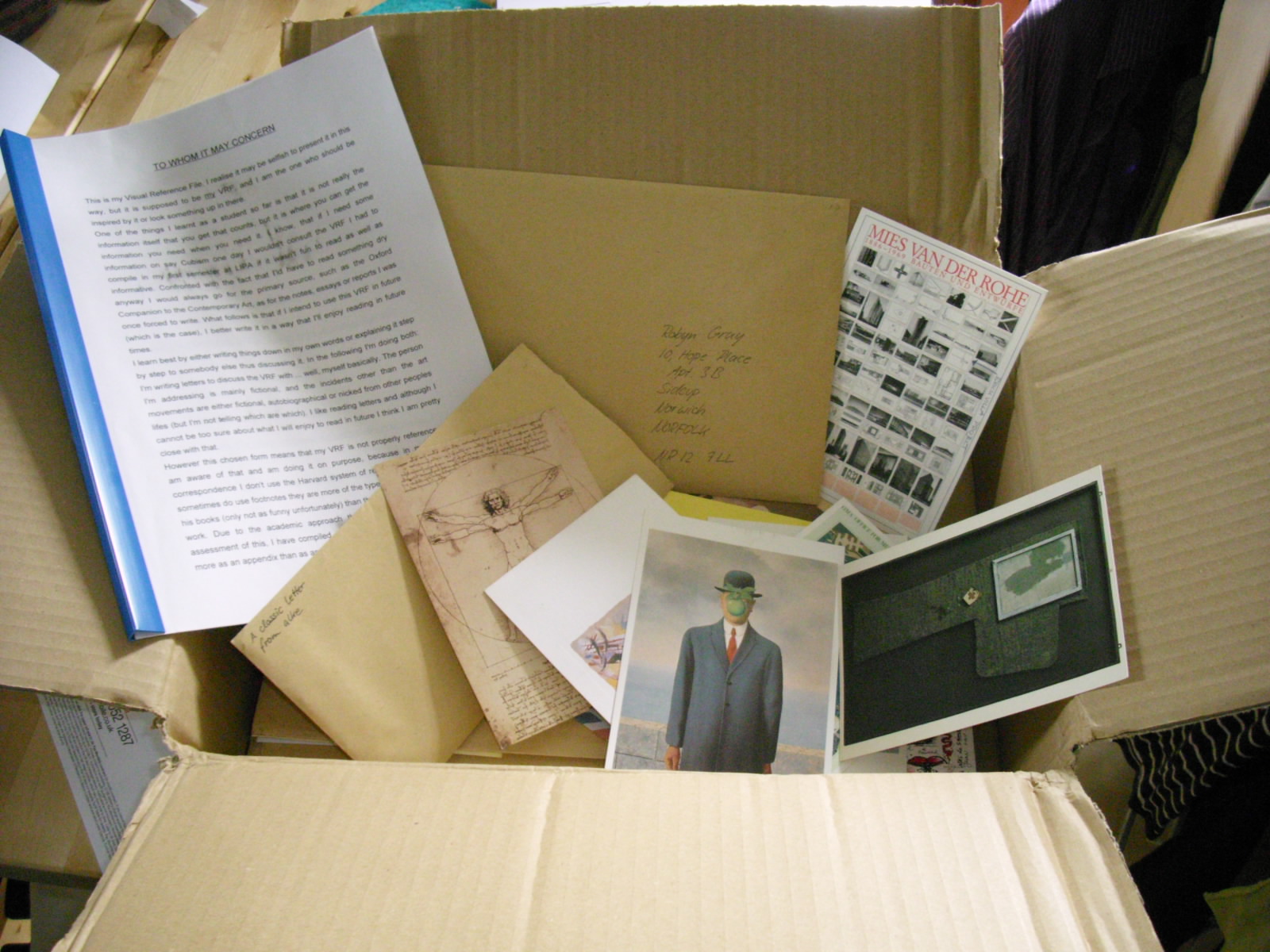
What I handed in was a parcel filled with letters and postcards, written to an imaginary friend, explaining the different movements and showing examples. This was accompanied by an appendix of sorts: a document explaining my reasons for presenting it in this way, a bibliography, and a list of academic references.
This was the explanatory text (just as it was with spelling mistakes and interesting punctuation, maybe I should point out that I am not a native speaker of English):
“To Whom It May Concern
This is my Visual Reference File. I realise it may be selfish to present it in this way, but it is supposed to be my VRF, and I am the one who should be inspired by it or look something up in there.
One of the things I learnt as a student so far is that it is not really the information itself that you get that counts, but it is where you can get the information you need when you need it. I know, that if I need some information on say Cubism one day I wouldn’t consult the VRF I had to compile in my first semester ar LIPA if it wasn’t fun to read as well as informative. Confronted with the fact that I’ld have to read something dry anyway I would always go for the primary source, such as the Oxford Companion to the Contemporary Arts, as for the notes, essays or reports I was once forced to write. What follows is that if I intend to use this VRF in future (which is the case), I better write it in a way that I’ll enjoy reading in future times.
I learn best by either writing things down in my own words or explaining it step by step to somebody else thus discussing it. In the following I’m doing both: I’m writing letters to discuss the VRF with … well, myself basically. The person I’m addressing is mainly fictional, and the incidents other than the art movements are either fictional, autobiographical or nicked from other peoples lifes (but I’m not telling which are which). I like reading letters and wlthough I cannot be too sure about what I will enjoy reading in future I think I am pretty close with that.
However this chosen form means that my VRF is not properly referenced. I am aware of that and am doing it on purpose, because in my private correspondence I don’t use the Harvard system of reference and although I sometimes do use footnotes they are more the type Terry Pratchett uses in his books (only not as funny unfortunaterly) than the type you find in academic work. Due to the academic approach that probably stands behind the assessment of this, I have compiled a bibliography, but this should be seen more as an appendix than as an integral part of the file.”
Looking back on this now (as an HE lecturer myself) a number of things are probably noteworthy.
It was clearly written BG (Before Google), as these days I would start my research on the internet (and expect my students to do the same).
I must have been paying some attention to learning outcomes and assessment criteria, hence the appendix, but I realise that this would have been spectacularly inappropriate if teachers had wanted to test my academic writing skills. (Indeed I sometimes tell my students about this particular assignment of mine and warn them that it would not have passed in the study skills module I am teaching – but only because here the academic essay is a named outcome, and in a way the point of the module.)
In a way I was successful with my intentions. Even though I don’t use the file to reference art movements (at the moment), that is because that is not the sort of work I do (at the moment) – I am not working as a theatre designer as I was trained to – it is one of the undergraduate assignments that I have kept through five house moves and that I do still go back to to look at and read every once in a while, that the odd postcard keeps getting added to, and that is now housed in a different parcel, because the original one was falling apart.


 Tactile Academia