Archive

Conferences

A long overdue post…
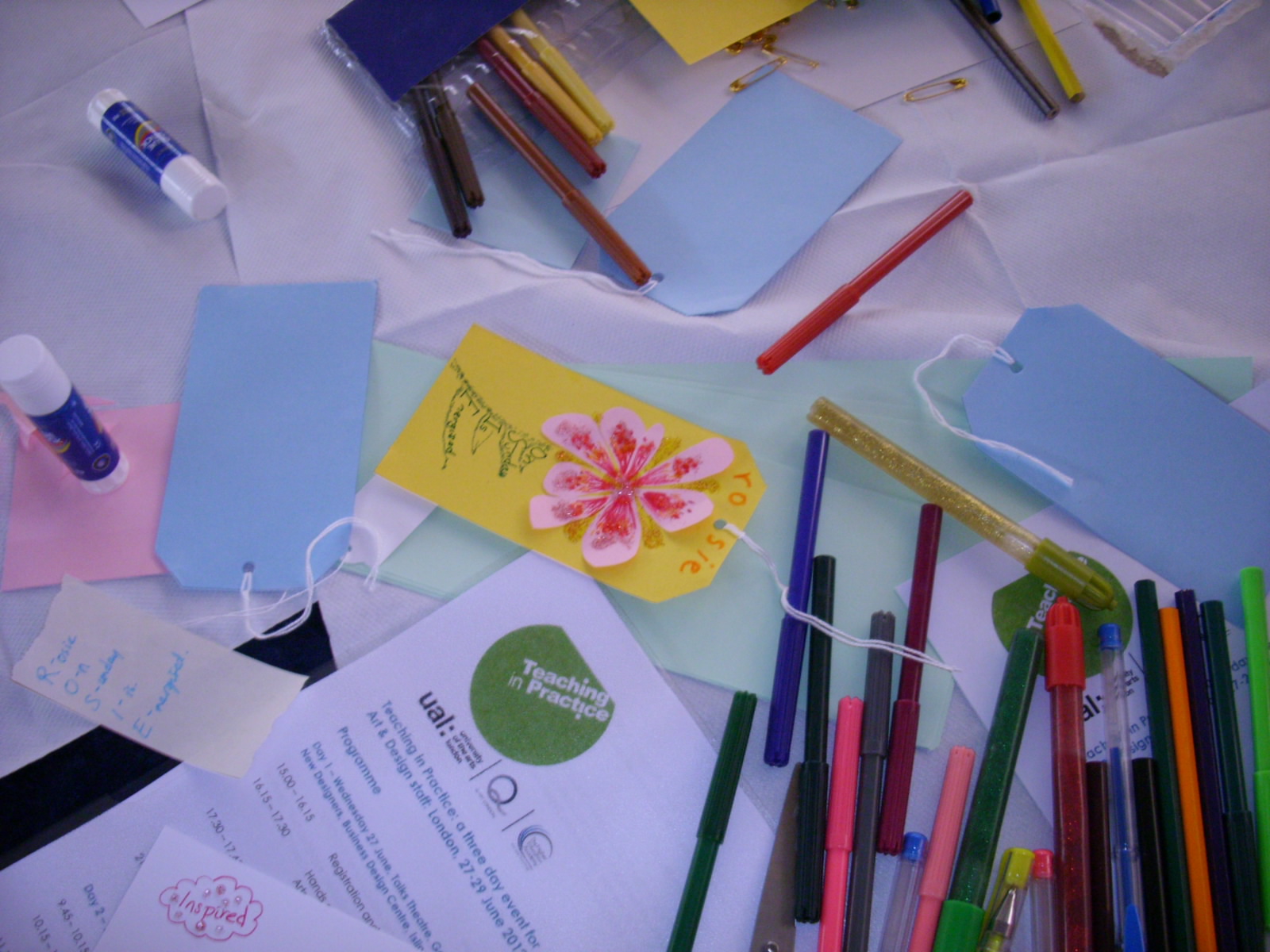
icebreaking through making name tags

At the end of June I went to the Teaching in Practice event, which was three days of Art and Design teaching staff getting together at different venues to network and talk about teaching in practice. Myself and Pat Francis had been invited to do two sessions, one on the first day as an ice-breaker and one on the second day to particularly get people thinking about the reflection-THROUGH-action that making provides.

the glue sticks came out again

One of the key formats we wanted to concentrate on was the use of postcards to focus thought, take notes and provide feedback, so everybody got a pack of postcards to utilise throughout the event, and we encouraged people to write/draw/collage their feedback down as well on self-adressed postcards, which I took home with the promise to mail them out in early September to remind people of the experience they had. (And yes, I did do that a couple of days ago.)

The first day was hosted at the New Designers 2012 exhibition, so we had the chance to see the show as well, and included a welcome by Linda Drew celebrating the launch of the Teaching in Practice event, which will hopefully become a regular feature on the HEA calendar.

Day two was taking place at the Garden Museum, a fabulous space (with some very nice food), particularly as we were lucky with the weather so the first workshop in the morning, Garden of specialist language: Ars cesura vs. art Critique led by Sarah Rowles and Giles Bunch of Q-Art, actually let us take over the garden as we explored ways of presenting work and the ‘crit’ that is often so important in teaching studio-based disciplines.

The keynote after lunch was given by Professor Juan Cruz, the director of the Liverpool School of Art and Design at Liverpool John Morres University. It was titled ‘Hunting in Packs’ and can be seen here (plus a video montage of the whole event).

The last workshop of the day was facilitated by Ellen Sims and Kirsten Hardy, and was exploring the UK Professional Standards Framework for teaching and supporting learning. There were some insightful discussions of the new HEA framework re the new different stages of fellowship – and why we should try to get accredited!

Day three was held at the Sackler Centre at the Victoria & Albert Museum. We were treated to two keynotes, one by Mark Craweley, the director of Widening Participation and Student Progression at the University of the Arts, London with painter, educator and curator Kimathi Donkor, the other by Leanne Manfredi, the programme manager responsible for Higher Education and Creative Industries at the V&A.

After a refreshment break James Corazzo, Senior Lecturer in Graphic Design at the University of Derby, led a workshop intriguingly titles ‘Teach less, Learn More?’ in which he explored ways of actively engaging students by making them get out there are try stuff rather than read or hear about it and stick to the drawing board.

The evening ended with the opportunity to networ as well as visiting the British Design 1948-2012: Innovation in the Modern Age exhibition at the V&A, as well as enjoying the Friday Late at the V&A event Un-built, which explored the interplay between architacture and the visual arts.

By the end of it I was exhausted, but I hope that it’ll be repeated next year so I can do it again! I also came home with a stack of postcards to myself (plus the feedback mentioned above), but that might be a later post.

Another conference that might be of interest is this year’s Writing Development in Higher Education international conference to be held at Liverpool Hope University, July 2-4th. The theme this time round is ‘Enacting thoughtful pedagogies and inclusive values in writing development’.

I am happy to report that my abstract has been accepted and that, pending staff development funding, I’ll be there to talk about my current research.

On the 21st of October 2011 I went to the Photography and the Artist’s Book Symposium, a collaboration between Salford School of Art & Design at the University of Salford,Hot Bed Press and Manchester Metropolitan University Special Collections, which is where it was also held.

Although my interest is not really concerned with photography, there were some very thought provoking presentations. For example, Jane Pendlebury from MMU Special Collections gave a brief history of this artist’s book collection and explained how until the 70s the artist’s books were treated as normal stock. Only later were they catalogued with a separate sequence and treated as the objects/artifacts they are now considered.

The event made me think a lot about juxtaposition of images, sequencing, scale, the intimacy of the small (book) object and the physical act of turning the pages (or unfolding a sheet, etc) and the suspense that builds.

Most interesting in the context of my own research was PhD candidate David Penny, who uses a book format to represent his practice-as-research, a working document that rather than illustrating theory is part of his research in so much he considers the rough models he works with as part of his outcomes. He explained that it was the physical making that has been particularly useful for him, because it let him spend times with the images themselves. (I hope to interview David in future to find out more about his experiences, so watch this space).

As the symposium was located in the MMU Special Collections space, there was ample time to browse the Artist’s Book collection, and some of the books that featured in the presentations were laid out so that participants could have a closer look.

‘How we experience material objects through our senses’ was the tag line of a two day workshop that I attended recently. The Sensuous Object, as it was called, turned out to be two days full of thought-provoking presentations (all centred around actual objects) with interesting people. So many issues were covered that it would be too much for just one blog post, so I may go into detail in future posts; suffice it to say that we discussed objects and the use of collections through focusing on their tactile nature, through sound, taste and smell, as well as movement. In the process we were treated not only to interesting visuals, like one presenter talking about hysteria while wearing a leather belt with which diagnosed hysterics were restrained to be kept safe in the nineteenth century, but we were also able to handle some of the objects that took centre stage.

One of the reasons that I really wanted to attend was that I was interested to see what is thought about object learning outside of my own field (of art and design), and I was not disappointed, coming home with a whole list of thoughts to follow up (once I have the time). I was particularly intrigued by the term ‘artifactualists’, the view of gloves as keeping an object of memory intact by not adding more memories, ‘imaginative imagination’, an ingenious way of visualising quantitative data, that sometimes we are talking about intuition but it may just be listening to sound without being aware of it (the sound being overlooked as it were), the question of how we listen and are we thinking about sound through metaphors, Gernot Boehme’s notion of athmosphere and the materiality of photography as well as drawing.

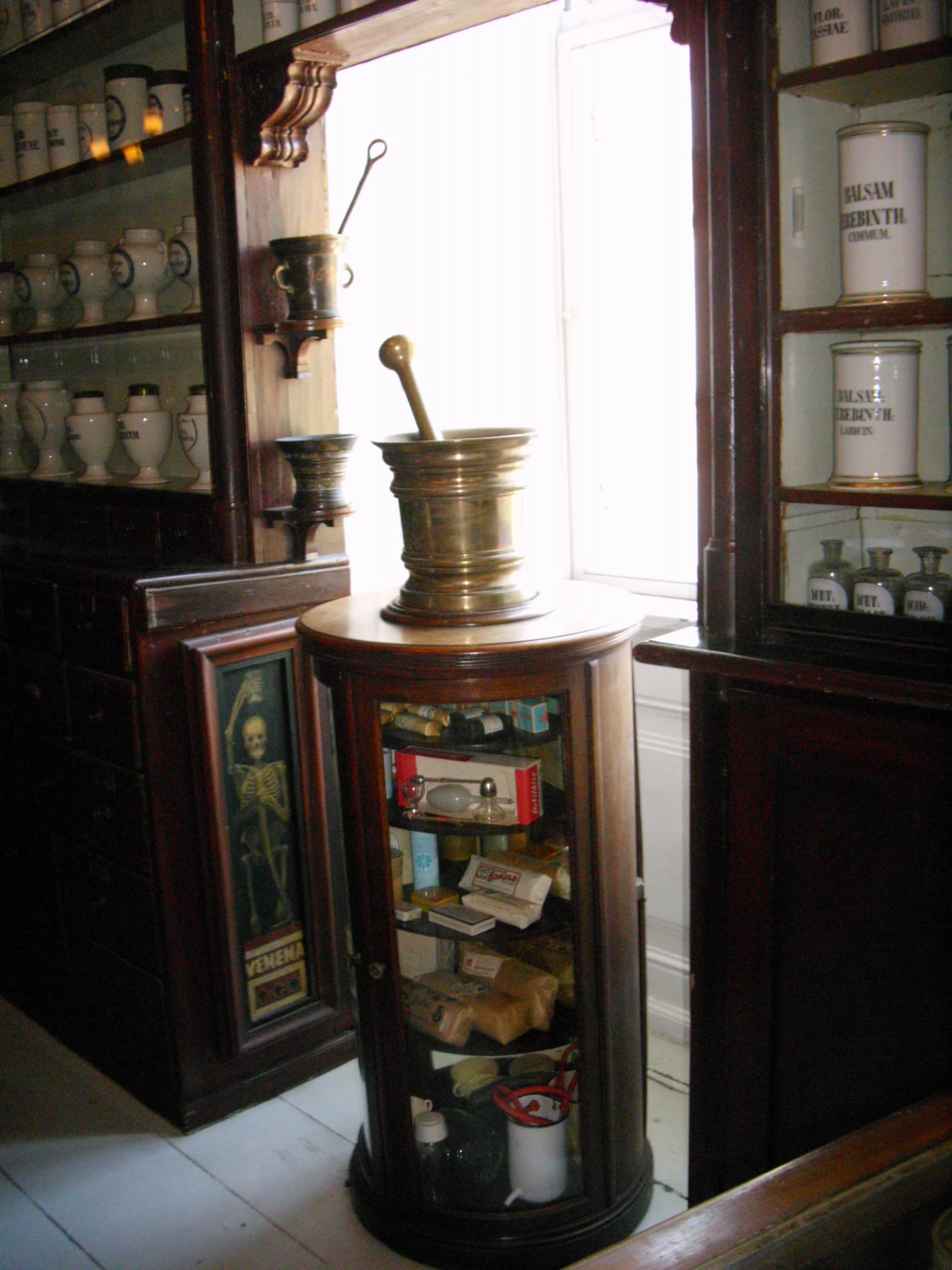
A big component was probably the Medical Museion in Copenhagen, which, as host, allowed the presenters access to its collection and also provided an athmospheric (and slightly unusual, for example they have a recreated Victorian pharmacy tucked away in one room) setting for the two days.

It might be a bit too early to start thinking about dissemination, but today a (fairly early) call to this conference landed in my inbox, maybe something to think about…

Making – an international conference on materiality and knowledge

The Making, Materiality and Knowledge conference aims to provide an outlet for international and interdisciplinary knowledge production within Making Disciplines/Making Professions/Making Education.

The active and creative aspect of the word Making is the centre focus, and the first key-concept of the conference. The making of something in something, a material, renders a focus on the physical and material aspects of making. Materiality is as such the second key-concept of the conference. The third key-concept of the conference, knowledge, emphasizes the need of understanding the making process as both a knowledge based and a knowledge generating process.

Organised by the nordic Research Network (Nordfo), this conference will take place in Notodden, Norway in September 2012, abstracts are due March 15th 2012.