Check out this analogy for explaining the work that goes into writing by Joanne Lozar-Glenn.
(Thank you to Kelly O’Brien for suggesting this via Twitter)

Check out this analogy for explaining the work that goes into writing by Joanne Lozar-Glenn.
(Thank you to Kelly O’Brien for suggesting this via Twitter)
The Fishscale research project is making some headway.
After the meeting in Huddersfield, I have been thinking about how to change what I have to a resource that other people could use – and it is quite a weird feeling to look at your own teaching materials and think about somebody else using them. But I think I am in the process of coming up with something that would be useful for others!

Brainy Sea Creature
Geoff and myself also had a look around our undergraduate Final Degree show on its opening night, and came away with a little stack of possible Illustration/Graphic Design students to approach for taking on the illustration. And I am happy to report that we managed to get our number one choice on board – Josh Filhol, who as you can see has already started to get some ideas to paper (and I really love this brainy octopus, never would have occured to me!) – more of his work can be viewed here.
We also decided to (for now at least) focus on getting the illustrations right and then maybe later think about possible animation into a film.
Katy has agreed to focus on the research questions for now, so we should be able to design this project over the summer – ready for testing in September!
(As it has become clear that this is a bigger project, I am introducing a ‘Fishscale’ category to this blog, it is clearly beyond the tag stage…)
The Writing in Creative Practice: Writing and the Object workshop was held at Middlesex University on 13 June 2013. It was a very full day – full with delegates, speakers and, above all, ideas. (You can find the official schedule here). Here are my initial impressions… (so far only my photos, more to follow soon)
Peter Thomas, who had organised the whole day on the Middlesex side, started us of with putting the day into a larger context, talking about the tension between the object representing tacit understanding and the writing, which records explicit knowledge. This is something that is very close to my understanding of the relationship between the word and object as well (as can be seen in The Land- and Seascape of Creative Practice), and I particularly liked Peter’s notion of the tension, which visually could also be read as interference in a way, which is somewhat ironic, because what the object particularly can give to writing is the focus and relevance that is so often lacking in student writing.
I then took over from Peter, introducing Sarah Williamson’s reflective book making activity (yes, by presenting everybody with a long paper strip, ready to be filled with collage/drawing or whatever else people felt like), giving a tiny little bit of background and particularly flagging up David Gauntlett’s notion of the ‘longer stretch of thoughtfulness’ (2010) that making brings. I then gave a brief overview of how I use objects in my teaching, particularly how interviewing an object can become a non-threatening precursor to an academic investigation (framed as an article) – because the genre of interview is less scary to students than the academic essay, because they are familiar with the former. I then put the two starting points – of using objects and making objects – together in the discussion of the 2D Challenge – making a sample copy of a magazine/newspaper based on the question ‘What would me work be like if it was a newspaper/magazine?’


Following this, Grace Lees-Maffei gave an overview of the different perspectives from which the relationship between words and objects are approached in Writing Design: Words and Objects, a book she has edited recently. What particularly stuck with me was the notion of triangulation – we need to approach objects from different angles, because really they “defy all attempts to define them in language”. I was thinking how looking at objects can become a great illustration of the concept of triangulation within academic research through using different perspectives/shots of the same object (maybe a future tactile academia booklet?). I also liked her talking about omission, how it can be revealing to look for what is not written about.
Luke White talked about the sense in which objects can be seen (or can become?) ‘haunted’ after Derrida’s Hauntology, framed through his own encounter with Hirst’s shark. This really opened thoughts of the real and unreal – can we really attempt to talk about an object’s ‘truth’, or is what we are talking about ALWAYS an interpretation? Does objectivity exist at all, or is it always – or sometimes? – more akin to reflexivity? Does Design Writing take possession of the objects that are its subject?
Pauline Sumner took over and talked about her work in dyslexia support. She started with a brief overview of how dyslexia connects with related learning difficulties and some facts, for example that why it has been shown that 3D visual information processing skills are better in dyslexic men, this has not been found to be the case for women… I found particularly interesting the system she described of colour coding and chunking text – breaking up text that needs to be produced for a whole essay into manageable chunks and colour code them in a reverse traffic light system (the introduction in green, the main body in sections of various colours and the conclusion in red).


And this was all before lunch! Over lunch I had a really interesting discussion with some delegates about the use of the reflective bookmaking as note taking, which seemed to be a big hit. (In fact this came up a fair few times in the feedback: “Absolutely LOVED the new method of taking notes and found I was able to focus on my own responses to the presentations in an entirely new way.” “Lots of memory triggers now to reconnect me to my thoughts today and take back into my practice.” “Didn’t think collage and listening would be so compatible.”)
After lunch, Peter and Ossie Parker told us about their interventions on an animation course, where they use a generative writing cycle of free-writing, reviewing for pathways, freewriting on the pathways, reviewing for a short presentation to facilitate an inner dialogue in students, basically scaffolding the developing and editing of ideas in preparation for a 15 second stop-motion animation.
Then Tony Side told us about how a writing portfolio (also as a designed object reflecting the content) has replaced the traditional dissertation on an Interior Design/Architecture course – and how this is supported/scaffolded through writing workshops including object/image analysis and site-writing to name but a few.
The last session by Peter, Emma Dick, Richard Lumb and Marion Syratt Barnes started by letting us experience how they link objects from their collections (the Museum of Domestic Architecture and the Library Special Collections) to student research, exploration and writing. They refer to a method of material artefact analysis described by Valerie Steele in ‘A Museum of Fashion Is More Than A Clothes Bag’ (1998), which goes through the steps of Description, Deduction and Speculation. Again one of the threads running through this approach (as in the approach to the Animation Project mentioned above) was making it clear to the students that there is a space in the process of generating writing that is (and should be) private – when you are still figuring out what you want to say.
We ended the day with Stewart Martin responding to the themes and issues that had been raised. I particularly liked his thought that both creative practice and academic writing are (or should be?) about the creation of something new… a novel contribution. Questions that came out of the following discussion were: “Should writing be considered as an independent field?”, “should we throw out the notion of ‘academic writing’ and just focus on writing?” and the idea of the “artefact of text”.
While there may have not been any answers, I found it a very stimulating day that has given me a lot to think about.
I have been sent this little film of what happened at the workshop in Ayr, just in case you couldn’t make it, but were wondering what we got up to in Scotland.
Thank you to Jamie Hare for filming and putting this together for us!
I finally managed to up-date the bibliography page with Sarah’s reference list from the Ayr workshop – also including Stylish Academic Writing by Helen Sword, my review of which you can read here.
As mentioned in an earlier post, I am working with some colleagues on bringing the Fishscale of Academicness to the masses. And I am happy to announce that a draft for the Only Connect un-book has been submitted this week!
Developing a teaching resource for testing has also made a step forward. Today my colleagues Geoff and Katy went to Huddersfield to meet up with Sarah, Judith and Liz to talk through what we could do. It turned out to be a very enjoyable afternoon with many ideas being shared (and not just one but two different varieties of cake!).
At the moment it looks like we will develop two different ‘kits’ – one for face-to-face delivery (including a presentation, staff notes, activity proforma and possibly another handout) and one for distance learning (including presentation/film, on-line activity and print-out resource). We will also put together a method for testing and data collection.
Next immediate step: visit the final degree show tomorrow and find students that might be interested to work on the design!
I’ll keep you posted!
This year’s HEA Arts and Humanities conference was held in Brighton this week.
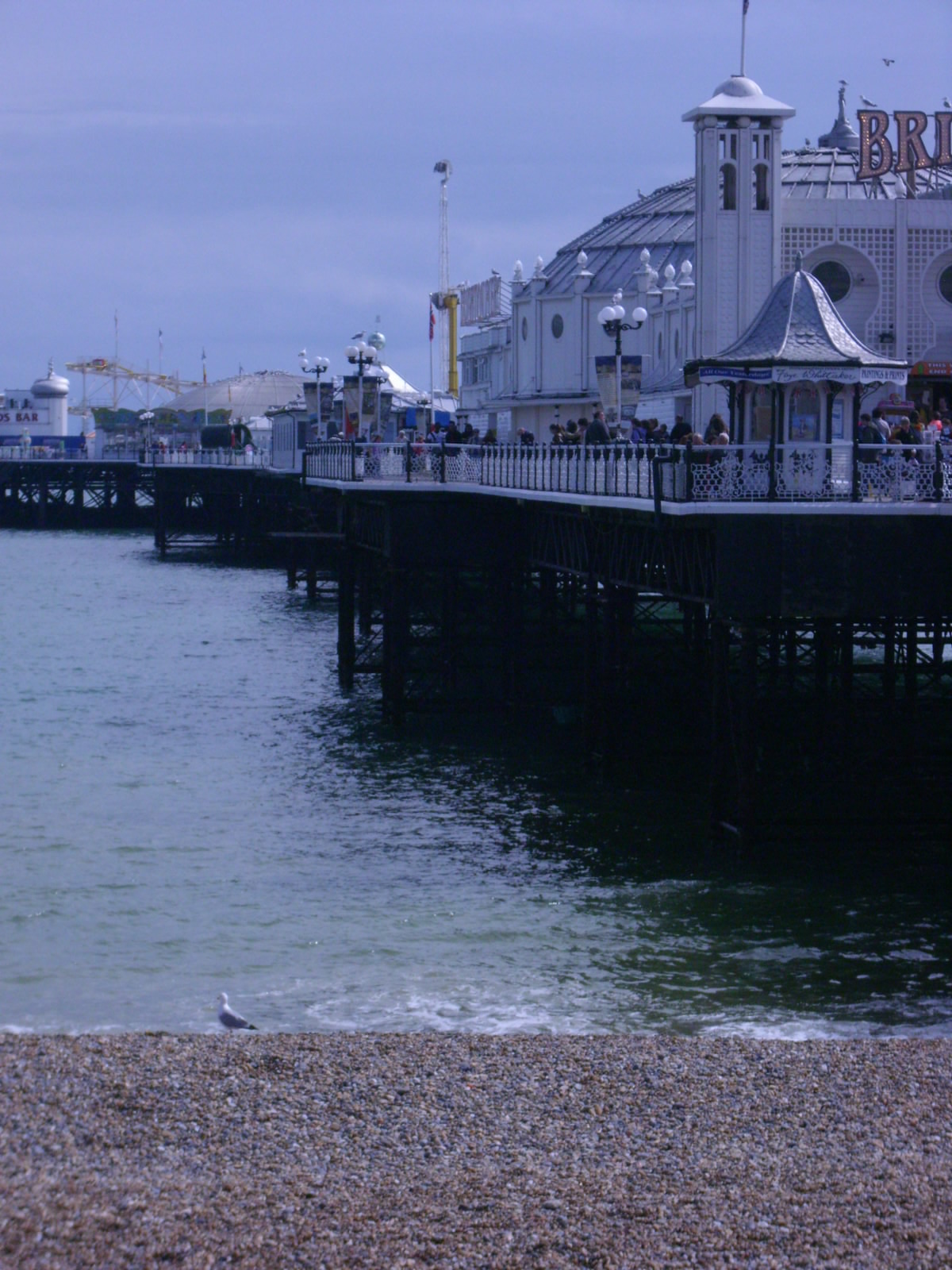 I had been thinking about architecture as a structure for my reflective book of it somehow – the idea of ‘housing’ the different stories told in the sessions somehow… and as I looked out to the pier over breakfast I really liked that structure – the somewhat fantastic structures you find on a pier of this sort, not unlike best practice in Higher Education, underpinned by a supporting structure. And then the conference started and I didn’t really have much time to think about anything much beyond what session to go to next (and at this event those were very difficult decisions). As I don’t have the time to get into the making of my reflective book just now, here a little write-up of the impressions of my very own conference experience…
We got started with a keynote by Dr Vicky Gunn, Director of Learning and Teaching Centre at the University of Glasgow, who talked about ‘Stories as re-membering: The tall tales we tell about teaching‘. It was a rich hour with lots to think about. What stuck with me most was the image of the emic mountain, and how you tend to think/reflect back on what you thought was going on, rather than on what was actually going on. What also got me thinking was the question whether we are using our teaching to produce gated communities rather than public squares, through the exclusivity of the ‘conversations’ we are having and are encouraging our students to have.
I then dove into a wildcard session led by Alex Moseley of the University of Leicester on ‘Who needs time and money? How to design cheap and effective traditional games‘ Here I found myself part of the Tibetan team in the World Speed Games Design Championship, using ten steps defining the Context, developing the Grand Design and then Refining the Design of a game that would allow students to build their vocabulary in a foreign language. It became a set of challenges on their (virtual) way to the Cannes Film Festival and involved zombies and meerkats at one point (don’t ask). We didn’t win (partly due to my absolute inabiblity to get us extra points by remembering the favourite games of the other members of my team), but we did learn how to create a learning game in ten steps – and as we only had 90 minutes it became clear that a game like this can be created in prototype fairly quickly. (For more information on creating low-cost games for learning see Whitton, N. and Moseley, A. (2012) Using Games to Enhance Learning and Teaching: A Beginner’s Guide. Routledge).
I spent my afternoon in the three hour session led by Nick Monk of the University of Warrick on ‘Learning from Narrative‘. This combined two activities, which we did in two groups of four. We started by going on a ‘long short walk’. The idea behind this is to slow down and notice things. So, we were required to take a walk that would usually take about 5 minutes and complete it in 20, while really noticing things. It is funny how you immediately pick up on things that your brain usually would filter out, for example the noise of the busy King’s Road, the pole with the odd looking construction, which might have been a camera – but also how there are things you on your own still don’t notice. I for example, didn’t see the Punch and Judy theatre/booth until Sharon pointed it out. They were gone when we went back. This activity reminded me of two things that have made an appearance on this blog before: the documentary drawing, as this is also about noticing things in a different way (and indeed, I tried to do my noticing here through drawing rather than writing), as well as the reflective walk. However, a link I hadn’t made that Nick pointed out once we were back in the room to discuss the experience was that he uses this to illustrate to his students the difference between reading and ‘close reading’ – because when you read for academic research purposes you are not just trying to get from A to B (so that you can say that you have read a particular text), you are trying to notice the nuances, pick up on the meaning, in short pay closer attention. I will definitely be trying that with my students next term! We then went into the second activity of the afternoon, ‘theory building’. Here we got a collection of materials – quotations and images that were all somewhat Brighton related – and were asked to use them to create out own narrative, possibly inspired by our experience of Brighton on our long short walk. After figuring out what everything was and possibly meant, it was really helpful to talk through different options, but in the end this came together in my group once we started to take away things. Our story became stronger once we removed items and only kept the ones that supported the story, rather than keep everything in. Again a very useful activity to do with students, showing the usefulness (and necessity) of developing a focus and editing the story you want to tell. Fascinating was that the other group had a very different approach and put together a small performance!
After this already very full day I felt conference fatigue setting in and decided to skip the next session, being ready for the poster reception afterwards. Here I particularly enjoyed Anna Lise Gordon’s ‘The mirror in the suitcase‘ on the importance of resilience for early career teachers. She uses creative writing methods to explore reflective practice, and I was particularly taken by the Haikus some of her research subjects had written.
We ended the day with the conference dinner, where I had some very interesting conversations about employability – and how that is such a difficult concept to define. Surely people realise that the employability skills you need depend on the job you want? There was also much talk about Skandinavian drama…
The second day started with Professor Hamish Fyfe, the director of the George Ewart Evans Centre for Storytelling. Another thought provoking keynote. What I particularly took away from it was that Stories are not true, but by being untrue they make you understand the truth (after Salman Rushdie). And I started to think about whether written stories are taken more seriously than told stories, and whether that is because stories are inherently personal and therefore seen as subjective (and qualitative), which in an academic community that is very much based on a scientific model might still be seen as inferior to the objectivity of numbers?
Afterwards there was Pat Francis’ and my workshop called Take a Little Button, where the 13 people brave enought to show up got to play around with buttons and consider different ways of using humble/ordinary objects such as buttons in their teaching to explore and explain academic practice. Pat particularly highlighted her work with fashion students on teasing out a context with a button as starting point and I talked about my way of likening buttons to quotations and handed out the newest in my series of tactile academia books, The Button Connection (will blog about this in more detail soon, I hope).


The feedback we got was very positive. People particularly liked how this way of ‘analogue’ working can support and complement the digital methods so much more common these days. There was also a particular sense that these strategies could help particularly when working with objects from an archive. And of course there was much admiration for the packs of random writing materials Pat had put together in preparation, a particular favourite in this workshop was the coffee filter – a great surface for writing on as unexpected things happen…
Here some of the feedback we collected (we want to make some sort of artefact out of it one of these days, so far these are the ‘raw materials’ we have to work with:


In the afternoon it was back to parallel sessions. I sat in on Olaojo Aiyegbayo’s talk ‘Metaphors we teach by: National Teaching Fellows’ metaphorical images of teaching in UK Universities‘, which identified how seasoned practitioners describe their teaching. One of the things that I am taking away from this was an image of a fish jumping out of the water, as Olaojo stated a fish isn’t aware of the water until her is out of it, just like metaphors are part of everyday life so that we need to work at them to become aware of the. It struck me that this might be a good way of visualising the ‘hidden’ academic practice I go on about – students can’t see a lot of it unless we take the jump and make it visible to them!
This session was followed by Amanda Couch talink about ‘A reflection on digestion: embodiment and the professional‘, which was interesting not just for the metaphor of digestion itself, but also for the links between the academic and personal, the bodily and the intellectual.
After a little break I found myself in the last parallel session of the day. Here I learned about ‘Academic staff perceptions of IT in the Humanities‘ by Pritpal Sembi of the University of Wolverhampton, reflecting on a work in progress that shows that it is not just the students who need to be considered individually when it comes to IT, but also the staff, who have their own hopes and fears when it comes to the introduction of new tools and systems. This was followed by an interdisciplinary (and interinstitutional) session on ‘Pioneers on the frontiers of learning?‘ by Rosemary Scott, Sarah Cousins and Dounia Bissar, that again talked about the personal approaches lecturers have to emerging and established digital technologies. This session finished with Zoe Johnson and Andrew Walsh from the University of Huddersfield talking about ‘Finding paths through the information forest‘. Important points made here was the difference between the information searches that you need to make when planning a holiday and the ones for academic research, and that there seem to be two main approaches subscribed to by lecturers: the ‘traditional’ approach of reading lists and letting students find familiar, ‘classic’ sources, and the more ‘practice as research’ approach of a more serendipidous exploration of sources that might come in useful and might challenge (established?) thinking.
By now I was absolutely exhausted and I almost didn’t make it to the closing keynote, but I am so glad I did (being fortified by two cups of tea). Nik Powell, director of the National Film and Television School, managed to pull off a very entertaining presentation, which reminded me that at the end of the day it is the story that is at the centre and that should determine the medium – something that needs to be kept in mind whether you are trying to make films or teach anybody anything!
While going through the latest Design Research Society newsletter, I came across these two conference that might be interesting to check out…
Cumulus Dublin 2013 – more for less – design in an age of austerity
November 7-9 2014, Dublin, Ireland
(but call for papers ends on 21st June… yes, slightly extended- phew)
11th International Conference of the Learning Sciences 2014 – Learning and Becoming in Practice
June 23-27 2014, Boulder, Colorado
Call for paper ends 8th November (…phew some more time for that one)
As already mentioned when blogging about the previous booklet, genre is a really important consideration when teaching writing. When putting together The Butterfly Challenge, half of it was trying to make readers aware that the different genre of writing follow different rules that a novice might not be aware of.
This was something that warranted further exploration, so the Northampton workshop looked into this in a bit more detail. And for that I was putting another book together, this time just concentrating on the consideration of genre.
The Dress-up Doll of Formality likens the choosing of appropriate communication channels to dressing for the occasion. Some occasions are very strict as to what outfit is appropriate, others not so much. Using a Gingerbreadperson as model, the book goes through suggestions of how particular genres of writing could be visualised as clothing, for example a business report could be seen as a three-piece suit: it should be formal, tailored to the business, there are certain elements that makes it complete (like a waistcoat and a briefcase completes the outfit, executive summary and appendices make the report).
The most important of these (from the perspective of my teaching) was the academic essay, that by students often seems to be seen as a prison uniform (complete with ball and chain), but really I think they should consider it more like an Elizabethan outfit – yes, it is a bit old-fashioned (conventions mostly are), but it has a lot of structure in it, as well as pleats and layers, just like a carefully crafted argument should.
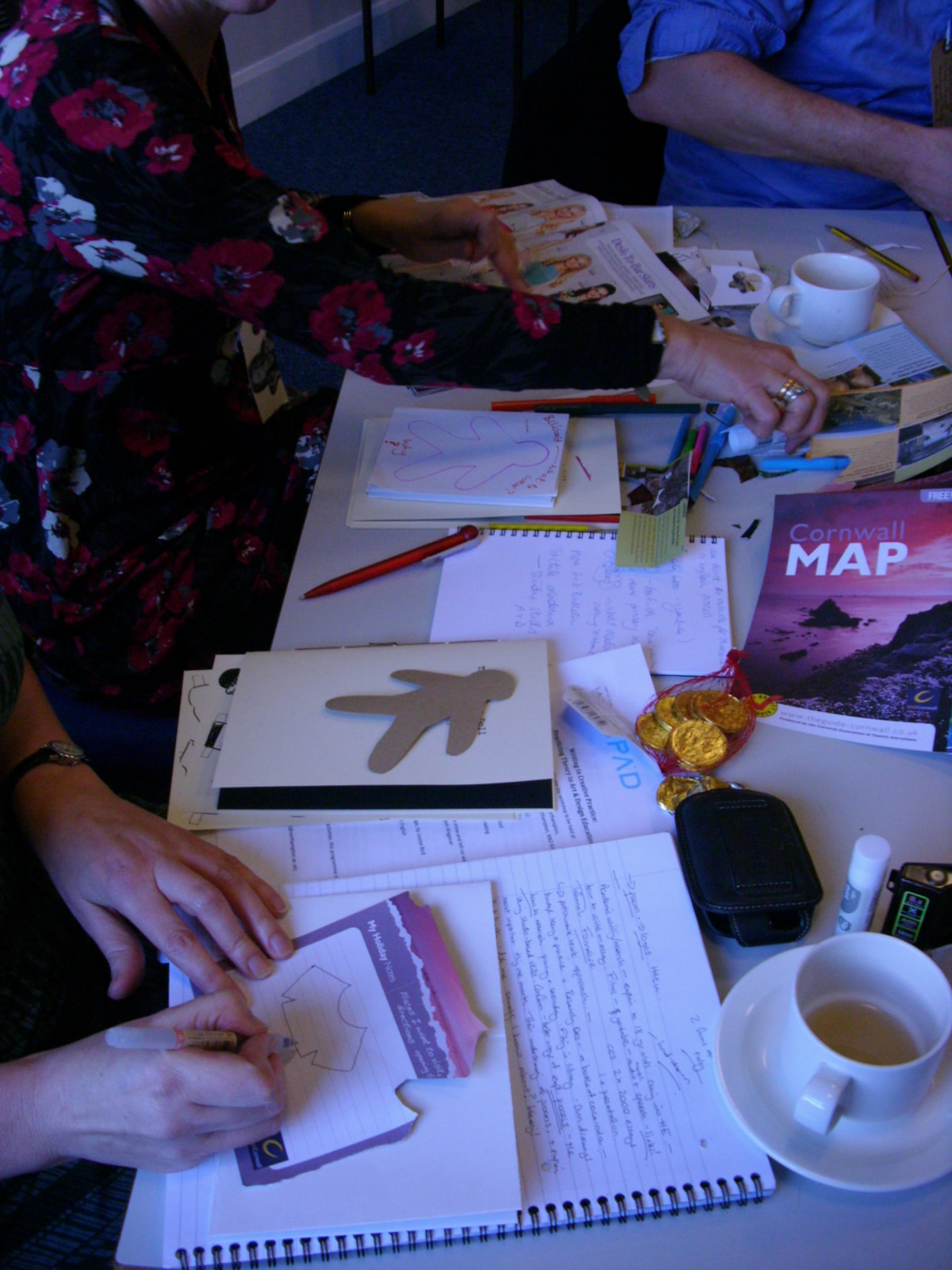 The teaching activity that goes with this is giving students a ‘model’ and asking them to draw genre out of a hat, and let them then design an outfit that would reflect that genre. here it is really useful to use a Gingerbreadperson as ‘model’, because if using a proper paper doll students can get sidetracked by trying to make their outfits beautiful. A Gingerbread-doll will always be funny, and that lets students focus on the idea rather than the design. of course the most important part of the activity is getting them to explain why they chose this particular outfit.
I have done this with the delegates at the Northampton workshop as well as with students and I think it is a really good way of getting them to think about different types of communication, which makes them think about the inherent rules each of these types gets constructed by – it helps them see the difference between an academic essay and the text for a website, for example.
I have also used this at a workshop where people were trying to figure out how they wanted to communicate to the world. Through the creative activity of putting together these outfits in small groups, they really started thinking about whether the traditional option they started out with was what they needed and wanted.
This booklet was produced in a preview edition of 31 given out at the workshop, including the paper doll and four A5 sheets that reproduced the outfits in the book as a starting point for making their own.
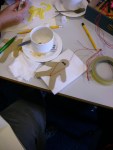
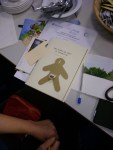
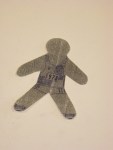
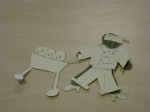
Here are some outfits which have so far been produced (can you spot the ones that are Tweets?)




Here something that found its way into my inbox… (Yes, I’m also speaking, please don’t let that turn you off…)
“Making the textual visual”: Engaging visual learners with text.
Thursday 4th July 2013
Kimberlin Library, De Montfort University
“Making the textual visual” offers Academics, Librarians and Learning Developers an opportunity to share experience and practice. A look at ways of enabling visual and kinaesthetic learners to transcend the text barrier; engaging with text driven disciplines and skills in a visual and tactile way. The day offers the chance to:
A day to consider the visual, kinaesthetic, multi-modal, reflective and more cerebral aspects of learning and engagement in a “freed up” expressive working space
This event is free of charge, refreshments and lunch are included.
Interested in attending ? Please book your place through this eventbrite link
Places are limited, a waiting list will be in operation.
Any queries , please contact Kaye Towlson (kbt@dmu.ac.uk). Please see Prog textual visual LLS logo for details of the full programme
 Tactile Academia