Archive

Tag Archives: writing-PAD

Here another event you might be interested in:

Screen Writes
A one-day symposium sponsored by LCC, HEA-ADM and the Writing PAD network.

Date: Friday, June 27, 2014
Start Time: 10.00 am
Location: London College of Communication Room T304 (Tower Block)

Background
The ‘Screen Writes’ Symposium to be held on 27 June at LCC will explore the purposes and practices of writing as practice for BA students engaged in visual communication, including graphic design, advertising and animation. The idea of a symposium has sprung from the new ‘writing and blogging’ course for Level 1 students at the London College of Communication (Mark Ingham, with Andrea Mason, Linda Stupart, Andrew Slatter and Harriet Edwards): this will be critically analysed. The emphasis more generally is on writing practices emergent from studio concerns in line with the ethos of the Writing PAD project and its subsequent network. There will be time to discuss and exchange across roles and institutions in this symposium.

The ‘Screen Writes’ symposium is intent on exploring a number of interconnected areas related to graduate attributes.  Firstly, the role of creative writings in relation to voice and identity through the daily and weekly practice of making the student’s writing public using online presences, in this case a practice/theory blog. This allows the students to see writing as going from being a fairly passive, summatively driven activity, to one that is in constant formation.

Secondly, it will explore the inherent mix that writing has with image and graphics in visual communication practices. This includes the surveying of tools and techniques employed when using online presences and how these can be used in such things as peer-to-peer learning. The idea that design and media students are writing with images will be analysed and challenged at this symposium. It will explore the possibilities of writing from images, writing with images, writing to images and writing against images. The beaten paths of these long and often debated relationships in academic writing will be taken off track to see if the cliches that surround these interactions in academia can be torn apart and reworked into more productive dynamic exchanges.

Thirdly, the potential of such practices to create a presence in social medias with a view to professional purposes, or how blogging, and indeed tweeting, can link the students to communities and prospective avenues beyond the university, will be scrutinised.  Students have been encouraged to think about their online presences in a number of ways. As a digital note book/sketchbook where ideas can be drafted, edited, reworked and published. It also made the students think about who they were writing for in a professional context.

Fourthly, the articulation of the place, and merit of such practices within the wider design curriculum will be discussed. This will be in relation to employers wanting to see, not only a finished portfolio website that is demanded by the profession and academia, but a blog type site that also show the thinking, mistakes and the processes through to the making of final works.

Programme

10.00  Coffee
10.30  Introduction to the day, Mark Ingham
11am   Writing as a creative activity for BA design (workshop,) Andrea Mason and Andrew Slatter
12.00  The pedagogy of creative writing in the context of design  (talk), Andrea Mason
12.30   Graphic design and writing, Andrew Slatter
1pm  Lunch
1.45  “eRTFs” (Enriched Text Formats) Online, continuous and present writing in Art and Design Contextual & Theoretical lessons, Mark Ingham
2.30 The Myth of Creativity: How ‘creative writing’ in arts and design courses fails as effective/affective to, Linda Stupart
3pm Tea break
3.30 Screens and writes: what kinds of intelligences? Harriet Edwards
4-5 Discussion and exchange in small group; final feedback

We have some space for participants outside LCC itself to write-up their own practice OR responses to the day, with images or as a visual essay for Writing PAD’s Journal of Writing in Creative Practice (Intellect).

Free but please book

Attendance is free of charge with preference being given to staff in HE institutions and FE colleges across the UK. Places will be allocated on a first come, first served basis. Lunch and refreshments will be provided, but travel expenses will not be covered. However, the HEA is currently running a funding scheme to support travel crossing national borders to attend events, which could be applied for independently. For more information visit the HEA UK Travel Fund.

We have 32 places available on this day.

To book a place, please email:

Dr Harriet Edwards
hedwards@csm.arts.ac.uk
(Journal Editor)

OR: Dr Mark Ingham
m.ingham@lcc.arts.ac.uk

On Thursday, 26th June 2014, the East Midlands Writing-PAD centre will be launched with a one day workshop titled ‘Journeys in Visual Learning’. This event will take place at Kimberlin Library, De Montford University in Leicester between 10.30 and 16.00.
For more information please email Christine Boulter (cmb[at]dmu.ac.uk)


East Midlands Writing PAD Centre launch: Journeys in visual learning
Thursday 26th June 2014
Kimberlin Library, De Montfort University, Leicester
Julia Reeve and Kaye Towlson

‘Journeys in visual learning’ offers Academics, Librarians and Learning Developers an opportunity to share experiences and practice in visual & kinaesthetic learning techniques. With the launch of our new East Midlands Writing PAD Centre we also seek to establish local & regional links with other HE institutions. The day will showcase creative and radical approaches to learning and teaching at DMU and elsewhere. Delegates will be encouraged through discussion and activities to reflect upon their own ‘visual learning journeys’ to the day and beyond.

The event offers the chance to:
• Experience visual and kinaesthetic learning techniques
• Hear about the student response and experience of such techniques
• Consider the theoretical underpinning to this type of learning
• Explore visual journeys in a number of contexts
• Take part in group work to encourage putting these methods into practice
• Network across disciplines, professions and institutions.

10:30 – 10:50: Registration and creative activity: Start the day with coffee and a look at displays of techniques plus resources

10:50 – 11:20: Creative activity: mapping your journey using a range of media

11:20-12:00: Our journey: Teacher Fellow research projects, Writing PAD and more: Kaye Towlson, Academic Librarian, DMU (Information Literacy) and Julia Reeve, Senior Lecturer, Contextual Studies for Fashion & East Midlands Writing PAD contact, DMU

12:00-12:40: Navigating the Essay: Making Writing Multi-sensory: Jackie Hatfield, Tina Horsman & Jacqueline Szumko, Specialist Tutors for Students with Specific Learning Differences, Loughborough University

12: 40-1:30: Lunch: in Learning Development Zone, Kimberlin

13:30 -14:10: Contextualised performance with collage: Simon Perril, Subject Leader for Creative Writing, DMU

14:30 – 15:00: Group work: your future visual learning journey – mapping practice, ideas, and experiences

15:00 – 15:20: Group visual learning journey tour and tea

15:20 – 15:45: Group feedback

15:45 – 16:00: Close

Interested? Please book your free place by e-mailing Christine Boulter cmb@dmu.ac.uk giving your name, job title and institution

If you require a parking space on the day, please book one through Christine Boulter (cmb@dmu.ac.uk). Please note parking is limited. DMU is a 10 minute walk from Leicester train station and approximately 15 minutes from Leicester bus station.

Here the details of a workshop some of you might be interested in:

Date: Friday, March 14, 2014, from 10 am to 5 pm

Where: Grove House on the main campus of Roehampton University, London

What: A HEA discipline workshop series focussing on MODULAR FORM: WRITING IN CREATIVE PRACTICE

Focus: ReWrite, the Centre for Research in Creative and Professional Writing at Roehampton University, in conjunction with Writing-PAD and partly funded by the HEA are delighted to hold a one-day symposium on the subject of “modular form.” We have invited practitioners from a diverse range of fields, including digital writing, performance art, curatorial studies, poetry, music, and psychoanalysis, to discuss the deployment of short and/or minimal units of text.

Who is it for and what will attendees get from the day: The event will be of interest to creative writers, post-graduate students, and academics in literary and art-based subjects, and it will provide a forum for the discussion of recent multi- and inter-disciplinary developments in creative writing practice and theory.

Programme: CONTRIBUTORS AND TEXTS (session times TBC)
•J.R. Carpenter, “Seven Short Talks About Islands …And By Islands I Mean Paragraphs.” J.R. Carpenter is a Canadian artist, writer, researcher, performer and maker of maps, zines, books, poetry, short fiction, long fiction, non-fiction, and non-linear, intertextual, hypermedia, and computer-generated narratives. She lives in South Devon, England. http://luckysoap.com<http://luckysoap.com/>
•Vincent Dachy, “Free Associations! Or Weaving with the Wind.” Vincent Dachy acts as the spokesperson of VDcollective (www.vdcollective.com<http://www.vdcollective.com/>), a front for Discreet Ventures in art DIY. He also practices and teaches Lacanian psychoanalysis in London.
•James Davies, “Minimalism and Modularity.” James Davies is the author of Plants (Reality Street) and, with Simon Taylor under the moniker Joy as Tiresome Vandalism, Absolute Elsewhere (The Knives Forks and Spoons Press). In 2008 he co-founded The Other Room poetry series in Manchester with Tom Jenks and Scott Thurston. Also in 2008, he set up his poetry press if p then q. He is currently studying for a PhD in Creative Writing at The University of Roehampton with a particular focus on minimalist poetry.
•Rupert Loydell and Kingsley Marshall, “CONTROL & SURRENDER. Eno Remixed: Collaboration & Oblique Strategies.” Rupert Loydell is Senior Lecturer in Creative Writing at Falmouth University. He is particularly interested in process and collaborative writing, and has several books of collaborative poems and poem-sequences in print, as well as volumes of his own solo writing such as his recent volume Wildlife (Shearsman, 2011), Encouraging Signs, a book of interviews and essays (Shearsman 2013) and Ballads of the Alone, a series of poem sequences about specific photographers, seeing, language and being. Kingsley Marshall is the Head of Film & Television at Falmouth University. His academic research primarily orientates around the use of sound (including music and effects) in film, and the cinematic representation of the real, including historical figures and events. He has contributed to two books that consider the representation of US presidents in cinema, both published by Palgrave Macmillan. As a musician, he has recently begun work on the sound design and score for a poetic documentary. Together with Rupert Loydell, he has recently written about collaboration, chance and the Oblique Strategies for Brian Eno: Oblique Music, due for publication through Continuum in 2014.
•Kaja Marczewska, “Modular form as a Curatorial Practice.” Kaja Marczewska is in the final stages of her PhD (hoping to submit in June 2014) at the Department of English at Durham University. Her research, and publications to date, focus on notions of authorship, originality and creativity as influenced by the contemporary digital culture and contemporary modes of information dissemination. Her work is situated at the intersection of cultural theory, avant-garde poetics and aesthetic, and intellectual property law.
•Nathan Walker, “Six Words Short: Textual Instruction Events.” Nathan Walker is an artist, curator and writer. His work and research investigates writing and speaking in performance. He is interested in digital, conceptual and durational writing practices. His artworks exist as live performances, bookworks, online projects, sound poetry and video. He has performed and exhibited nationally and internationally, and he is co-director of the performance art organisation OUI Performance.  He is currently Senior Lecturer in Performance at York St John University.

Booking Details: The symposium is free but places are limited, so please book early to avoid disappointment. The event includes a catered lunch. To book a place, please contact Julia Noyes julia.noyce@roehampton.ac.uk

Contact Details: Dr. Peter Jaeger, Director of ReWrite, the Centre for Research in Creative and Professional Writing
p.jaeger@roehampton.ac.uk

After our December workshops had gone down quite well, Falmouth University invited Pat and myself back to this time put together a whole day as part of the Writing in Creative Practice series – Making Writing.

We started off with making name tags in order to explore the materials available for reflective bookmaking – and I don’t think we ever had as many feathers to use before!

Pat then started us off with an extended Writing Warm-up, which we used to explore writing on different textures ending up with writing about both objects and photographs. Again, a very rich experience to loosen us up (we didn’t really need to warm up as the weather was absolutely fantastic!).

Nancy de Freitas then shared her expertise of coming to writing from a material studies background, talking about Writing and Materiality (Falmouth_workshop2) – starting us off with blue sky thinking, introducing the importance of having a working abstract when doing any sort of research project, the usefulness of questions to prompt where you are going, the utilisation of images in both abstract ‘writing’ and planning structure as well as the differences between personal and academic writing (yes, there should be one!).

What I particularly loved was her use of the image of a shed to illustrate what a working draft of a piece of writing is like – yes, it might feel cobbled together (and the shed on the image she showed us really was…), but the important thing is that it is holding together! in a way this is the point when writing goes from a solitary to a social activity – now you can show it to somebody else, because it has enough structure to make sense. And from now on it can be worked on, carefully turning the precarious shed into a house with foundations, a solid structure, a roof that doesn’t leak, maybe even a conservatory… No, she didn’t actually mention conservatories, that is just what I was thinking, she did however go on to talk about the importance of editing as a social practice, because writing should work for the ‘other person’ – the reader! (An important fact that my students often don’t seem to be aware of.)

Nancy also shared some interesting thoughts on active documentation, and how that can be used to get students to think about structure and editing.

After lunch Oliver West took over sharing with us his journey of how he developed the Footnotes project out of his own struggle with writing as a dyslexic student and then practcioner. This is based around taking notes on a simple folded grid – allowing visuals to be recorded, annotated and then reordered. And of course we got to have a go – and I saw Nancy’s shed make an appearance on not just my grid!

I ended the official program with a gallop through the visual anaolgies and metaphors I use in order to engage my students with writing and particularly academic practice. Using the ‘mini’ quilt’ developed for the recent School of Education conference as a starting point, I introduced the framing of Kolb’s Experiential Learning cycle and then really briefly talked about The Land- and Seascape of Creative Practice, The Butterfly Challenge, ways of using objects, reflective bookmaking and poetic inquiry, The Dress-up Doll of Formality, visualising introduction/main body and conclusion of an essay as stages in journy planning, The Fishscale of Academicness, The Button Connection and The Winning Hand of Independence. And while I am not convinced all of them made sense with only a few sentences to explain them, I believe the gist of it came across – and I had some interesting feedback at the end of the session.

We ended with a discussion round wondering whether approaches are different for practitioners and teachers, people who see themselves as more comfortable with words rather than images – and how we can make sure to cater for different learning styles of out students.

It was a fantastic day full of interesting sharing, and some fabulous reflective books were made that will hopefully inspire things to come – and I hope that we can do it again sometime. (And then we immediately did with a Writing Retreat the following two days, about which I will blog soon!)

I experienced the Making the Textual Visual workshop at De Montford University on the 4th July as a wonderful sharing of ideas and coming together of different disciplines.

image

my butterfly name tag

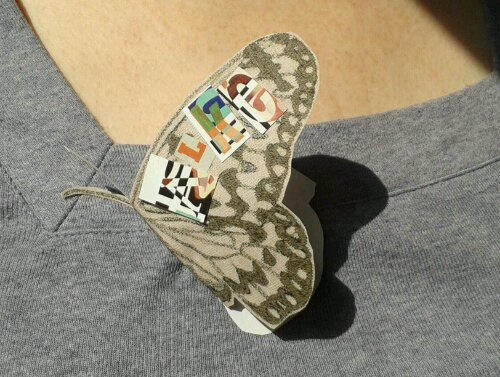
Julia and Kaye not only had put together some lovely bright green bags for us, but also collected a lot of interesting and stimulating materials for collaging and to begin with making name badges. I found a lovely image of an embroidered butterfly, which not only reminded me of the Butterfly Challenge analogy I use with my students, but also of the idea of the quilt that I want to properly tackle this summer, so obviously I had to use that as my name badge!


Julia and Kaye then started the day – and it was a very full house, I understand there was a very long waiting list of people who didn’t get in – talking about new ways of seeing and how they engage their students in contextual research as well as library skills. I particularly loved the new approach to re-framing, based on Pat Francis’ contextual circles idea this idea uses an image, like a postcard, in the middle of a poster (flipchart paper) and then gets students to work outwards filling ‘frames’ with answers to the W questions – what is is? who made it? where was it made? how was it made? etc. until they come to the all important why? and get to design a frame that surrounds their investigation. Julia described the success they have had with using this to get students from the descriptive to the analytical. Very inspirational indeed.

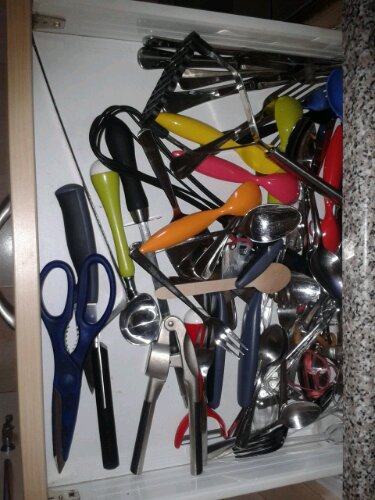
Lisa Clughen then talked about writing as a social act – how important the conversations are, within your writing, about your writing, because really they are conversations about your thinking! She also gave us some examples of how she uses visuals to illustrate writing ‘problems’ to her students. My favourite of these was using the image of a cutlery drawer to get students to think about structure – a cutlery drawer is at its most effective when there are clear spaces designated for the knives, forks and spoons, just like as writing makes the most sense when the ideas that are linked are presented together and not in a jumble. I love this really simple idea of visualising structure… especially because most if not all students will be familiar with the concept of a cuterly drawer and also the annoying thing that sometimes happens if utensils are added that are an odd shape – haven’t we all needed to wriggle the potato masher so that we could open the drawer again? Well, in a way a writing problem can be just like that, and sometimes it just needs a little bit attention (the wriggle) to get it to fit the overall structure, so that we can close the drawer smoothly again!

image

our group’s visualisation of the different levels of critical thinking in Jenny’s exercises

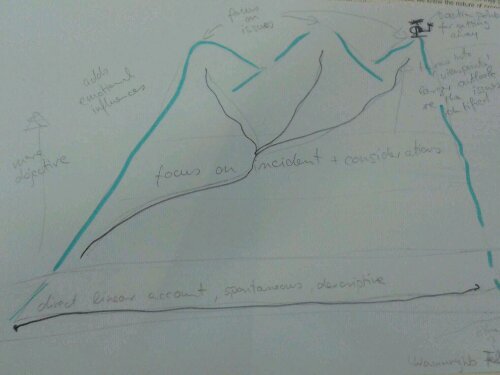
Jenny Moon then introduced one of her exercises to deepen critical thinking. We were transfered to a mountain walk through reading different forms of report about an incident, and had fun in group discussions figuring out how those reports differed, again reflecting on the descriptive to the analytical. Our table also started talking about mountains as a metaphor/analogy as a whole, and we ended up discussing Wainwright’s graphic descriptions of his walks, which seemed inevitable, but I wonder whether this happened at one of the other tables…

My own session was a brief talk about my use of post-its to organise reflection as a patchwork (as discussed on this blog under the ‘quilt’ tag). When agreeing to do this session I had hoped that this project would be much further along and that I could have brought a finished piece, but maybe the nature of it being in progress actually helped bring across the point… and a personal development mapping like this is, of course, never really finished. I was very aware that I hadn’t really looked at it for quite some time, and that it urgently needs updating before I continue working on it. However, it was nice to see how many of my dark green pieces, which I use to denote future plans, will need to be changed in colour, because I have achieved or at least further developed them! I got some great feedback and hope that I have inspired some of the attendees to start their own post-it patchwork as a tool for their personal reflection, maybe towards the HEA fellowship application. (And if you are one of these people, this blog wants to hear from you!) I will also try to write this up soon!

Through clever planning we then still had some time to do some making! So the tables made some posters using the strategies learned – and then shared what they thought had been most memorable. Here the collaging/reflective note-taking was mentioned a number of times and the (re)frames made a number of appearances, too.

Overall a very memorable and enjoyable day. Kaye and Julia have been talking about having more events, to which I can only say: yes, please!

image

help! this is my cutlery drawer at the moment… not much structure at all!

P.S. on a slightly worrying note I have taken a new look at my own cutlery drawer. On my list of things to do since I moved into my new flat (almost four years ago) was making a cutlery tidy out of old tea towels. Suffice to say this hasn’t happened yet… is this rather unstructured way of keeping my cutlery indicative of the chaos my research/life feels in at the moment?


Today’s Writing in Creative Practice workshop led by Nancy de Freitas was a masterclass in how to combine a lot of information with plenty of discussion and trying out, while still fostering a relaxing atmosphere. Honestly, the only person running around like mad and a bit frazzled was myself (but then I had to worry about the caterers – not that they didn’t do a fantastic job again!).

The idea was to this time focus on our own writing rather than our students’, and specifically on that mysterious beast: writing for publication.

People were so eager to get started that everybody was present fairly soon after we opened registration (i.e. when the coffee had arrived), so we for once had the time to go around the room and introduce ourselves and talk a little about why we were there.

Nancy then started us off with an introductory lecture that very clearly set out the process of writing for academic publication – the thinking processes that go into finding focus, the putting together of a (working) abstract, the writing itself, the editing process, the rewriting of the abstract this time for publication, the submission – and what happened afterwards, i.e. some stages of the review process. As editor of Studies in Material Thinking she was able to share some valuable insights from ‘the other side’ of the submission process (and I wish somebody had told me about all this when I was starting out in academia).

Our first little exercise used Rowena Murray’s Ten Prompts for planning a paper – and we all got some time to have a go, and then discuss the usefulness of having prompts like this. The following conversation showed that while not all questions were helpful in all contexts, the activity of sitting down and thinking with focus about the writing we were about to embark on was seen as helpful all round. Nancy also introduced us to Robert Brown’s Eight Questions and her own provocations, which include the requirement of putting forward not just writing, but also pictures. During our conversation we also found out that one of the group used a similar method for getting started in her writing – imagining she was going to the pub and having a conversation about her writing with somebody there (apparently this Pub Method is helped by actually going to the pub during a break in the writing…).

We talked about a number of ways to get started with writing and developing projects, my favourite probably the term of ‘Snack Writing’ – little writing tasks that are done regularly to put together a portfolio/file of little pieces of writing that can then help develop/be the starting point of something bigger. This could be reviews of own or other’s work or free-writing exercises, for example. I already do this with my students – setting them regular tasks to get them writing regularly – so now having a good term (Snack Writing) is great to get across to them that these tasks are meant to be non-threatening.

After a lovely buffet lunch, I did a session on thinking about different ways that writing can be published. I tied it into the Fishscale activity that I do with my students (and if you are a regular reader of this blog you will know what this is about, if you are not, search Fishscale as a Category) and shared my own experiences with a particularly frustrating article, where I made the (all too common) mistake of trying to adapt an article written for one journal and rejected for submission to another journal and ended up with what must have read as a confused mixture of data. (I now call this the Frankenfish phenomenon, after Frankenstein’s monster. Beware of the Frankenfish and always carefully tailor your writing to the journal you are submitting to!) I also made delegates design some fish representing the different ways of presenting work (hopefully I will be able to put some of them up on here soon).

Nancy took over again, and we talked some more about clarifying our practice – for example thinking about the concept, context, focus and methods of your research… and then swapping them around – what happens if you see your methods as your concept or your context as you focus? Again there was a great discussion with people starting to think about how to tailor the same research for different journals/audiences and possibly also how to mine a PhD for publications.

We ended by analysing two abstracts and discussing their strengths and weaknesses – and in extension talked about the review process a bit more. Nancy shared the form the review report at Studies in Material Thinking takes, which was again really useful.

Overall I found it to be an enjoyable and informative day – and can’t wait to do it all again, only with a bit more time, at the forthcoming Writing Retreat in Falmouth (there are still places left… sign up here!)

A special thank you to the Higher Education Academy and the Institue of Applied Creative Thinking (I-ACT) at Staffordshire University for funding this event!

The Writing in Creative Practice: Writing and the Object workshop was held at Middlesex University on 13 June 2013. It was a very full day – full with delegates, speakers and, above all, ideas. (You can find the official schedule here). Here are my initial impressions… (so far only my photos, more to follow soon)

Peter Thomas, who had organised the whole day on the Middlesex side, started us of with putting the day into a larger context, talking about the tension between the object representing tacit understanding and the writing, which records explicit knowledge. This is something that is very close to my understanding of the relationship between the word and object as well (as can be seen in The Land- and Seascape of Creative Practice), and I particularly liked Peter’s notion of the tension, which visually could also be read as interference in a way, which is somewhat ironic, because what the object particularly can give to writing is the focus and relevance that is so often lacking in student writing.

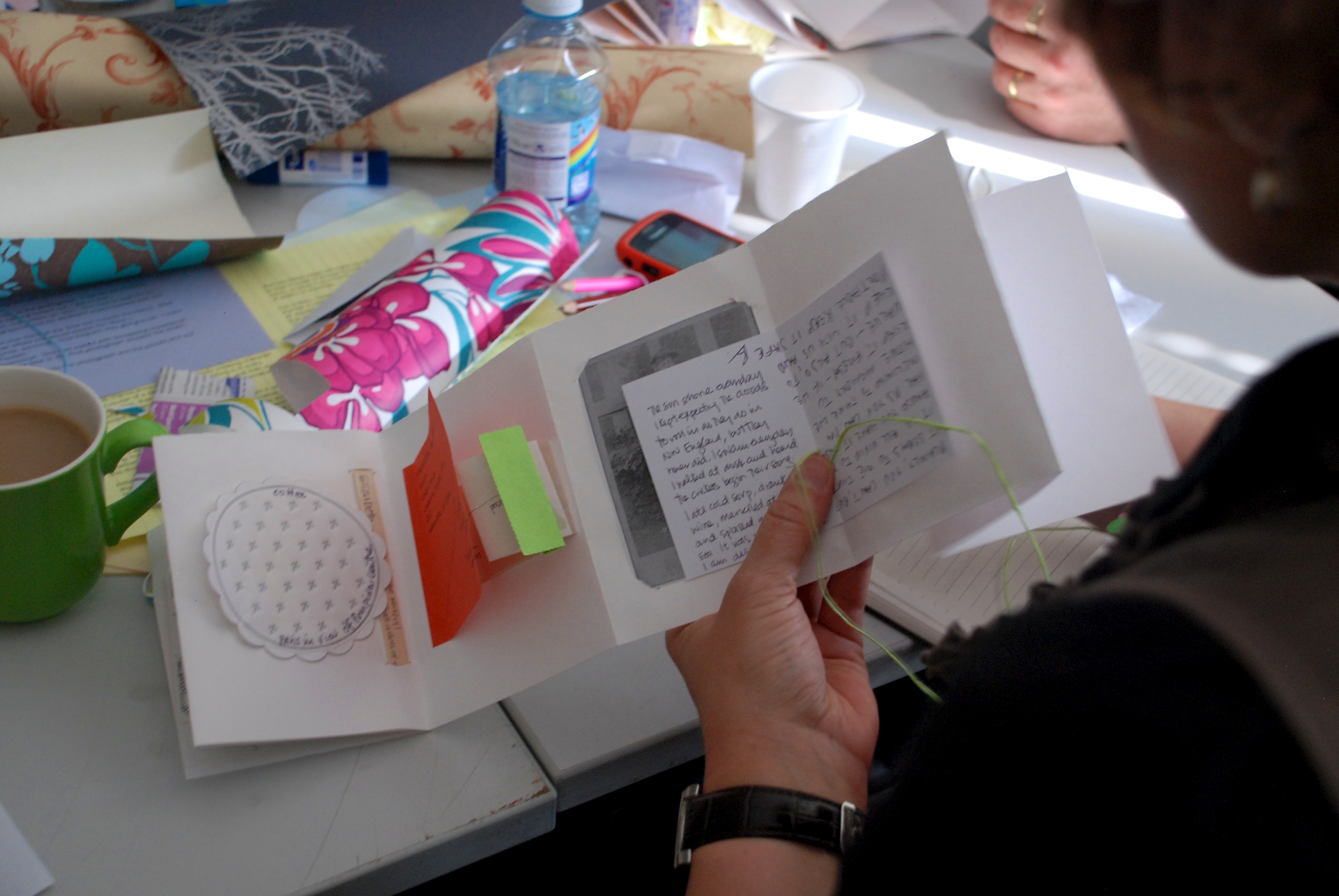
I then took over from Peter, introducing Sarah Williamson’s reflective book making activity (yes, by presenting everybody with a long paper strip, ready to be filled with collage/drawing or whatever else people felt like), giving a tiny little bit of background and particularly flagging up David Gauntlett’s notion of the ‘longer stretch of thoughtfulness’ (2010) that making brings. I then gave a brief overview of how I use objects in my teaching, particularly how interviewing an object can become a non-threatening precursor to an academic investigation (framed as an article) – because the genre of interview is less scary to students than the academic essay, because they are familiar with the former. I then put the two starting points – of using objects and making objects – together in the discussion of the 2D Challenge – making a sample copy of a magazine/newspaper based on the question ‘What would me work be like if it was a newspaper/magazine?’

Following this, Grace Lees-Maffei gave an overview of the different perspectives from which the relationship between words and objects are approached in Writing Design: Words and Objects, a book she has edited recently. What particularly stuck with me was the notion of triangulation – we need to approach objects from different angles, because really they “defy all attempts to define them in language”.  I was thinking how looking at objects can become a great illustration of the concept of triangulation within academic research through using different perspectives/shots of the same object (maybe a future tactile academia booklet?). I also liked her talking about omission, how it can be revealing to look for what is not written about.

Luke White talked about the sense in which objects can be seen (or can become?) ‘haunted’ after Derrida’s Hauntology, framed through his own encounter with Hirst’s shark. This really opened thoughts of the real and unreal – can we really attempt to talk about an object’s ‘truth’, or is what we are talking about ALWAYS an interpretation? Does objectivity exist at all, or is it always – or sometimes? – more akin to reflexivity? Does Design Writing take possession of the objects that are its subject?

Pauline Sumner took over and talked about her work in dyslexia support. She started with a brief overview of how dyslexia connects with related learning difficulties and some facts, for example that why it has been shown that 3D visual information processing skills are better in dyslexic men, this has not been found to be the case for women… I found particularly interesting the system she described of colour coding and chunking text – breaking up text that needs to be produced for a whole essay into manageable chunks and colour code them in a reverse traffic light system (the introduction in green, the main body in sections of various colours and the conclusion in red).

And this was all before lunch! Over lunch I had a really interesting discussion with some delegates about the use of the reflective bookmaking as note taking, which seemed to be a big hit. (In fact this came up a fair few times in the feedback: “Absolutely LOVED the new method of taking notes and found I was able to focus on my own responses to the presentations in an entirely new way.” “Lots of memory triggers now to reconnect me to my thoughts today and take back into my practice.” “Didn’t think collage and listening would be so compatible.”)

After lunch, Peter and Ossie Parker told us about their interventions on an animation course, where they use a generative writing cycle of free-writing, reviewing for pathways, freewriting on the pathways, reviewing for a short presentation to facilitate an inner dialogue in students, basically scaffolding the developing and editing of ideas in preparation for a 15 second stop-motion animation.

Then Tony Side told us about how a writing portfolio (also as a designed object reflecting the content) has replaced the traditional dissertation on an Interior Design/Architecture course – and how this is supported/scaffolded through writing workshops including object/image analysis and site-writing to name but a few.

The last session by Peter, Emma Dick, Richard Lumb and Marion Syratt Barnes started by letting us experience how they link objects from their collections (the Museum of Domestic Architecture and the Library Special Collections) to student research, exploration and writing. They refer to a method of material artefact analysis described by Valerie Steele in ‘A Museum of Fashion Is More Than A Clothes Bag’ (1998), which goes through the steps of Description, Deduction and Speculation. Again one of the threads running through this approach (as in the approach to the Animation Project mentioned above) was making it clear to the students that there is a space in the process of generating writing that is (and should be) private – when you are still figuring out what you want to say.

We ended the day with Stewart Martin responding to the themes and issues that had been raised. I particularly liked his thought that both creative practice and academic writing are (or should be?) about the creation of something new… a novel contribution. Questions that came out of the following discussion were: “Should writing be considered as an independent field?”, “should we throw out the notion of ‘academic writing’ and just focus on writing?” and the idea of the “artefact of text”.

While there may have not been any answers, I found it a very stimulating day that has given me a lot to think about.

We have been working hard on the programme for the workshop on July 2nd – here’s a preview: (There are still some places left, if you are interested, send an email to tactileacademia[at]gmail.com)

Programme

(as this is going to be a very hands-on workshop, this might change slightly)


10:00 Registration and Refreshments (Make your Own Nametag icebreaker)

10:30 Welcome

10:40 Writing Creative Practice / Material Thinking: towards academic publication.

            (Introductory lecture: Nancy de Freitas)

11:40 Small group work part 1 – see ‘what to expect’ below.

13:00 Lunch

14:00 Genre and Academic Writing

            (Alke Groppel-Wegener)

14:45 Small group work part 2 – see ‘what to expect’ below.

15:30 Refreshments

15:45 Reporting back – see ‘what to expect’ below.

16:30 Summarising – see ‘what to expect’ below.

17:00 end


What to expect


·         A lecture: to orient the session.


·         Handouts: will be circulated at the workshop.


·         Provocations: will be set for individual and small group work – tone of voice, audience, and shape.


·         Small group work part 1: writing plans – structure/schema; writing abstracts with clarity and keywords.


·         Small group work part 2: clarity of concept; image text intersections; concluding and making sense; fearless editing.


·         Collegial critique: for personal growth and improvement.


·         Role models: finding one.


·         Reviewer perspective: sitting on the other side.


·         Reporting back: group plenary discussion for sharing insights.


·         Summarising: feedback session to take stock of what we need to do better.


What to bring


1.             Bring your own laptop or iPad, etc. if possible.


2.             Bring one of the following:


·         An example of recent writing

·         A full draft of a research paper in progress

·         One completed draft of a previously published paper

·         A title/idea for a new piece of research writing – a potential paper you are thinking about.


Hope to see you there!

dsc_ 78On 2nd July 2013, Staffordshire University will be hosting another one-day workshop in the Writing in Creative Practice series. Since starting this series, which developed out of the work of the Writing-PAD network and has been supported by the Higher Education Academy, we have mostly shared best practice and allowed some space for exploration to link to engaging our students in writing for Higher Education in the creative disciplines. To find out more about what we have been doing, explore this blog, particularly the ‘workshop’ category.

This up-coming workshop will focus not on students’ but on our writing, and how we can turn it into writing for academic publication. Therefore it is aimed at members of staff who want to publish in this very specific context for the first time (or just more); it would also be suitable for post-graduate students within art, media and design.

dsc_ 309Nancy de Freitas, Associate Professor at AUT University, New Zealand and Editor-In-Chief of Studies in Material Thinking, will share her expertise of writing in the context of material thinking practices, introducing workshop participants to methods and insights on good structure, clear writing and elegant style when talking about research, processes, images, objects and spaces. There might also be the opportunity to discuss the genre of academic writing – and review this as currency within the creative, studio-based disciplines. This day is meant as a day of starting points, sharing tips to get (academic) writing projects on the go. It would be helpful if participants come with a particular writing project in mind.

The attendance of this workshop is free of charge to all those interested in the workshop topic, with preference being given to staff working in HE institutions and HE in FE colleges from across the UK. Places will be allocated on a first come, first served basis. Lunch and refreshments will be provided, but travel expenses will not be covered.

For more information or to book a place, please get in touch with Alke Groppel-Wegener (tactileacademia[at]gmail.com).

And, if you are interested in following this up with a more immersive experience where you can actually get some writing done, check out the related Pedare Weekend Writing Retreat  at Falmouth University.