Archive

Author Archives: alkegw

As you will know if you are following this blog, last year I put together my own version of a guide to writing research essays (see Writing by Pictures), which I am currently revising for a proper release. Caught up in the excitement of this project, I don’t think I have ever really talked about WHY I thought it was important to do so. Yes, I wanted to collect the analogies and activities I do with my students in one place, but in a way this came out of a much larger context, which I am trying to tackle at the moment. I recently presented my initial thoughts at the Popular Culture Association/American Culture Association conference as well as the Writing PAD East Midlands Forum and thought I would sketch it out here, too, in case you are interested, but couldn’t make it to either of these meet-ups.

In my work my main challenge is to engage art and design students with academic research and writing. We are using a Writing in the Disciplines Approach, so these students are not doing something like Composition 101 with other subjects, as they might be doing as part of a liberal arts college in the US, for example, but rather they are in the cohorts that they spend most of their time with, which are very subject focused. I have some sessions with them in their first year (most of them in the first term), and I believe I give them the skills to research and write a pretty decent basic essay. Most of these students, however, I don’t see again after these encounters – other colleagues are taking over their contextual studies education. One class, however, I do see again in the second and also in their third (and final) year, and I noticed that they urgently need a refresher in all these skills. Of course the main issue here might be that they don’t have to write enough research papers to internalise these skills as part of an academic practice, but that is probably a different discussion (and also something that ultimately I probably won’t be able to change…). Anyway, so I was wondering whether there is an appropriate resource out there to teach or remind them of how to write an essay. And there are some very good books on this, but I could only find TEXTbooks, in the sense that they are predominantly made up of text. Occasionally you’ll find the odd diagram or cartoon, but most of them are very much text based.

This got me thinking about the textbook as a genre, and I came up with three pillars upon which the development of the textbooks that we know, use and, yes, also write are based on:

  • An assumption that knowledge can (and needs to be) expressed in words (both spoken or written, but really better written) in order to be counted as ‘proper’ academic knowledge.
  • The transmission model of education, which assumes that there is fixed knowledge that needs to be transmitted to the students, filling them up with it.
  • And, maybe slightly overlooked in academic discussions on learning strategies and resources, the simple fact that when the textbook genre developed, printing technology had become very good at printing words (removable type and all that), but until fairly recently was very expensive when it came to reproducing quality images in large numbers.

Since this happened, however, a lot of development has taken place that has challenged all this. I would argue that while writing is still seen as a very good way to share insight, it is not considered the only way to develop your thinking. There has, for example, been a noted rise in the popularity of taking notes in non-written ways, which has come to the fore recently particularly through very popular publications in the business/management sector. Dan Roam argues in his Back of the Napkin series (my favourite is Blah Blah Blah, 2011) that words don’t work in some contexts, that drawing doesn’t mean you are ‘dumb’ but rather that we need ‘vivid‘ thinking, the visual and verbal working interdependently (Roam, 2011). Sunni Brown makes very similar points in her book The Doodle Revolution (2014), where she questions the usefulness of copiously written notes, that don’t really question the noted or put it into a personal context. Mike Rohde has developed the same problem into ‘sketchnoting’, which he states developed out of frustration with purely written notes (2013). Now, none of these people write for an academic context, but the success of their publications makes clear that the way to develop your thinking (which I would argue is actually quite crucial in an academic context) goes beyond the written word. While these books aren’t academic textbooks, they challenge the ‘three pillars of the textbook genre’, however, they are still pretty close to the familiar format of lots of text.

So I was wondering, are there any examples out there that go beyond this and that are aimed at an academic audience?
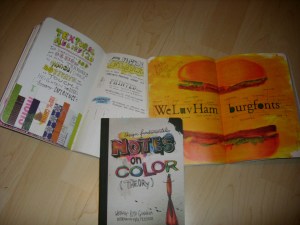
Design Fundamentals by Gonnella, et al

Design Fundamentals

Rose Gonnella, Christopher J Navetta and (illustrator) Max Friedman have put together a series of books on Design Fundamentals (2013, 2014, 2015), and I would say that the contents of these books are very close to textbooks, but the presentation is very colourful and visual. The idea behind these books is that these are the notes your friend might give you if you have missed class. They include summaries and exercises of sessions, seemingly taped in, as well as the most important facts of the subject matter at hand.

The Good, the Bad and the Data

The Good, the Bad and the Data

The Good, the Bad and the Data (2013) is the second of Sally Campbell Galman’s Shane the Lone Ethnographer’s Guides. These are set out like comic books, with very simple black and white line drawings. They use the narrative device of Shane, the heroine, becoming the clueless student, asking all the questions we might ask about ethnography, and allowing us to go on a journey of learning with her.

Syllabus

Syllabus

Syllabus, Notes from an Accidental Professor (2014), by Linda Barry also has traces of a comic book in it, but then it is about a class for comic book students written and drawn by a comic book artist. This book has a very eclectic feel, simulating a yellow paper composition book popular in the US, and consisting of seemingly collaged together notes Barry made throughout her first few years of teaching a new course.

Unflattening

Unflattening

Unflattening (2015) is Nick Sousanis’ PhD thesis that was conceived in form of a graphic novel. It is a fascinating document that is a commentary on current educational practices, using the format of the graphic novel to make some very complex points in an incredibly elegant way.

While they are very different, and all of them have advantages and disadvantages, I think these four examples demonstrate that it is possible to redraw the textbook. While they all include linguistic knowledge, this is complemented – not just illustrated – by images more akin to a symbiosis. They are more inclusive in that they cast the reader in a role that makes you work for it – these are texts that need to be actively read in order to make sense of them, thus transcending the transmission model of education. They also use the current possibilities in printing, until quite recently none of them would have been able to be produced to this quality for a mass market.

A similar treatment might not be suitable for every subject discipline, but these examples show a way to open up the genre of the academic textbook and encourage us to redraw its rigid templates in order to allow our students to learn more effectively.

Do you know of any examples that should be included here?
Yesterday I went on a little daytrip up to Glasgow. This was a fairly short notice affair after I had spotted a seminar intriguingly titled ‘Troubling the Academic Thesis – An Artist Teacher Public Seminar’ via Twitter. It promised the perspectives of Dr Chris Dooks, whose doctoral work included sound presented on three vinyl records, including sleeve notes with an essay on one side and story-board like image sequences on the other – find out more at his Idioholism website -, and Dr Nick Sousanis, whose thesis was developed and presented as the comic book/graphic novel Unflattening (Nick skyped in from Calgary). It was a really interesting conversation organised by colleagues from the University of the West of Scotland, which provided a lot of food for thought.

Maybe my favourite bit was a quote that Chris shared with us from Knowledge in Policy, a book by Richard Freeman and Steve Sturdy. In the Introduction they write:

Drawing a simple analogy with the three phases of matter – solid, liquid and gas, we argue that knowledge too exists in three phases, which we charaterise as embodied, inscribed and enacted. Furthermore, just as matter may pass from one phase to another, so too can knowledge be transfromed, through various kinds of action, between phases. (Freemand and Sturdy, 2014: 1)

This is surely to become one of the quotes I use all the time when talking about my teaching practice and Tactile Academia. I don’t know whether I agree with the three phases of knowledge they point out (I’m planning to read the book soon to find out), but what I really like about it is that it emphasises the idea, no the necessity, of transformation within knowledge and knowledge making. This is something that came up over the course of the seminar again and again (or maybe it is just something that I picked up on particularly because for me another PhD was in the mix, I am currently reading Stephanie Black’s PhD thesis on Illustration as a form of practice-led research, which highlights similar issues).

So, there is the process of doing research (in this case doctoral study of some kind), and then there is the finished product that is presented. Within the creative practices there is an ongoing discussion as to whether the academically written thesis should be a required product. I think there is a lot of insecurity about writing in particularly and there seem to be some insecurities as to whether one is (or maybe even we all are) ‘good’ enough to claim our place in the academy (whatever that might be). Very often it seems to me that writing in this case is cast as the obstacle – and usually here writing seems to mean putting together an academically written exegesis, ignoring the potential of writing as a process.

This made me think back to my own PhD thesis, which was a straight academic thesis based on some action research done through teaching, so one could argue it was practice-based, but you couldn’t really call it based on creative practice. One of the things this explored was the importance of writing for designers (and design students). While I was writing this I was concerned by a movement that seemed to try to almost get rid of writing within art and design disciplines, putting forward the photo essay and dissertation. I was concerned by this because the process of writing is incredibly useful in order to develop your thinking – as is the process of sketching (as Nick showed by sharing some of the development work of his comic not just with us at the seminar, but also in the notes/appendix section in the published book) and making other work (as Chris talked about). At one point Chris stated that a lot of the words that he wrote didn’t make it into his thesis (he decided to write a thesis to go alongside the work). I was thinking: “well, of course not!” I bet not all of the things he produced as part of his practical exploration made it onto his LPs either. This is the process, the knowledge going through the different phases – only a fraction ends up in the product to be presented. I’m a big fan of the concept of regenring (as explored by Dr Fiona English and mentioned elsewhere on this blog), and I think that works so successfully because it changes the phases of knowledge – but also because it is a process that generates more work, work that will not necessarily end up in a final piece.

So maybe the problem here is this weird ambiguity that seems part and parcel of traditional (Western?) educational systems: there is the learning that is all about the process on the one hand and then there is the ‘thing’ that gets presented and evaluated. At times these seem so apart that they could almost be called a dichotomy. Which is tragic, really.

So maybe we should try to put the process of research first and the ‘product’ (i.e. the physical outcome) last. Because the latter should develop out of the former. Don’t worry about finding an innovative or alternative way of presenting your research, find the most appropriate way of presenting the outcomes of your research. That might be through academic writing, or it might be something else. But on the way there, explore the different phases of knowledge (and here writing can be your friend!) and then see in what phase it seems to want to stay. I would argue that is what both Chris and Nick did.

It is February, 2nd and everybody seems to be talking about Groundhog Day (the film).  In fact, I pretty much started my day What’s App-ing my sisters (who live in Germany and Italy) that one of the Sky channels is showing it today back-to-back for 24 hours, which I think is hilarious. But while reading the connected article in The Independent online, I was thinking that while this is funny, there was an opportunity missed, because although the sections here occasionally change a tiny bit, they don’t quite change enough. The great thing about the film is that at the end (spoiler alert), Phil gets his day just right!

Really if seen in an academic context, Groundhog Day is an analogy of editing: Just like Phil is trapped in this day, when writing a paper/chapter/book/whatever, a writer can easily get into a routine where you change small things – or big things – see how they pan out, and if they don’t quite work, you go back to the beginning. You reflect on what worked out in your last draft and what didn’t quite work, and you change it. Sometimes you refine details, sometimes you change the big stuff. Sometimes you change it back, sometimes you decide that a totally new direction is needed. And only once everything is in place you can finally move on to the next piece, just like Phil finally moved on to February, 3rd. Unfortunately, though, is that even if it feels like you are stuck in a timeloop while editing your own writing, time goes on around you and you might get to your deadline before you are ready to move on. I can only assume this happens because we don’t actually live in movies…

Last week I met up with some colleagues in Leicester to catch up and make some plans for the future. Check out the blog post that Julia posted about our get-together here – I was mainly excited about showing off my academic quilt 😉

I came back re-energised and with two main areas to develop for 2016: the academic poster as a genre and supporting post-graduate researchers in their writing. I’ll keep you posted!

A bit more than a week ago I found myself at a conference as an observer, rather than as a presenter, a luxury which hadn’t happened for a long time. I will write a bit more about the actual themes of the conference in a later post (I haven’t had time to properly digest all of it), but wanted to share something that I have been playing with a bit, and that I decided to test over the two-and-a-bit days of this particular conference: ‘sketchnoting’

The subject of two of Mike Rohde’s books, The Sketchnote Handbook and The Sketchnote Workbook, this is a term he coined for visual note taking, really a combination of note taking and sketches, or maybe better for the use of sketches to augment note taking.

I am a big fan of taking ‘notes’ through collage (something I was introduced to by my friend and colleague Sarah Williamson currently at the University of Huddersfield, and we have tested this out and published on it here), but that is not always possible or appropriate. So trying out drawing as part of the note-taking process seemed a good next step (or maybe a good compromise).

I had read through (not worked through) both of Rohde’s sketchnoting books within the last month, so I felt quite happy to just give it a go – making use of the paper pad and biro that were in my conference pack. And I have to say that I really loved it! It allowed me to take notes I am excited to review (plus two people at the conference mentioned to me how much they loved my notes when looking over my shoulder). I have already made another pass at them by adding some more colour – a good way of reflecting on the conference, and I do want to put together a retrospective drawing/document that summarises the themes that have come up for me at the conference.

Of course there are some things this does not immediately afford: taking notes at a live conference you don’t necessarily know where the talks are going and you might commit to imagery that at the end makes less sense – or you might not know how much space to allocate. but I found it was a great way to keep my mind (and hands) engaged, even in talks I wasn’t that interested in.

When comparing it to the collaging process, I don’t think it has quite the same potential to encourage reflection and discovery. The exciting thing about using collage is that the found materials you collage with provide an extra layer that your subconscious can latch onto and that allows you to develop your own thoughts on the material – or just with the material as a starting point. But that isn’t necessarily a bad thing, I think one of my reservations of encouraging students (particularly the ones who have just started their university career) to use collage is that it can take them very far away from the subject, using the sketchnoting technique on the other hand, might be just what they need to keep them engaged in the lectures, to encourage them to take their own notes – and then review them in preparation of the next session.

…yes, I realise that it is slightly ironic to publish this without images… I will once I have the time to take some of my sketchnotes :-)…

Here a guest post from Justine Thomas on how she teaches English as a second language:

Teaching English as a second language to people from different countries via Skype is a lot of fun and seeing that your students understand and work at lessons is a real pleasure. Your students will like you and everything you say will catch their attention, simply because you are so alien (hence, interesting) to them. Speaking about teaching on Skype, I would like to mention its advantages over teaching in-class: since you’re not a school teacher to discipline students, you will never be hated, which is a great help for building a good rapport. Also, as a Skype tutor, you’ll plan all the lessons and activities yourself and you will be free to change the strategy or a program due to the student’s needs. However, there are certain pitfalls that might trap both beginner and experienced teachers – there is no guarantee for the smooth connection, excellent understanding (especially if you do not know student’s native language) and other thing like this. And if with the technical aspects you can deal simply by setting your computers properly, I would like to talk more about the issues, which cannot be “fixed” in a couple of minutes.

1. Understanding.
The most important thing, let’s say, a corner stone in the building a communication with your students will be your advertency and openness to intercultural dialogue. You should keep in mind that different cultures approach to teacher-student relations in a different ways, for example, if in the Western countries a teacher and a student are partners of the educational process, in Eastern Asian countries they would never be equalized. Teaching language to foreigners is inseparably connected with culture and social aspects, so you should pay utmost attention to the student’s background. When I taught English to girls from Spain, I realized it is totally okay for them to treat a teacher as their senior friend; I was rather a mentor than an actual teacher, we played together and chatted about all the stuff the girls could chat about. The point is that to a Western non-native speaker of English a second language can become a convenient extension with a very little cultural interference because of many similarities. To Asian students, English as a second language will bring not only new speaking patterns, but also a huge cultural layer, including body language and gestures. For example, showing a “thumbs up” and “thumbs down” in front of Japanese class may cause a tear burst, because a “thumb down” is considered as an extremely rude and accusing gesture. Thus at the ESL classes, a teacher should give more thought to how these subtle signs are used so that the learner enhances the skills without being overwhelmed or offended.
And this gradually flows into….

2. Behavior
In a class, foreign students usually show special obedience and politeness, they always try to do their homework and rarely disturb other classmates or ask questions. However, during the Skype lessons (both individual and group) it could become a real trouble, because you are limited in the means of communication and time and need a direct response. In some cultures (for example, Japanese), an outgoing participation in the class activities is a form of “boasting” and might be really embarrassing for them. They believe their job is to memorize the things the teacher says and they simply repeat that when needed, but repeating English and speaking English are totally different things. Of course, paying special attention and encouraging students to participate more freely is a good idea, but yet might not be efficient enough due to the lack of time. At my Skype lessons with Japanese students I found that drawing and co-working through Google Documents is a better option. You see the progress of all of your students and do not have to point the most shy kids out. Besides, creating common mind-maps has been proven as a great method for visualizing. Aside of social behavior, you as a Skype teacher, should pay attention to the linguistic peculiarities of your students.

3. Speaking and Spelling
The first step in teaching foreign students correct pronunciation is to help them realize that English has different sounds than their native language, even if some sound similar. Most students simply substitute “hard” English sounds with close of their language. You should help them understand that there is a difference and incorrect producing of the sound could change the meaning of words. A good way for you would be to learn at least basic patterns of your student’s language to get the image of the language and be able to point on the differences. Aside the recorded audios and pronunciation exercises, an effective tool to teach spelling to students has always been flashcards. However, you will have to adapt this to your Skype lessons. I suggested my students to work on the flashcards together – we cut out the shapes and then painted them, naming colors and patterns. Hence, we not only prepared our tools, but also learned new vocabulary. Another convenient activity may be a “stripped essays”. You send a mixed text to your student and ask to cut that in lines, which, in future, should build up a logical story. This is a simple and quite popular exercise, and performed in the “offline” way it will add more “reality” to your virtual lessons. Teaching students on-site includes personal contact, such as shaking hands or winking or smiling and other small gestures. In online communication this part falls out, so it should be substituted with at least named “kinesthetic” activities.

Justine Thomas is an ESL tutor, passionate about creative teaching and psychology. Her hobby is everything connected with language and writing. Justine is a contributing blogger to Edubirdie.com.

Marion, one of the lovely participants in our first Thoughtbites workshop sends this account:
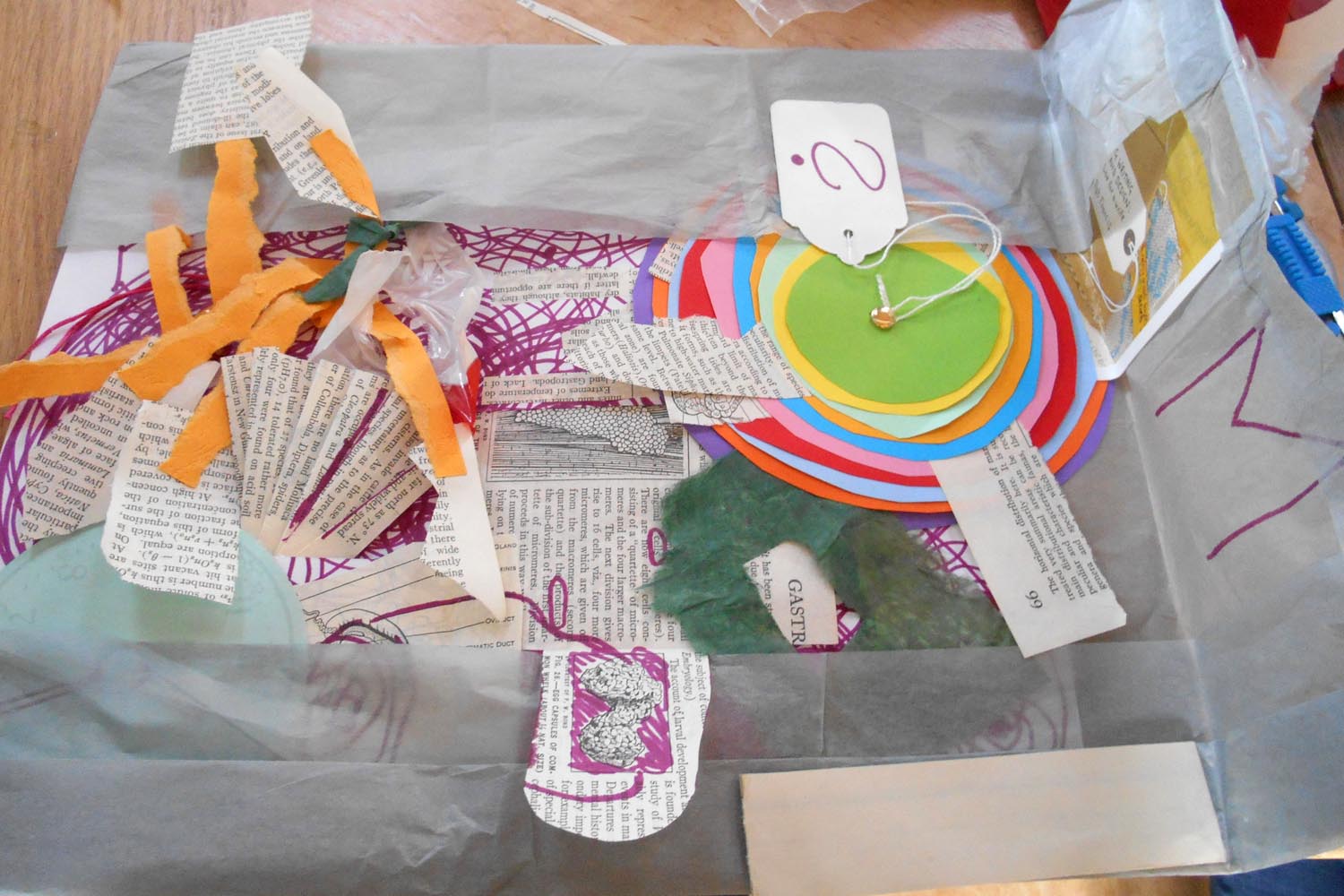
I took part in the ‘thoughtbites‘ workshop looking at ‘folds and layers’ as a method for visual-tactile note taking.

I myself have always found it very difficult to keep any notebook in a state that I appreciated it after its use or that I wanted to return to it and remind myself of what I had written.

Working with my hands and materials whilst listening I found myself beginning to relax and filter information based on what seemed important at the time. Although I felt I had hardly listened consciously, certain information became very dominant and stuck with me afterwards.

Engaging with the materials I noticed that I had used them in various ways that began to make sense to me and that I could see certain methods that I could use in the future and which also could be shared with others as a form of template.

Examples were the use of dials and circles (e.g. priorising information, looking at the ‘central’ question), icons that could serve to highlight specific information and covering/uncovering information through material layers as a way of discerning information.

Collage Workshop VMC 2015 from Marion

In my own research I have come across the functions of the right and left hemisphere of the brain which opens up an interesting perspective on memory retention through visual-tactile means and the workshop has inspired me to include these methods in the future.

In mid September, Susan and I met up at the 4th International Visual Methods Conference in Brighton to fly the flag for thinking-through-making-and-doing. While we had originally proposed a panel, we ended up running two workshops titled “Thoughtbites: Transdisciplinary cuts, folds and collage in thought and practice”. As part of that we had been commissioned by the conference organisers to author and print a little booklet that most attendees got in their conference bag (not all of them as the conference ended up over subscribed so we hadn’t printed enough).

Titled Thoughtbites – Cuts and Folds in Thought and Practice, this booklet used the work of notable philosophers as starting points for reflection and very basic activities – so people were able (and meant) to customise their own copies, and in the two workshops we used the same starting points to make, reflect on the conference so far and just provide some space for thoughts.

The first workshop used the pop-up facilitated by cuts and folds  to transform the usually flat surface to a three dimensional structure, complete with little windows to glimpse through. We were inspired here by Rene Descartes’ notion of the material world and its non material counterpart, the subjective and objective, abstract and material, mind and body. We also explored layers, inspired by Edmund Husserl, thinking about layers of meaning and how they reveal and conceal, sparking new trains of thought.


The second workshop explored the idea of tracing – and Gilles Deleuze’s suggestion that we should focus on the differences of tracings, the intentional and unintentional losses and gains, in order to reveal meaning. We also looked at Jacques Derrida and the fold as well as the moebius strip – is it possible to determine one side from the other? Does it matter?

Looking back what was most interesting was the way discussion unfolded. While some people came to both sessions, mainly people attended just one. But what was really different was the set up. The first session was done in the ‘Waste House’, a workshop space constructed pretty much entirely from recycled materials. Here we had one huge table, which resulted in everybody sharing materials with each other and a very informal conversation that included everybody throughout the 90 minutes. The second session was in a more traditional seminar room, where we had set up a number of smaller group tables. And while people were talking at their tables, the atmosphere was markedly different (though not necessarily in a bad way).

Overall it was a nice few days, with maybe some people encouraged to make some more time and space to reflecting through enjoying the process of making.

(sorry for the delay in posting this, freshers flu and start-of-term workload made it hard to blog immediately)

In my teaching, I often talk about how useful it is to make as part of the process of both research and writing (and I know I am not the only one who tries to get students to do this). Students often see this as suggesting they take a detour of sorts, a process that doesn’t let them go to their perceived destination in a straight line (and this is very much linked to Lucy’s recent post on the creative process here). I think it is not taking a detour, but rather not letting them take shortcuts before they are ready for them. In order to take a shortcut, you need to be familiar with the original work, because otherwise you might cut something out of the process that later on will turn out to have been vital.

Unfortunately it is very easy to get used to taking the shortcut, especially if you are short on time and are familiar with the processes. In some situations this is fine, but there are projects where it is really worth taking the long way round. Here’s a recent example from my desk…

I am currently in the process of putting together a workbook on essay writing for students (as regular readers of this blog will know, and new readers can find out about here). It tries to explain academic practice through visual metaphors and also includes little making projects. I had wanted to do this for some time and had a first draft finished one-and-a-half-years ago, but the time wasn’t quite right to finish it until recently when I convinced myself to take the plunge and actually commit to it through a Kickstarter campaign.

And that really worked for me – it took the project idea and gave it some real deadlines, and promising to make something tangible to give to people who had pledged money for it was apparently just the right pressure I needed to make this actually happen. Putting the crowdfunding campaign together was a bit like putting together a research proposal/bid only writing in a way that was accessible to people and adding a video, and I can only recommend it. (I have also been asked to write a guest post on this for the Piirus Research Network, which I will do in due course.)

But what really surprised me was how useful it was to design and make the book itself. When I made the funding campaign live, I thought that I had the content pretty much nailed and that I only needed to do the layouts for it. I should explain that this wasn’t just a writing project for me, but also a design project.

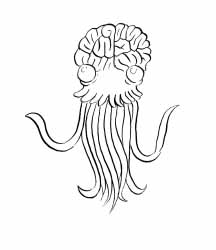
Theoretical Jellyfish

Josh Filhol’s Theoretical Jellyfish

For the project I had tackled before, turning the Fishscale concept into a shareable resource, I had worked with a very talented illustrator and while that was a good working relationship, I found myself frustrated sometimes. And that wasn’t due to his work in any way, shape or form, it was because I felt like I wasn’t making it. It is not that I didn’t appreciate what another person – or in other circumstances a team – can bring to the table. I know that my illustrations wouldn’t have been as good, and there were also a number of things I would simply never have thought of in a million years (the theoretical jellyfish, for example). Plus, I didn’t really have the time to do this project back then, so if it hadn’t been for my illustrator this would never have seen the light of day.

But this new project I wanted to be ‘just mine’. I didn’t realise I felt this strongly about it until one of my colleagues from the Graphic Design department offered to design it for me. I just really wanted this to be my work. And when I thought about why I felt this strongly about it, I realised that I hadn’t really done a substantial project like this in a long time, while I had spent way too much time filling in all sorts of monitoring forms, putting together official documentation and writing research papers. Call me selfish, but I wanted to have some fun!

I also had some very specific ideas of how to design this. I wanted to illustrate it by collaging the patterns that can be found in envelopes from banks, etc. – and there are a lot of different patterns and colours if you start paying attention to these. I didn’t want to do it on the computer, I wanted to put together hardcopy artwork for each of the spreads. I wanted some of the text printed, but some of it to be hand-lettered. And I wanted to have this risographed, which is a particular printing process which means that I would have to do colour separations, too.

Work in Progress

Work in Progress

Anyway, these are just details you don’t really need to know for this story, what is important is that I didn’t want to take any shortcuts – and I ended up doing the illustration and layouting with the help of scissors and a glue stick, a rotring pen and a lightbox. And if you start working like this, your relationship with your content changes – and that also changes the content (well, it makes you change the content). You start thinking about text and images together – the layout makes you reconsider your text, maybe something needs to be cut so it fits or there is some more text needed somewhere else; the placement of illustrations changes according to the text you have, maybe to fit paragraphs, sometimes illustrations are just not right anymore and new ways of illustrating bits need to be found. Once I had gotten into the process, this became not just a slight revising of the content, a word here and another there, a sketch on this page moved to the next, no, I rewrote sections significantly. My introductory spread (the text of which you can find here), for example, hasn’t kept anything of the draft I started the design process out with – it’s a different text, it’s different artwork – and it uses a different way to explain the whole thing.

The scary thing is that if I hadn’t gone through the process myself, if I had handed my text and sketches of the images off to somebody else, this wouldn’t have happened. The book would have my original introduction in it, maybe slightly rewritten and certainly a bit pruned, but it would have remained the old version – and the new one is just better (even if I say so myself). The process of designing as well as the time I spent physically making the hardcopies of the colour separations changed not just the appearance but also the content, it gave my thoughts an opportunity to develop further, which has made a better workbook in the end. Not taking the shortcut has meant ending up somewhere slightly different than I expected to, somewhere I believe is better, because sometimes it is worth investing the time to take the long way round.