Archive

Author Archives: alkegw

Here the details of a workshop some of you might be interested in:

Date: Friday, March 14, 2014, from 10 am to 5 pm

Where: Grove House on the main campus of Roehampton University, London

What: A HEA discipline workshop series focussing on MODULAR FORM: WRITING IN CREATIVE PRACTICE

Focus: ReWrite, the Centre for Research in Creative and Professional Writing at Roehampton University, in conjunction with Writing-PAD and partly funded by the HEA are delighted to hold a one-day symposium on the subject of “modular form.” We have invited practitioners from a diverse range of fields, including digital writing, performance art, curatorial studies, poetry, music, and psychoanalysis, to discuss the deployment of short and/or minimal units of text.

Who is it for and what will attendees get from the day: The event will be of interest to creative writers, post-graduate students, and academics in literary and art-based subjects, and it will provide a forum for the discussion of recent multi- and inter-disciplinary developments in creative writing practice and theory.

Programme: CONTRIBUTORS AND TEXTS (session times TBC)
•J.R. Carpenter, “Seven Short Talks About Islands …And By Islands I Mean Paragraphs.” J.R. Carpenter is a Canadian artist, writer, researcher, performer and maker of maps, zines, books, poetry, short fiction, long fiction, non-fiction, and non-linear, intertextual, hypermedia, and computer-generated narratives. She lives in South Devon, England. http://luckysoap.com<http://luckysoap.com/>
•Vincent Dachy, “Free Associations! Or Weaving with the Wind.” Vincent Dachy acts as the spokesperson of VDcollective (www.vdcollective.com<http://www.vdcollective.com/>), a front for Discreet Ventures in art DIY. He also practices and teaches Lacanian psychoanalysis in London.
•James Davies, “Minimalism and Modularity.” James Davies is the author of Plants (Reality Street) and, with Simon Taylor under the moniker Joy as Tiresome Vandalism, Absolute Elsewhere (The Knives Forks and Spoons Press). In 2008 he co-founded The Other Room poetry series in Manchester with Tom Jenks and Scott Thurston. Also in 2008, he set up his poetry press if p then q. He is currently studying for a PhD in Creative Writing at The University of Roehampton with a particular focus on minimalist poetry.
•Rupert Loydell and Kingsley Marshall, “CONTROL & SURRENDER. Eno Remixed: Collaboration & Oblique Strategies.” Rupert Loydell is Senior Lecturer in Creative Writing at Falmouth University. He is particularly interested in process and collaborative writing, and has several books of collaborative poems and poem-sequences in print, as well as volumes of his own solo writing such as his recent volume Wildlife (Shearsman, 2011), Encouraging Signs, a book of interviews and essays (Shearsman 2013) and Ballads of the Alone, a series of poem sequences about specific photographers, seeing, language and being. Kingsley Marshall is the Head of Film & Television at Falmouth University. His academic research primarily orientates around the use of sound (including music and effects) in film, and the cinematic representation of the real, including historical figures and events. He has contributed to two books that consider the representation of US presidents in cinema, both published by Palgrave Macmillan. As a musician, he has recently begun work on the sound design and score for a poetic documentary. Together with Rupert Loydell, he has recently written about collaboration, chance and the Oblique Strategies for Brian Eno: Oblique Music, due for publication through Continuum in 2014.
•Kaja Marczewska, “Modular form as a Curatorial Practice.” Kaja Marczewska is in the final stages of her PhD (hoping to submit in June 2014) at the Department of English at Durham University. Her research, and publications to date, focus on notions of authorship, originality and creativity as influenced by the contemporary digital culture and contemporary modes of information dissemination. Her work is situated at the intersection of cultural theory, avant-garde poetics and aesthetic, and intellectual property law.
•Nathan Walker, “Six Words Short: Textual Instruction Events.” Nathan Walker is an artist, curator and writer. His work and research investigates writing and speaking in performance. He is interested in digital, conceptual and durational writing practices. His artworks exist as live performances, bookworks, online projects, sound poetry and video. He has performed and exhibited nationally and internationally, and he is co-director of the performance art organisation OUI Performance.  He is currently Senior Lecturer in Performance at York St John University.

Booking Details: The symposium is free but places are limited, so please book early to avoid disappointment. The event includes a catered lunch. To book a place, please contact Julia Noyes julia.noyce@roehampton.ac.uk

Contact Details: Dr. Peter Jaeger, Director of ReWrite, the Centre for Research in Creative and Professional Writing
p.jaeger@roehampton.ac.uk
Yes, we are still looking for academic mantras (for more info and the regularly up-dated list of examples see here).

In the meantime, here is the card I have been working on – commenting on numerous students’ tendency of surface learning and their lack of understanding of the learning process to grasp that some work is process work, development work, work in progress, that needs to be completed if they want to end up with a better result. No, I’m not going to mark each draft that you write or each sketch that you make, because I know that if you go through these stages your final work will be better than if you don’t!

So, here my academic mantra:

Process doesn’t get you extra credit

… but it will make you a better artist

… but it will make you a better designer

… but it will make you a better teacher

… but it will make you a better writer

This slideshow requires JavaScript.

I decided to emboss the four “…but it will…” sentences as a border first (you can’t really see it on these pictures, because there is no ink on them), and then set the ‘Process’ and ‘extra’ with wood type, hand inked in a number of colours. The rest of the text I then set with lead type to fit into the gaps (in a lovely magenta colour).

This will probably become the centre piece of my exhibition in May, displaying 25 of them in a 5 x 5 square, showing off the different colours. I have also kept a lot of the work in progress to exhibit alongside, possibly annotated, to make visible how much process work is in even a little card like this.

I am currently on research leave taking the Tactile Academia approach to the United States. At the moment I am artist-in-residence at the Massachusetts College of Liberal Arts (MCLA), where I am team-teaching some classes, and also am doing some professional development for staff. (And I will blog about more details when I have the time, though realistically it might take me until February, when I am back in the UK for a bit.)

Today’s session with staff was built around the idea of the Mantra Card, which Melanie Mowinski, a colleague from MCLA ,often does in the letterpress studio that is part of a teaching and community project she leads. (She even put together a 2014 calendar with monthly mantras, check it out here.)

Melanie recently put together a workshop making academic mantra cards for the Design Principles and Practices conference in Vancouver in January, which I had agreed to help facilitate, although that didn’t actually work out as my own workshop on the Fishscale was scheduled at the same time. As it had been very successful we decided to do this with the folks at MCLA.

image

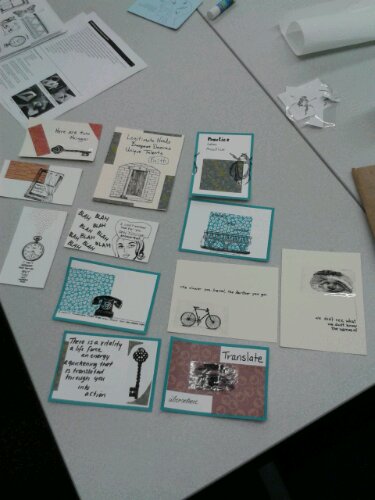
Academic Mantra cards produced at MCLA faculty workshop

In a nutshell an academic mantra is a short saying that you a) say to yourself all the time, b) tell your students all the time, c) is the advice you would give to other academics or d) is an inspirational quote you want to be reminded of. In the workshops we work with packing tape transfers (a really nifty and easy way of getting images from a photocopy to your own card) and hand lettering, and people get the opportunity to play around with stock images and the layout.

And as it was so much fun, we decided that developing this idea further might be a good project for me to fulfill the idea of an artist residency, which comes with an exhibition at the end (while I am only in Massachusetts until the end of January, I will be returning in May to catch up with staff and students, and for said exhibition, of course).

So while I/we will typeset the academic mantras we made this evening, we thought it would also be an idea to collect some more, which we will either make into letterpressed/printed cards or just display around the gallery. They will, of course, be referenced to whoever submits them, if appropriate.

So please, send me your academic mantras, by either commenting on this post or tweeting them #AcademicMantras to me (@alkegw).

Here are some we already have (I will update this list with the new suggestions as they come in):

  • No matter how obvious you think something is, to students it is probably anything but.
  • If you don’t have time to do it right, when will you have time to do it over?
  • The creative act is not performed by the artist alone (Marcel Duchamp)
  • Try being a student yourself at least once every two years.
  • Deciding how you write is like dressing for the occasion.
  • I can’t answer that for you. Only you can answer that.
  • Good craft like good grammar should be invisible.
  • Always, always, always read your work aloud.
  • Proof read, proof read, proof read!
  • Take time to admire your work.
  • Practice takes practice.
  • Show! Don’t Tell! (submitted by Darren Raven)
  • Show me the evidence!
  • Remember to breath.
  • There’s always a way.
  • I don’t know, try it.
  • Consider craft.
  • YOU can do it.
  • Believe.
  • You can’t create and analyse at the same time.
  • Write now, edit later.
  • Sometimes it is better to ask for forgiveness than ask for permission.
  • There is a vitality a life force an energy a quickening that is translated through you into action (submitted by Lisa Donovan)
  • Translate – uebersetzen (submitted by Lisa Donovan)
  • We don’t see what we don’t know the names of (submitted by Ben Jacques)
  • the slower you travel, the further you go (submitted by Ben Jacques)
  • Here are two things: (submitted by Michael Dilthey)
  • Legitimate Needs – Deepest Desires – Unique Talents  –  Faith (submitted by Michael Dilthey)
  • Fortune favours the brave (submitted by Susan Ryland)
  • Just do it! (submitted by Sue Challis)
  • Do things for the goodness of your artistic soul (Alex Pacheco)
  • If you have a dream, it might hide a treasure (Luis Mundo)
  • This point needs unpicking further (submitted by Katy Vigurs)
  • Quotations don’t speak for themselves, tell reader what’s significant & why relevant (submitted by Katy Vigurs)
  • Don’t assume a sweeping generalisation is shared by anyone except yourself… (submitted by Louise H Jackson)
  • Once you accept referencing as part of the research process, and make it systematic, it becomes much easier (submitted by Louise H Jackson)
  • Researching Learning & Teaching is Research with a big R, whatever your specialism (submitted by Louise H Jackson)
  • Process work doesn’t get you extra credit. And it shouldn’t.
  • As wonderful as it might be, you’re not here to do what somebody else has already done (Louise H Jackson, as reminded by @RichStubbs89)
  • Learn about the apostrophe or avoid using it (Russel Spink)
  • Writing is the placeholder of thinking (Caroline Cash)
  • Ask Forgiveness, now Permission (submitted by Clare Aitken aka @LibClare)
  • make friends with the gatekeepers
  • Inspiration is for amateurs. The rest of us just show up and get to work. (Chuck Close)
  • The beautiful thing about learning is that nobody can take it away from you. (B.B. King)
  • Stop waiting for inspiration (and just write!) (submitted by Meagan Kittle-Autry aka @makautry)
  • Teachers open the door, but you must enter by yourself. (Chinese proverb)
  • Words are loaded pistols. (Jean-Paul Sartre)
  • The best artworks create artists. (James Wallbank)
  • Simplicity is just infinite complexity presented well. (Tim Klapdor aka @timklapdor)
  • Diagrams and quotations do not speak for themselves! (Katy Vigurs)
  • You don’t teach a subject, you teach people!
  • You have failed only when you fail to try
  • Problems: a word often used for opportunities to invent creative solutions or learn more. (Deborah Chandler)
  • Before you can think out of the box, you have to start with the box. (Twyla Tharp)
  • Art can’t be taught, it can only be practised and developed. (Anita, TiPP)
  • Writing, to me, is simply thinking through my fingers. (Isaac Asimov)
  • If we mistake ‘unthinkable’ with ‘impossible’ we reduce our options. Just thinking beyond the possible is miraculous. (@metadesigners)
  • Education is the ability to listen to almost anything without losing your temper or your self-confidence. (Robert Frost)
  • Patience is also a form of action (Auguste Rodin)
  • Work begins when the fear of doing nothing at all finally trumps the terror of doing it badly. (Alain de Botton)
  • Everything stinks till it’s finished (Dr Seuss)
  • Know the rules so you can break them effectively (Dalai Lama XIV)

You can’t waste time, you can only use it.
Be fascinated by it more than you are frustrated by it.
When ego is lost, limit is lost.
Don’t judge a book by its cover. (Submitted by Jennie Malbon)
Time is inner space. Space is outer time. (Novalis)
There are no facts, only interpretations (Nietzsche)
Your mind is not a vase to be filled, but a fire to be lit. (Rabelais)
You may choose to live in a dream, face reality, or turn one into the other. (Erasmus)
Any straight line is an arc in an infinite circle. (De Cusa)
If you want to truly understand something, try to change it. (Kurt Lewin)
You can’t use up creativity. The more you use, the more you have. ( Maya Angelou)
Do not go where the path may lead, go instead where there is no path and leave a trail (Ralph Waldo Emerson)
Creativity requires the courage to let go of certainties. (Erich Fromm)

Last week I was lucky enought to attend the Happenings & Knowledge Promenades: working cross discipline workshop at the Arts University Bournemouth. It had been promised that the workshop would explore “the value and potential of cross discipline collaborative activities and the dynamism of the Happening and the ‘knowledge promenade’ in learning and teaching”, and it really delivered.

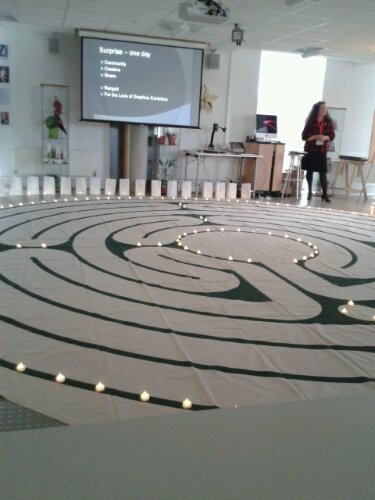
The graphics studio, which was to be our base for the day’s activities, had been overtaken with a large labyrinth on a floor cloth augmented with little electronic tea lights, and we were invited to walk this art work at any time of the day – as long as we didn’t take our beverages further than the christmas tree branches playfully demarking its outer edge (no drinks beyond the treeline).

image

The Labyrinth in the Graphics Studio (and Kirsten in the background)

Hosted by Kirsten Hardie it was introduced by short Pecha Kucha presentations to set us up for a day that was built around four sessions, which explored different aspects of disruption of the traditional methods and spaces of teaching. And while each of the examples was based in a particular discipline, great care and attention was taken to get us participants started to think about the cross disciplinary potential of what we were experiencing.

The order in which I ended up doing the sessions led me from the contemplative to the disruptive, which turned out to be just right for the day.

I started with Labyrinth making and walking facilitated by Jan Sellers. Here we learnt to draw some basic ‘classic’ labyrinth ourselves and thought about the meditative qualities that even the drawing has. We then ventured outside to do a collaborative one with chalk, which we then ran (we didn’t have the time to walk it, and actually that little run was absolutely hilarious). Jan gave us some more reading materials and resources to take home, for example the link for the Labyrinth Society and the Labyrinth Locator

image

Starting the Seed Pattern for our outdoor labyrinth

I then joined Becoming through Music facilitated by Laura Ritchie, where each of the participants found themselves with a cello in one hand and a bow in the other (yes, an actual cello), learning to plug and then play some simple notes. (Note the mnemonic: Active Dreams Give Courage to remember which string is which). In the end I could play an almost recognisable rendition of Twinkle, Twinkle, Litte Star. But of course the important aspect of the session was to reflect on what it is like to be a learner yourself (something every teacher should be reminded of every once in a while), how sometimes ‘giving it a go’ can be both scary and exhilirating, and how important non-verbal communication can be (we also did some cello playing as a group).

After lunch I joined in Clive Holtham’s session on the Knowledge Promenade – walking and recording, where we explored ‘learning by walking about’ (or the dérive, to give it a more academic sounding term). Again we learned about this more by doing, exploring the campus as small groups who had lost their memories about all knowledge of the nature and workings of a university, trying to make sense of this alien environment. The narrative our group came up with was an intriguing conspiracy of some sort of institution obsessed with the colour red, trying to indoctrinate us (it did make sense in the moment). Again, Clive shared some resources with us to allow us to find out more about this intriguing method of exploration and above all noticing. (In that way quite close to the long short walk I experienced at the HEA conference in Brighton in May.)

My last session of the day was Happening with Gordon Ramsey. Here we shared in groups things we had already done that could be considered disruptive – productively surprising students and introducing a new energy into traditional lecture and seminar settings. When he first briefed this, I though to myself: I haven’t done any of that!, but surprisingly once I started thinking about it, I could come up with a short-ish list… some of the stuff already documented on this blog. We then went on to consider what task we could set students that would be so memorable that they would never forget it – and again there were some interesting ideas thrown about.

Unfortunately the day was over all too soon (as these events so often are). What was particularly valuable was that it allowed an insight into practices from a wide range of disciplines, all of which with the potential to be built into other disciplines (most obvious with Clive’s session, where he also shared how this has already spread from management to health). It was a memorable day that provided food for thought for a long time to come!

After the recent link to the beautiful graphical music notations, I have kept noticing more blogs on visualising content, though in this case more written structures. Frances Kelly thinks about Metaphors for Thesis Writing, while Emily Temple has collected Famous Authors’ Handwritten Outlines for Great Works of Literature. Both great examples of how visualising the content can help you develop a structure that makes sense for your reader.

After a summer of redesigning some lecture slides and ideas into a (hopefully) better presentation, as well as some serious research design talks – with some initial questionnaires – and finding some people who might be interested in helping test this, I am happy to report that I have done the first two sessions today… and it wasn’t a total disaster! Actually, it went quite well, I think. I haven’t looked at the questionnaires yet, as I don’t want them to overshadow my own recollections of the sessions, but I am pretty sure I saw at least one student circle the Yes to the question whether this was helpful. Success!

So, after about a year of talking about this with colleagues, the proper testing is actually beginning, which is quite exciting!

(If you want to know more about the Fishscale, check out the new page I made on this blog, which explains the concept and the research project.)

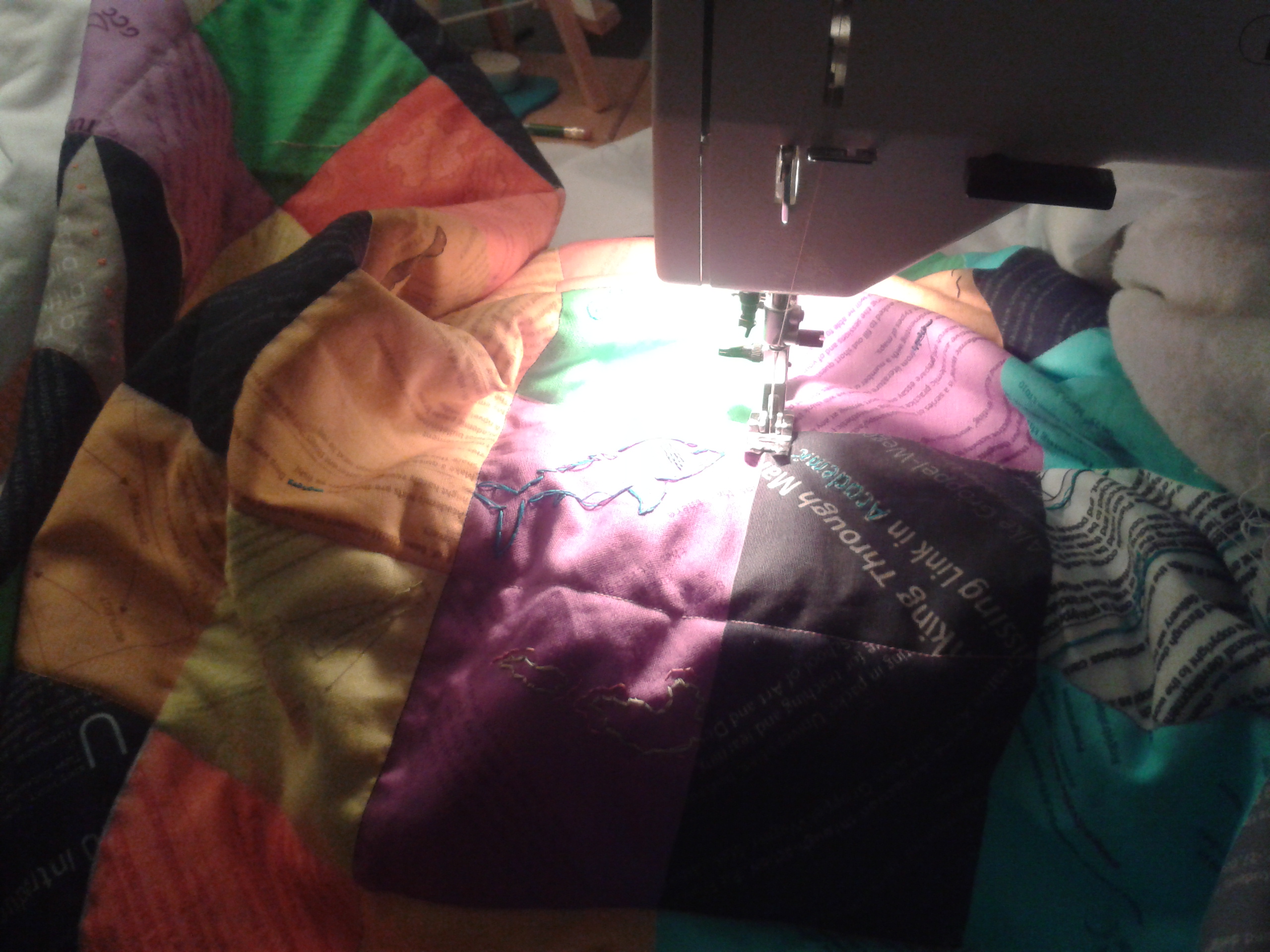
So, after all the embroidery going on over the last week or so, I declared enough was enough and got out the sewing machine to finally quilt the patchwork.

Quilting the Patchwork

Quilting the Patchwork

As with all design processes I have ever undertaken, it was a good thing that a deadline was looming: the portfolio for HEA accreditation needed to be handed in at Staffordshire University yesterday. And while I had been going back and forth in my head about whether to actually hand in the quilt as part of it or not, I thought it would be nice to have the option. The actual quilting transformed this piece of work, making it look much more ‘finished’ (although it took way longer than I expected it to, I’m glad I did it on a non-work day, because I wouldn’t have been able to complete it in just one evening).

But what about the portfolio? While all the embroidery was going on, I was also busy writing my annotations and sorting out my references. And during a chat with a colleague of mine about the portfolio, he commented on how conversational my writing was and said that on reading the first bits he thought I was going down the interview route. Now, I am ashamed to admit, but this hadn’t really occured to me. It should have, as I do a lot of work with genre writing (lots of cream embroidery on my patchwork), but my initial plan had been to get all the information down (conversationally as I find that easy as a first draft) and thenn ‘academic it up’ with making it more formal. However, if the whole point of the portofolio was to represent my practice, then using a slightly alternative genre made sense.

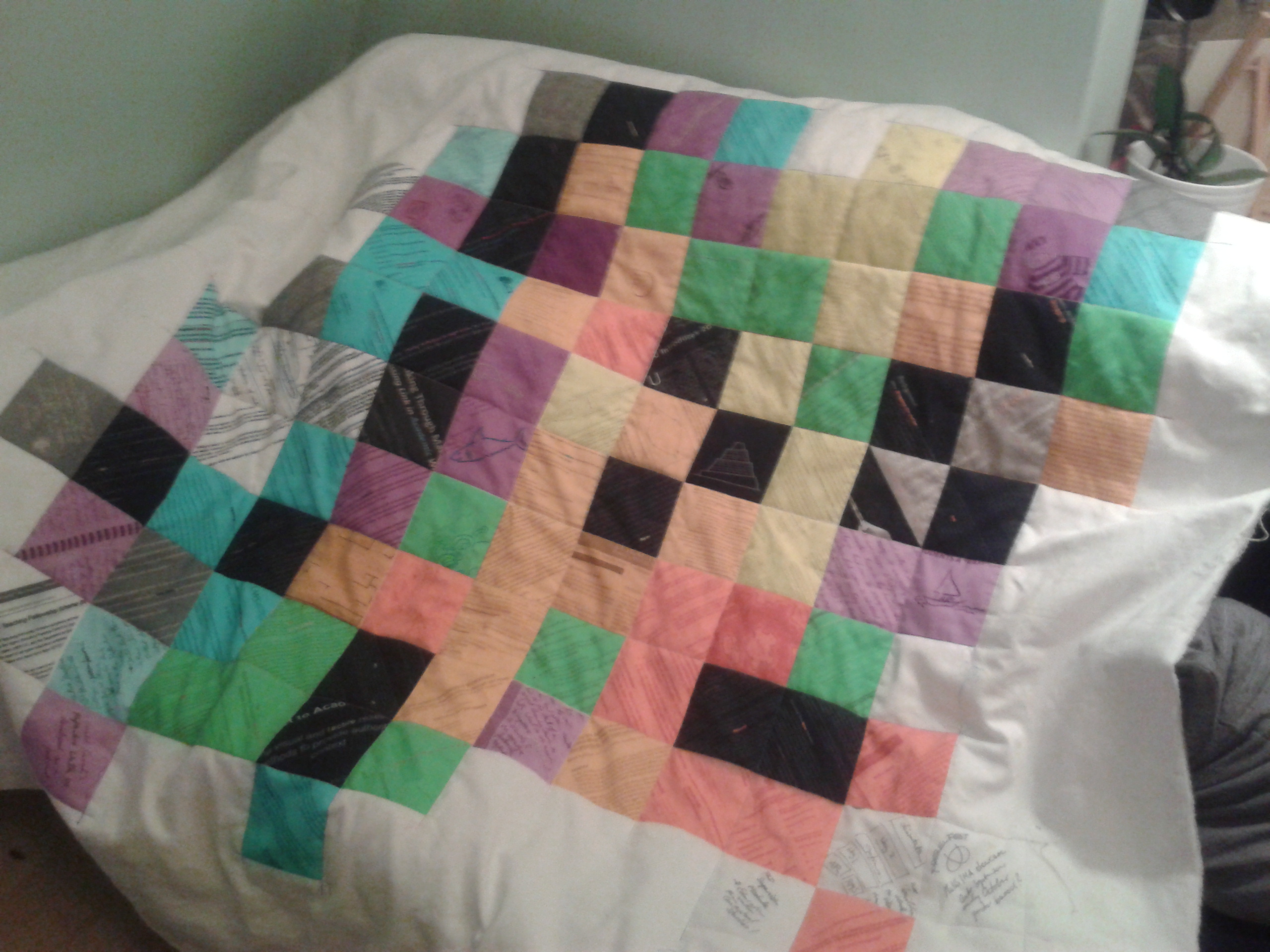
The finished patchwork side of the quilt

The finished patchwork side of the quilt

So, inspired by the quilt itself,  I set about rewriting the whole thing, turning it into an interview with myself, trying to explain the quilt concept, why there was only going to be one side of it (for now), and trying to guess the questions that might come up while viewing this piece – and answering them. Of course that made me end up with a combination of the annotations and the reflective commentary (which might have gone slightly beyond the word count), but I think I ended up explaining the concept, how it relates to my portfolio of work, and how it is not only reflective practice in action, but also reflecting my practice.

When the time for the decision came, I decided to go with the quilt and interview, rather than just the ‘normal’ portfolio and annotation. And the HEA bag I had from the Storyville conference in May was just the perfect size…

It's in the bag

It’s in the bag

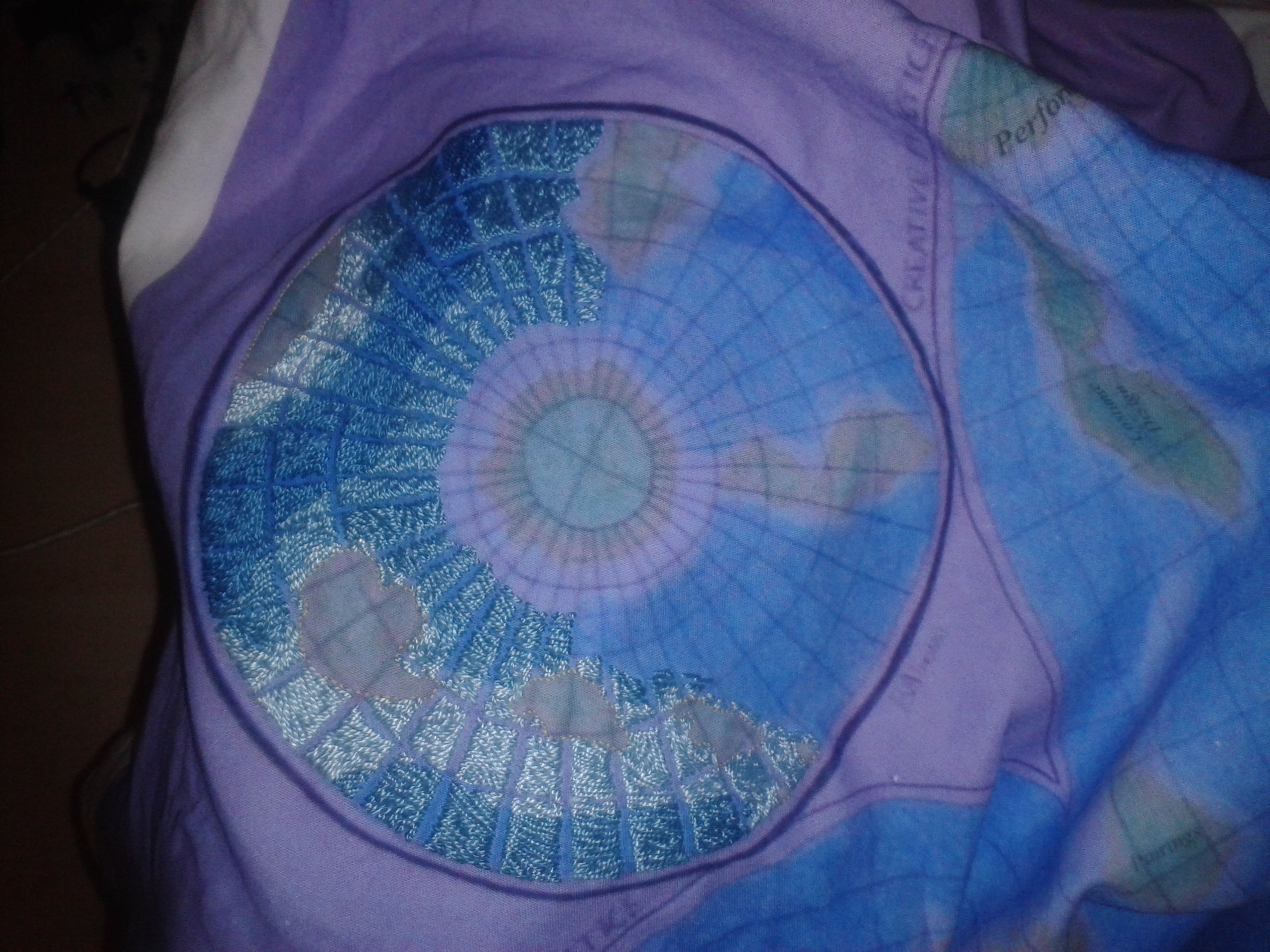
The work on the quilt as such is not finished. I am working on the other side – a map that locates my different practices in relation to each other – and am doing more embroidery on that. And I keep updating my Post-it Patchwork, as this has become a valuable working document that helps me plan future projects.

current state of embroidery on the 'map' side

current state of embroidery on the ‘map’ side

As to how the portfolio was received, I will let you know once I know more…

If you are interested in infographics of any kind, you might really enjoy reading this feature on The Guardian webpage. Written by Tom Phillips it looks at what can probably be best termed as ‘alternative’ muscial notations. Make sure you also check out the ‘Graphic Scores In pictures’ section, where you can not only see some extraordinary scores, but also find some links to hear them performed and learn more (the wonder of hyperlinks).

I have finished the ‘virtual’ patchworking and am working on fabric now – thanks to the lovely technicians at Staffordshire University who printed my file onto a quite substantial cotton.

The Patchwork printed onto fabric

The Patchwork printed onto fabric

The patches are all colour coded – so one purple is for the Tactile Academia stuff, blue for the Writing in Creative practice workshops, black for publications, grey for publications in the works, white for very early publication plans, green for teaching activities, red for administrative/uni stuff, orange for important outside influences and yellow for ‘old’ stuff, i.e. my PhD and things before that. And I am really pleased with how this turned out.

However, to add a bit more interest, I have decided that before I attempt the actual quilting, I am going to add some (very basic) embroidery, picking out the odd word or illustration. The way I choose these colours are based on the content – so really it is another layer of colour coding. I started with the content relating to the Tactile Academia booklets, mainly because there I already had colours picked out: blue for The Fishscale of Academicness, red for The Winning Hand of Independence, yellow for The Button Connection, cream for The Dress-up Doll of Formality (and all sorts of ways of playing with written genre), dark green for The Butterfly Challenge and light green for The Land- and Seascape of Academic Practice. Actually this last one I thought was very complex and deserved two colours really, so I used the light green for the islands as well as anything connected to object-based learning and introduced a pink for the ‘shallow’ waters – and anything connected with the ‘off-loading’ practices of craft (the pink inspired by the Pairings Project, which really should have been more magenta, but I decided to stick with the colours liberated from my grandmothers sewing box rather than buying new ones). You can find a very light blue representing The Underwater Iceberg (a book in  preparation), and orange representing my work on blogging (inspired by the colours of the blog on that which is now defunct).

Since then I have also added dark blue for the work with collage and reflective bookmaking, purple for the overall tactile academia ideas, a light brown for genre that is not written and olive for experiential learning (although I don’t seem to have a picture of that – oops!). I will post soon about the actual quilting of it…

And, just as with the whole process of putting this together, this work has allowed me time to reflect and analyse my work. I have been able to see how the things I do interconnect with each other – and how long I have already been on this journey of ‘Tactile Academia’ without knowing it. This has been particularly useful as I have also been in the process of putting together the portfolio for the accreditation to Senior Fellow of the HEA . Taking the time to work on the quilt has allowed me to see a lot of things more clearly – and it has given me an example with which I can visually and conceptually explain what I do in a learning and teaching context.