One of the things I particularly wanted to explore at the second workshop in Stoke-on-Trent last year was genre, and why academic writing specifically seems to be such a problem for students. Yes, there are the students who ‘don’t like to write’, but in my experience a lot of students also come to university safe in the knowledge that they KNOW how to write, because they learned it at school. And it is difficult for them to understand that they now need to write at a different level – and for a different purpose.

I was talking about this with my colleague Jane Ball, who works at our study skills centre and was scheduled to do one of the presentations at the workshop, and she mentioned the Concscious Competence Model/Ladder/Matrix. In brief, if you are learning skills you go through four main stages:

  • Unconscious Incompetence (You don’t know that you don’t know)
  • Conscious Incompetence (You know that you don’t know)
  • Conscious Competence (You know that you know)
  • Unconscious Competence (You don’t know that you know, because you have internalised the skill)

(Some people argue that there is a fifth stage which is akin to either mastery or coaching, but I don’t want to make this more complicated here.)

Now I think that this is a really good model, but one of the problems with it, is that there are some tongue twisters in there and it becomes really complicated to try to talk about the difference of concious incompetence (which is the stage I would like my students to be at) and unconscious competence (which is the stage most of them seem to think they are at, due to them not paying attention to what I am trying to teach them when it comes to essay writing), because frankly the terms all sound so much alike. So we needed some better terms, and possibly a little visual to tie this together. And we came up with the lifecycle of a butterfly – and that is what The Butterfly Challenge became about.

This slideshow requires JavaScript.

So the trick is to be aware of what stage you are in for each skill you encounter. Are you at the egg stage (blissfully unaware of anything going on around you – and not really caring)? Are you a caterpillar (hungry for knowledge you realise you don’t yet have)? Are you at the crysalis stage (knowing all the rules and quietly practicing applying them all)? Or are you indeed already a butterfly (having internalised all the rules to the point where they are second nature to you)?

different types of butterfly representing different genre

different types of butterfly representing different genre

This becomes particularly tricky if a transferable skill is concerned, because you might not be aware that the rules have changed. (And I think this can often be the problem with my students.) Surely once you know how to write, that is it? Well, here it becomes important to understand the concept of genre – not all written pieces are the same. There isn’t just one type of butterfly, there is one for writing text messages and one for writing academic essays, and they are not necessarily exchangable. But because some students are not aware of that, they think that they are a butterfly (or in the crysalis) as far as writing is concerned, when really they are only at the egg stage for the writing they have to do.

When I presented this idea as part of the talk I did for the Staffordshire University School of Education conference, this seemed to particularly strike a chord… at a different level. Not of undergraduates coming into Higher Education, but rather of graduates continuing on at Masters and PhD level. There also, academic writing (and other research skills) takes a ‘step up’ (in the case of PhD work quite dramatically), and students are sometimes not aware of this. Indeed, somebody in the audience said that when she was working on her PhD it felt like she was a butterfly who got slowly torn apart… In order to avoid this sort of student experience, it might be well worth to introducing the students to this model at the beginning of their courses.

A possible activity to go with this would be to get the students to make butterflies out of copies of different types of texts, and then put them together on a museum type tray complete with labels that identify the specific rules the different texts have to adhere to. (I developed this as an activity a bit, I thought washing pegs might be good for the body of the butterflies, but then never actually used it as the idea of using a paper doll came along and seemed to make more sense – see The Dress-Up Doll of Formality, to be blogged about soon.)

(This booklet was made in a preview edition of 31 handed out to delegates at the Writing in Creative Practice: Integrating Writing into a Studio-based Curriculum workshop, each with a pop-up butterfly in the middle.)

Last Friday I went to Staffordshire University’s Inaugural School of Education Conference. This was particularly interesting in two ways… I had the opportunity to learn a bit more about education research, policy and practice from the education perspective, and, as I was also speaking, I could test out the Tactile Academia ideas on this audience, which is broadening it out a bit as so far I have mostly talked to/worked with people who although lecturers/teachers primarily have an art and design background (like myself).

There was too much going on for me to summarise it here, however, I want to just give one tidbit, which might be interesting for you as I think it links to the Tactile Academia ethos… Jim Pugh did a session on The HE Learning Experience, where he not only recommended Venn that Tune, a book you might also find interesting, but also made us create our own hand-out on Rally Variations. Based on Laurie and Spencer Kagan’s Structures, this not only told us about different types of ‘rallies’ (as in tennis rally, i.e. a sequence of shots) in the classroom, we experienced them in small groups and then were led into how to (visually) record this on a simple hand-out. So he made us not only reflect on the Higher Education Learning Experience for students through what we were talking about, but also about different ways of engaging students in group work, as well as note taking. Definitely food for thought.

me, talking a lot with my hands

me, talking a lot with my hands

After lunch I did my presentation. This was the event I had designed the mini quilt for to put on the poster. Unfortunately I haven’t been able to get it onto fabric yet (students keeping technicians busy with work for final assessments no doubt), but as I liked the visual I decided to actually use it as the basis for my presentation as well. It felt like a very hurried half an hour of me zooming around, briefly describing the different activities. (Some of which I have already blogged about, for example The Land- and Seascape of Creative Practice, which isn’t actually on the quilt, as this is more connected to the framing of the whole thing but it was mentioned in the presentation, or The Fishscale of Academicness, others will follow!)

And I am happy to report that I had a very positive response to these ideas, with a number of people remarking that there were one or two things that they could put into practice almost immediately. I hope that they do and then let us all know how they are getting on.

my poster

my poster

I have since been thinking about how much explanations you need on a poster (or indeed handout). Because I know that if you just have that poster (so all the people who decided to go to the other parallel session) you get very little information about the actual activities. You get slightly odd titles, and some quotations and an overall statement of what Tactile Academia is about, but is that enough? Or is this about right, considering that this is all about getting people curious to find out more – and as long as the blog address is on there, they can do that? I don’t know.

Anyway, the last session I was in was about the importance of networks for Post-Graduate Researchers. While we slightly ran out of time, I started to think about the role that social media can play in that. It made me think a lot about that, in a way also apt, as this blog is one of the ways I stay in touch with you. So I also decided that I would (finally) join twitter. So in future you might hopefully be able to get shorter updates on my research from @alkegw and searching for #tactileacademia.

Today we talked about Area of Activity 3: Assess and give feedback to learners.

Suggested as evidence for the portfolios was at Fellow Level:

  • Anonymised assessment feedback
  • Evaluation of the impact of assessment feedback
  • Formative or summative assessment brief

at Senior Fellow Level:

  • Evidence of co-ordination toles in relation to student feedback, for example standardisation and moderation

When discussing what examples we could include into our individual portfolios, we were thinking not just about the written feedback the students get, but about the whole experience and how that is structured. For example, one of us explained the feedback procedure in her award area and how the students are provided with written feedback as preparation for a tutorial, which allows them time before the tutorial to reflect and actually prepare for the tutorial, so they can come up with specific questions they have. This is something that wouldn’t necessarily be apparent from the suggested examples, so we thought that it might be a good idea to put together a flow-chart of how the feedback process works – and how it is effectively turned into feed-forward.

We were talking about how to visually present the feedback to students, and I particularly mentioned a paper on this I heard at a conference in 2010 (which I highly recommend and can be found here), which I have based my current feedback sheets on.

We were then also thinking about ways to visually explain to students the weighting of different aspects, whether they be different parts of the module or different learning outcomes, as this is a problem that students often seem to have, not quite understanding that not every part is of equal importance when it comes to coming up with the final grade. We thought that it might be a nice idea to include a pie chart to show this to students.

So last week, Sarah and myself made our way to the first Writing in Creative Practice workshop to be held in Scotland. We had been invited to come to the Ayr campus of The University of the West of Scotland by Alison Bell, who had been at the very first of these workshops in Stoke-on-Trent, and we had been talking ever since to make this happen.

bags waiting for participants to arrive

bags waiting for participants to arrive

The idea behind the programming of the day was to particularly look at collage, but more in the direction of reflection than the recent Chester workshop had been, which was very much about interpretation of text I felt. And of course we had set it up so that participants could have a go themselves. Intitially (after making our own name tags), Sarah introduced reflective notetaking in book form, with a particular look at poetic inquiry and its roots in Dada (as well as referencing the songwriting of David Bowie).

After lunch, Alison shared her experiences of working with collage as a methods of enquiry as part of her PhD. This was a very thought- and personal reflection on her work, which (for me) particularly made the point that it is not only the collages that can be interpreted, but that taking photographs of them then allow their interpretations from mutliple perspectives, again changing what one is able to see in them (and in extension in the work).

The next part of the day was given over to just that exploration of words in not just two but three dimensions. Brigid Collins introduced us to her work on poem houses, and with the help of some handy template boxes, participants were encouraged to take their two dimensional collage into the third dimension. Brigid had also given everybody a haiku as a possible starting point. A really intensive working period followed, where people were working on both two and three dimensional visual reflection.

This slideshow requires JavaScript.

To bring everybody back to the university context, I then introduced a way of using collage as a way of thinking about collating a literature review, and particularly for explaining to students the difference between a literature review and an annotated bibliography (something I seem to have trouble at in my teaching). I will blog about this in more detail soon.

In order to collect feedback, we used an activity that Sarah had recently tried with her students: we gave everybody a page of notes from the back of a found book of a greek play (I think), asking them to pick out three words and expain how these three words reflected their experience of the workshop. Because the notes were quite academic and sometimes included translations of greek and latin terms, the found words were really interesting and the feedback in places was almost lyrical.

Overall it was a great day – on our way back we were already making plans on a future event, so keep your eyes peeled for that (though of course it might take another year for that to actually happen…).

Igniting Anything - my poem house

Igniting Anything – my poem house

Here is a picture of my ‘poem house’ (slightly unfinished as yet). It was inspired by a David Bowie quote in a video clip Sarah showed: “igniting anything that might be in my imagination” and a Conquergood quote that popped up in Alison’s presentation “braiding together of disparate and stratified ways of knowing” (2003). I liked the idea of igniting and found a map of islands at least some of which I thought might well be volcanic, and liking the idea of braiding things together, I cut them into strips according to the longtitude. So far I didn’t do any braiding, but that might still come!

if walking alone
I am lonely it is both
a place and a path
        Thomas A. Clark

This was the haiku I found on my bag at todays writing in creative practice workshop at the University of the West of Scotland in Ayr. I will blog about the actual event – including why there were haikus on the bags – in a few days when I’m back at my computer, but these few lines made me think about the nature of this growing network… while it may sometimes feel like each of us is walking alone in the teaching and support we are providing in our respective posts at our respective universities, getting together for days like this, meeting in a place, allows us to share a path. And maybe even point out shortcuts (or detours) to each other.
Today new friends were made, the network got a bit bigger and the path might become a bit more travelled.

Rather than getting distracted for days and then delaying the writing of this like last time, I’m doing it today – only one day after our meeting.

This session we wanted to look at the annotation that needs to be done for these portfolios. While we have to provide evidence as to the different Areas of Activities, we need to show the Core Knowledge and Professional Values through some sort of annotation of the included Area of Activity documents.

There are six areas of Core Knowldge:

  • K1 The subject material
  • K2 Appropriate methods for teaching and learning in the subject area and at the level of the academic programme
  • K3 How students learn, both generally and within their subject/disciplinary area(s)
  • K4 The use and value of appropriate learning technologies
  • K5 Methods for evaluating the effectiveness of teaching
  • K6 The implications of quality assurance and quality enhancement for academic and professional practice with a particular focus on teaching

and four areas of Professional Values:

  • V1 Respect individual learners and diverse learning communities
  • V2 Promote participation in higher education and equality of opportunity for learners
  • V3 Use evidence-informed approaches and the outcomes from research, scholarship and continuing professional development
  • V4 Acknowledge the wider context in which higher education operates recognising the implications for professional practice

For the different levels of accreditation, Associate Fellow candidates have to annotate the portfolio to demonstrate examples of at least K1 and K2 and each element of the Professional Values, Fellow and Senior Fellow candidates have to demonstrate at least two examples of all the Core Knowledge and Professional Values.

In order to get our heads around this, we had a look at an example of a successful document from a colleague at a different university. However, as this didn’t go down the portfolio route it was describing the evidence of the Areas of Activity rather than including them as examples. Even though the process is therefore a bit different from what we will have to do, it was really helpful to look at an actual example. We really liked how this clearly refered to each of the Knowledge and Values in brackets after the description (for example K1 and V4), and how it used the discussion of both of these dimensions of the UK Professional Standards Framework to fold in theory.

We thought that it might be useful to physically organise this annotation (and also the editing of the portfolio) by collecting our possible evidence and using different coloured sticky-notes to remind us of what Knowledge and Value descriptors would be shown by these examples. That would make it easier to later on decide which examples to best include (briefness always being a virtue in portfolios) and would also make the writing-up of the annotations much easier.

We also thought about possibly keeping a grid to show what Areas of Activity could cover what Knowledge and which Values, to allow us each an overview to make the editing process easier. A grid of the submitted pieces of evidence could then also be submitted to give the reviewers that same overview.

And then we had some fun thinking about different ways of presenting these annotations. As we will have documents as evidence, we could signpost good practice much more directly than our colleague could in one long written piece. So we were thinking of using post-its to refer to the Knowledge and Values – and even where appropriate to point towards theory – or maybe luggage tags. Maybe the Knowledge needs to be represented by something other than the Values, so we could possibly have both? Or will that just become confusing?

As I am still thinking about at least somehow including a quilt (although whether I will have an appropriate one ready by then remains to be seen), I was also thinking of attaching things with safety pins, putting in looped (or sewn on straight) labels, or maybe even showing how things are being held together through Knowledge and Values by differently coloured thread. Yes, it would be way more complicated, but so much more fun than a boring collection of printed WordDocuments…

A message from Sue

Dear Alke and all,

Another stimulating, inspirational and useful seminar day in Chester last week ! I was particularly intrigued by the ideas about literally ’working into’ academic text, creating new understandings and breaking the shiny, polished and finished sense of the ideas. Attached are some images for the blog, of the tunnel bag I made from ‘found’ collage materials supplied at the seminar. I first found words in a Joseph Conrad story which expressed the panic which surrounds the current process of writing my PhD, and, in the second layer, words which made some of that clear to me: it’s partly my reluctance to let go of the ‘vague’ and complex, “that idea kept back” (as Conrad says), and commit to claiming my representation of the world is ‘the truth’ !

Finally, in the last layer, by spooky serendipity, a map supplied showed the house I was born in … it made me think hard that I must start from ‘myself’, keep myself in the writing somehow… A helpful way in to thinking a little bit about the barriers I face when trying to write up complex ideas in an academic way and to remind me not to lose myself in it.

Thanks! Sue

As you know I have been thinking about visual ways of representing experiences in patchwork/quilt form for some time. And this had developed quite nicely to what I call the ‘Post-it stage’ (other sticky notes are available) until the idea of the fabric printer moved it into another dimension of possibility. but it still felt a bit vague, and I was thinking that I would like to test this out in a smaller, contained way.

And lo and behold, an opportunity presented itself! I was asked to present a session at an internal conference hosted by our school of education – and ideally something that would give an overview of what I am trying to do with my students. And if I could put together a poster, too…

So having to do a poster anyway, I thought, why not come up with a patchwork design to put on the poster – and then if there is time I could run that through the fabric printer and see how it comes out.

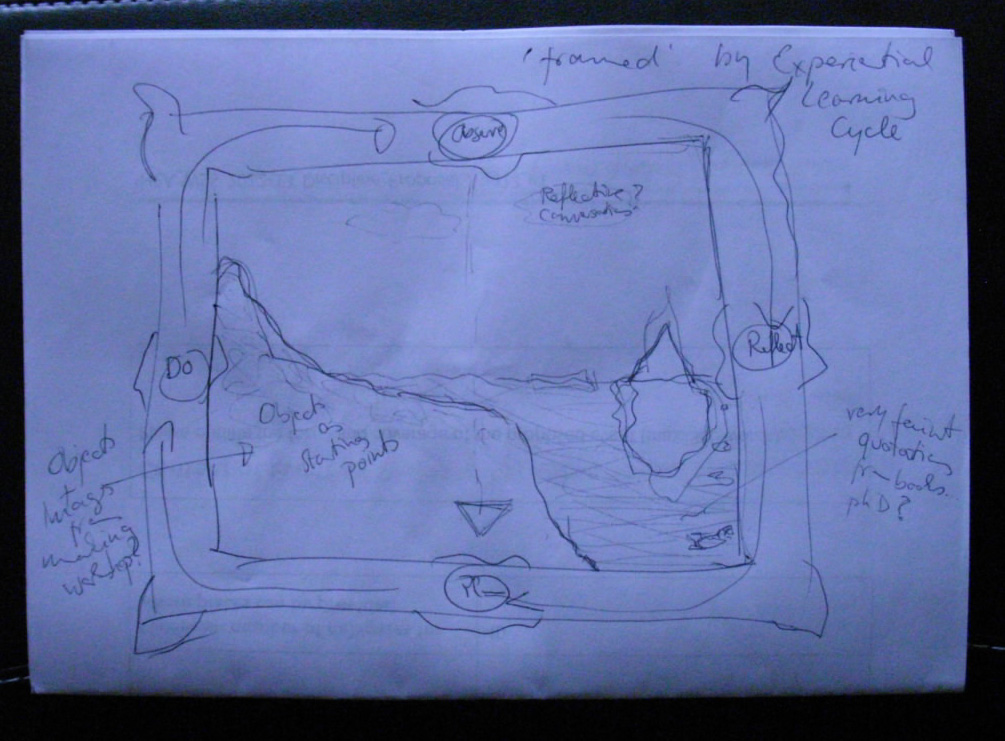
My first idea was inspired by an artistic quilt – so something much more about one large image rather than regularly shaped bits that are joined together. I also liked the idea of using a frame in some way. Sarah has done a poster with a large ornate gold frame in it, which I really like, and I was thinking of nicking that idea and using it to show Kolb’s Experiential Learning Cycle, which in a way is framing almost everything that I do – it sort of provides a really good model of how I approach both teaching and learning. So I was thinking of having a gold frame and on each of the four sides have a little label with one of the four stages Kolb refers to. As the actual image I thought I would use the idea of the Land- and Seascape of Creative Practice, but extend it so that it includes the Underwater Iceberg and the Fishscale of Academicness. A bit complicated, but in my head that still makes sense.

mini quilt concept drawing

mini quilt concept drawing

And while I still like the idea, I was wondering whether it might be a bit inappropriate because it is very much linked to art and design and takes studio-practice as a starting point. Really what I wanted to do was to come up with a poster/quilt that would prompt me to talk about the actual activities I do with my students (some of them still in development), rather than a lot of theoretical background that might not apply anyway. So maybe square pieces added together to make a larger square image after all?

Sitting down again with another large sheet of paper and another stack of post-its I was thinking of how much overlap there would be between the quilt I am planning about the development of my work and teaching philosophy and this one. In a way I wanted this one to be more ‘hands-on’, really focus on analogies and activities I actually use in my teaching, rather than give evidence of inspirations and conference presentations. But I also wanted to include some quotations that might be important.

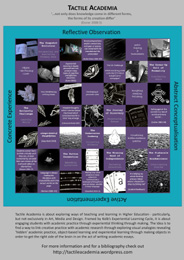
I took key illustrations from the little tactile academia book(let)s and things I draw on my whiteboard in class as starting points and after some playing around I realised that it might be nice to have a checkerboard effect – with images as one colour and words as the other. After a lot of to-ing and fro-ing I came up with a size and order I liked.

mini quilt at post-it stage

mini quilt at post-it stage

Now it was just a matter of filling it up. I say ‘just’, but of course this took actually quite some time. It is interesting, but it is at this stage, that I might abandon a project. In a way by now it is worked out – and I have a very clear idea in my head of what it would look like if it was actually finished. Of course in that case it would never really be shareable, so it is a good thing to have somebody waiting for a file they can print as a poster and a deadline to boot.

A period of designing began. I started with the images I already had – from the booklets and teaching prep, etc. – but invariably they were all somehow wrong in size or format, so I ended up redrawing most of them. I had some photographs I wanted to include, too. Putting them together just didn’t look as nice as the pink and green post-its, so I decided to treat them so they would all be black and white (well mostly), and so that they were more likely white on black than the other way around, because I wanted to emphasise the checkerboard effect.

Now all I had to do was populate the in-between spaces. I knew I wanted this to be text based, some squares giving my names for the activities (or books), some of them quotations that underline the importance and relevance of experiential learning (and in extension teaching) and some more informal ideas and activities I use in my teaching. For these three I used different typefaces, but tried to keep the font size equivalent. I also decided on a background colour, going for the colour of this website to make it tie in (and because I didn’t want it just white and couldn’t think of anything better).

And my mini quilt was done! Yippee!

For the poster I did frame it in Kolb’s Experiential Learning Cycle, but in a plain frame. And I added a little bit about the idea of Tactile Academia to the bottom, plus the address to this blog if people want to check out the bibliography especially. (I could have included that on the poster, but would have had to make the type really tiny. Plus, isn’t it a good thing to give all those lovely people a reason to check out this blog?)

With it being the Easter break I don’t have access to the fabric printer just yet, but will keep you posted on how this turns out!

Yes, we had a second meeting, but I haven’t had time to blog about it until now…

This time we were concentrating on the area of Activity 2 – Teach and/or support learning.

The examples that are listed in our portfolio suggestions are at Fellow level:

  • Teaching aid (e.g. visual aid, handout)
  • Explanation of a teaching activity used in a relevant setting
  • Evaluation of teaching/learning sessions
  • Your reflection on National Student Survey results for your area

and at Senior Fellow level

  • Evidence of providing mentoring or development opportunities for staff who are teaching or supporting learning
  • Your strategic response to National Student Survey results for your area.

At Associate and Fellow level, we felt that this was an easier activity to provide evidence for than A1 – as we are all teaching, and that it was great to have the option to explain a teaching activity if teaching aids were inappropriate to include (or would be needed to back up a handout). so people who are demonstrating or giving tutorials a lot could still find evidence for this area or activity.

We spent a bit longer taling about what evidence we could provide at Senior Fellow level. on reflection (and in discussion) we were able to come up with examples how the people interested in that level of fellowship do mentor other mentors of staff, whether that be through sessions as part of a PgC, workshops offered through staff development, contributing to conferences and unconferences, just helping out colleagues or indeed this blog.

Next session: Annotating the Evidence – how to show Core Knowledge and Professional Values (as this session is scheduled during the Easter break, there might be only a few people coming, but we might do another session later in the term)