Here a review of the Writing in Creative Practice: Towards Academic Publishing workshop in July. More info on the workshop can be found here.
Towards Academic Publishing Review
Leave a comment

Here a review of the Writing in Creative Practice: Towards Academic Publishing workshop in July. More info on the workshop can be found here.
As you know if you are following this blog regularly (or by checking out the ‘Quilt’ category if you don’t), one of the projects that I am currently working on is an alternative presentation of my CV/expertise/Learning and Teaching development in form of a patchwork quilt.
After an initial surge of working on it, this had gone through a more fallow period while I was dealing with other stuff, but over the summer I had set aside some more time to work on it. (Although it turned out that I had less time than I thought I would have. Isn’t that always the case?) However, I am happy to report that I not only updated my post-it version to reflect what had happened in the last few months (a great feeling of replacing some dark green post-its that show plans with some other coloured post-its which show things that have actually happened; and then adding more dark green ones!), but also set aside the August bank holiday weekend to do some ‘virtual quilting’. So I made a concerted effort to dig out the information I needed and put it together.
But how to visually ‘code’ this information? The transfer from post-its to representational ‘patch’ actually proved trickier than I had expected. Initially I had thought about finding as many photographic images as possible to represent my patches. But putting them together (virtually with the help of Powerpoint) made the whole thing incredibly busy – and ironically at the same time less interesting.
For a while I got excited by the tactile opportunities a physical patchwork would bring and started thinking about different fabrics, playing with textures. And while that would have worked very well for selected patches, I realised that they would have been only very few, so few they would have been distracting.
In the end I went back to thinking about the post-its. The post-its work as the ‘working version’ because they fit together easily (being all the same size and square) and exactly because they have very little visual information on them: they have black writing or basic sketches on them, while the background is a base colour from a very limited palette. That’s what makes the post-it version easy to read; so that is what I needed in the more elaborate (hopefully to be fabric one day) version as well.
I therefore decided to keep that aesthetic by using bits of text or simple drawings to go on the patches. Most of them set at a +/- 45 degree angle, these squares literally cut out of existing documents give a hint of their content, but also have a clean appearance with a stripey look as opposed to the clutter of visual information photographs would have provided. This also allowed me to set apart external inspirations and influences by again cutting squares from textual/published material, but not setting them at an angle.
In putting together these patches over a couple of evenings, I realised that most of my material can be drawn from a textual base – published articles, abstracts or words on slides, handouts and written notes, although there was also the opportunity to include the odd line drawing. I decided to set apart the ‘future plans’ / ‘in progress’ category by using sketches and hand-written rather than typed text.
By now I was working on Photoshop (a very slow process as I am not a graphic designer and have a very old and limited version of it – it was free, I shouldn’t complain) and it was time to come up with some ‘rules’ for the colour coding. I had decided quite early on to use negative images for externally published papers or events, the white text on black reminding me of so many black cotton conference bags with white logos I have collected. Initially I had thoughts that they would mostly represent logos, but then I realised that where exactly I had been was less important than that it was external and the content. (The ‘where’ could always be taken care of in a separate patch of the UK/world with little beads representing the places papers and workshops were delivered… there’s an idea to follow up on one day!)
So: talks at external conferences and published papers would be white text on a black background. In contrast the papers that are not quite there (written and submitted abstracts, for example, or ideas) I would leave black on white.
The rest of the patches would be coloured like post-its, with the help of the opacity function in Photoshop.
The Writing in Creative Practice workshops, mostly external events funded by the HEA, were very important in the development as a learning and teaching professional, as I was (co)organising most of them, presented my own research and networked with other interested parties. A major staff development activity. I decided to give each of them a separate patch rather than just doing one to represent all of them. As a colour I decided to go for HEA blue-ish.
For the Tactile Academia related things I am going with a purple/lavender colour inspired by this blog, while also being reminiscent of the different Tactile Academia booklets, which are printed black on different colours.
Other colours I needed were for Teaching Activities, External Inspirations/Influences, Responsibilities at university (often linked to admin type work) and important ideas that went back to my PhD research. After I spent a fun weekend playing around with different patches and colours I had come up with this:
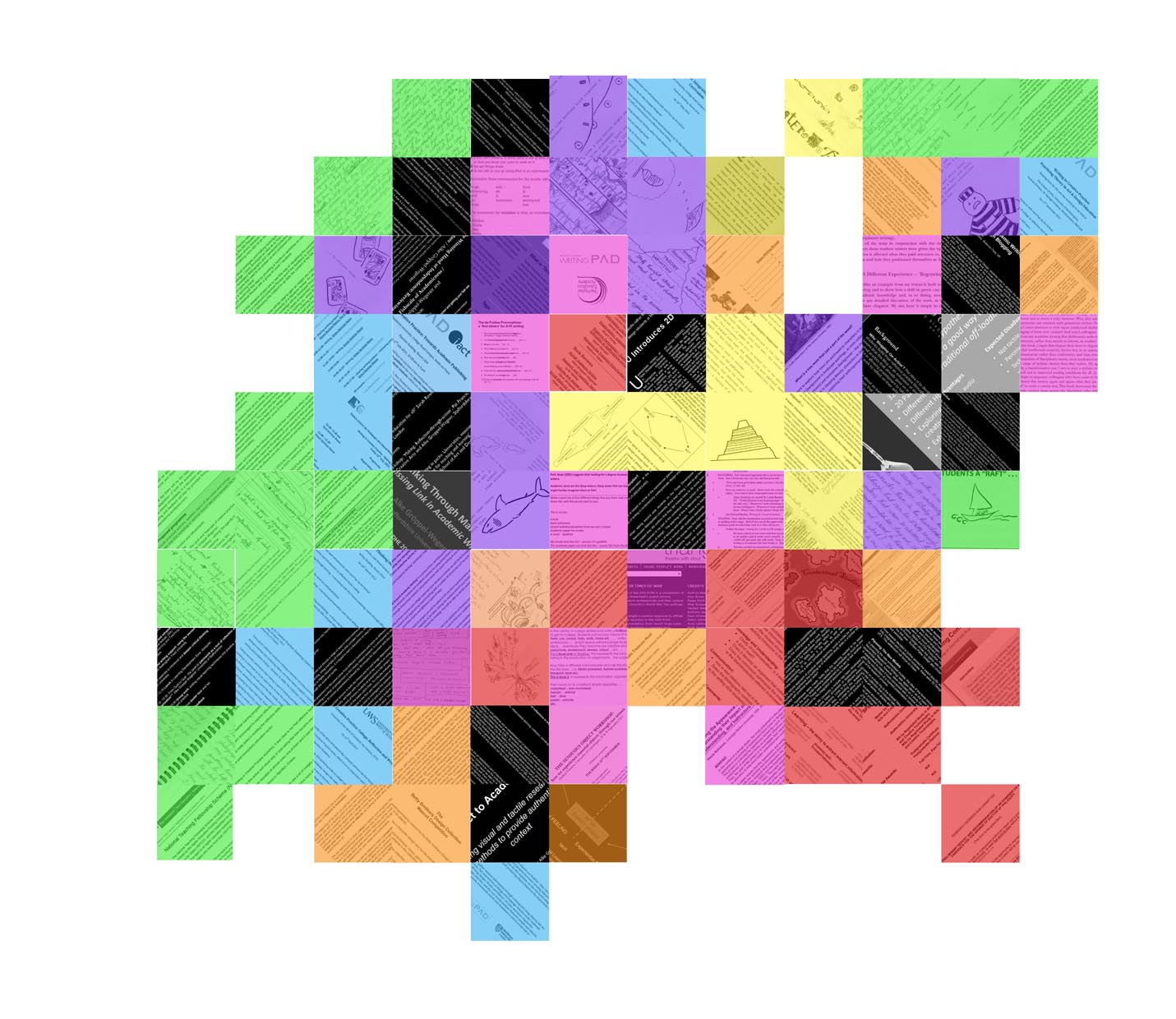
a version of my coloured patchwork
I am going to slightly change this – and some patches are still missing – but I have to say I am quite happy with this as a rough version of the patchwork side of my quilt.
Now I just have to make some headway on the other side as well… and get it printed onto fabric… and actually quilt it…
So, I was doing something else, but in my research, I came across this amazing project on The Guardian website and I thought I would share it here (also so that I won’t forget about it).
The idea of representing the structure of a book in three dimensions is, of course, not new – I mean artist’s book makers do this routinely, but I like the cross-over of literary work and model making. It also reminded me of both the tunnel books and, of course, the poem houses we have been making at some of the Writing in Creative Practice workshops.
And thinking of the structure of writing as having a shape is something that can be incredibly useful when writing. I have been sketching models of how my research is organised for both my Masters and my PhD – and in a way am doing something similar with the quilt (which is the thing I was doing when I was getting sidetracked, so more on my progress on that in a future post). I know that Pat Francis encourages her students to describe the shape of their writing to identify more clearly where they are going – is it a Christmas tree? is it an hourglas? is it a number of blocks that are fitting together like a dry-stone wall (or do they need to be moved and shaped slightly to make the fit work)? – and seeing how the argument develops and where the evidence is presented.
Right, just thought I would share this. Going back to work now…
And another link…
As you know I have been working with some colleagues on different ways of getting the Fishscale concept out into the open. And I am happy to announce that the chapter I have been working on with Geoff Walton is about to be published in the Only Connect (un)book. Find out more about the whole book from this brief introduction by Emma Coonan, one of the editors. (Look out for two fabulous illustrations by Josh Filhol, who is working with me on illustrating this concept!)
And yes, it also includes another chapter from me that was written as one of the Tactile Academia booklets – The Winning Hand of Independence – first featured at the Writing in Creative Practice workshop in Ayr.
This morning this link ended up in my twitter feed, and I thought I would share it with you. There might be something to be said for re-designing standard forms to appear a bit more friendly – surely this peer support plan could easily be adpated to make a more accessible appraisal form, or to put the peer observation process in a different light (oh so dreaded by some, but so useful at the same time).
The use of the recipe is also something that is a very good genre to think about. I’m reminded of an interesting section in Richard Sennett’s The Craftsman (2009), where he talked about different ways of recipe ‘writing’. But also about an activity that Pat Francis sometimes does in her workshops: using a blank recipe card to describe ‘what made you’, which is a really fun way of reflecting on the skills you have, use – and maybe also need.
Thanks to Andrew Walsh (@andywalsh999) for tweeting this from the IFLA World Library and Information Congress.
As already mentioned (and with Susan posting her experience of it recently), after the Making Writing workshop, Pat, Nancy and myself stayed on in Falmouth for a weekend writing retreat. I was especially interested in seeing whether the approach of writing warm-ups and visualisations could be combined with some focused structuring and writing activities in order to produce writing for ourselves – and the gorgeous Cornwall seemed to be just the right place! (So a thank you to Pedare and especially Caroline Cash for hosting us.)
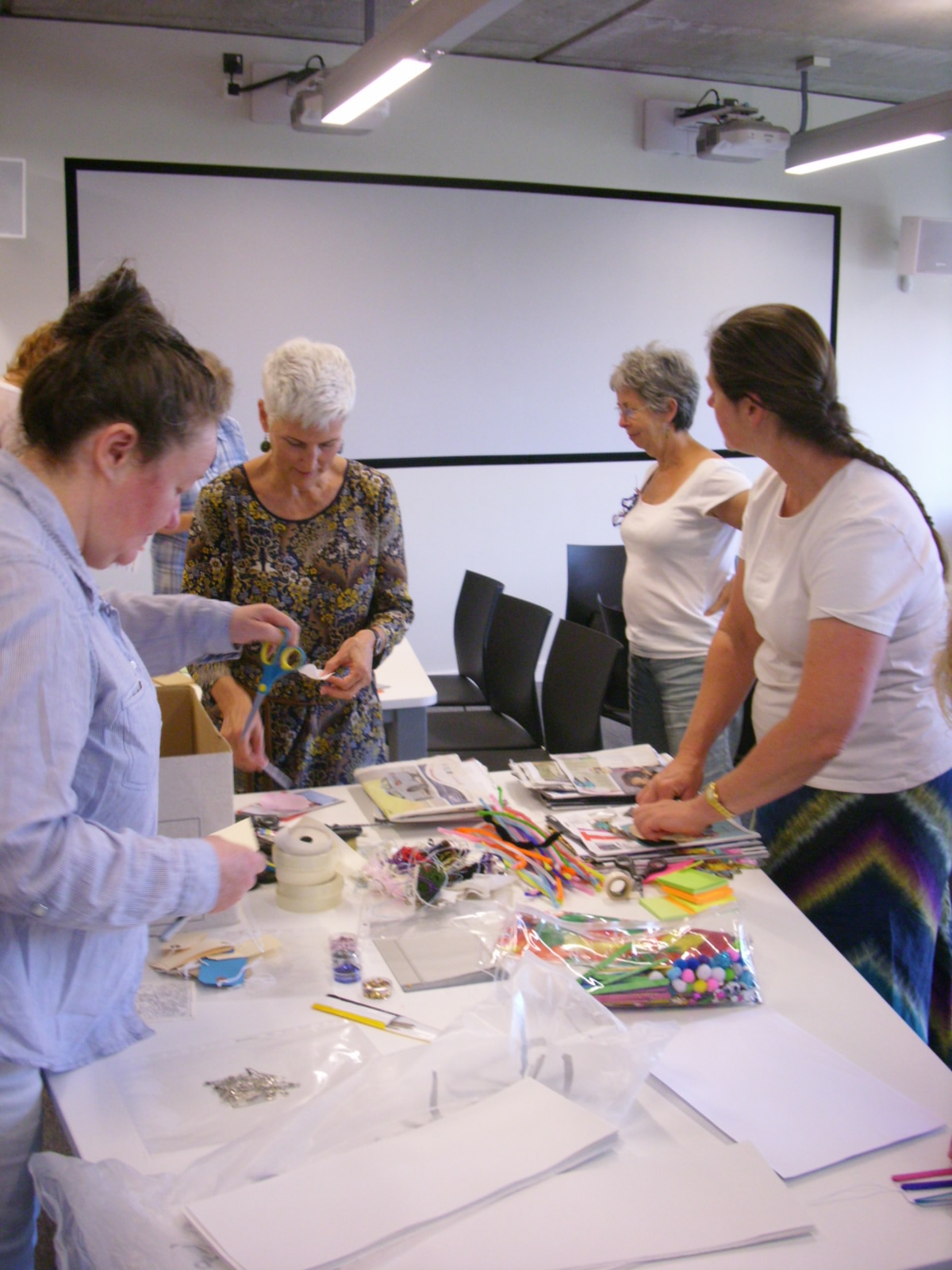 Although some of us had been there for the Friday as well, we started off with (re-)making name tags, really an excuse to see what materials were available to use. I thought it would be very important to have a sort-of ‘break out’ space with making materials in case we would be stuck in our writing endeavours and needed what Gauntlett calls the ‘longer stretch of thoughtfulness’.
Then Pat started us off with a writing warm-up to loosen up our creative juices. I then led an exercise in objective setting – thinking about where you are, want to be, what you want to work on and what the specific objective for the weekend was. I suggested using fish as a visualisation (yes, I feel the time has come where I have been working on the fishscale for too long!), but as always with these things there are no wrong ways of doing this. So when we shared what people had come hoping to achieve, we heard about the full backpack that had accumulated throughout the year and now needed to be unpacked, aired, washed and lightened; the experiences that needed to be put into an academic framework; and the reports that simply need to be written up in order to be able to close the door and focus on the light at the end of the tunnel – and many more. It became quite clear that our initial plans for structuring the weekend would be useless as attendees were at very different stages in their planning/writing, so Nancy, Pat and myself, set everybody a little task to crystalise what they were doing (mainly based around abstracts – writing one for the people who hadn’t done one yet and extending or editing it for the people who had), while we went off to formulate a new game plan.


In the end we split up the larger group into three smaller groups depending on the stages that needed to be tackled: Nancy worked with the people who were already very far in their research and mainly needed to make a decision on the audience for their writing piece(s), Pat worked with the people who were trying to fit experiences (their own and others) into an academic framework and I myself worked with the people who needed to develop a clearer focus – and that Pat’s group ended up with only people whose first name began with a P was purely coincidental!
We came together at different points over the two days to share progress and to break up the tasks – while still keeping large chunks of time in which people could work on their own pieces, either with us in one-on-ones or on their own, dotted around the campus.


It became quite clear that the humble sticky note and large wall space are some of the best tools an academic writer has at her disposal as thoughts were sketched and written, stuck and re-stuck, and linked with arrows all over the place.


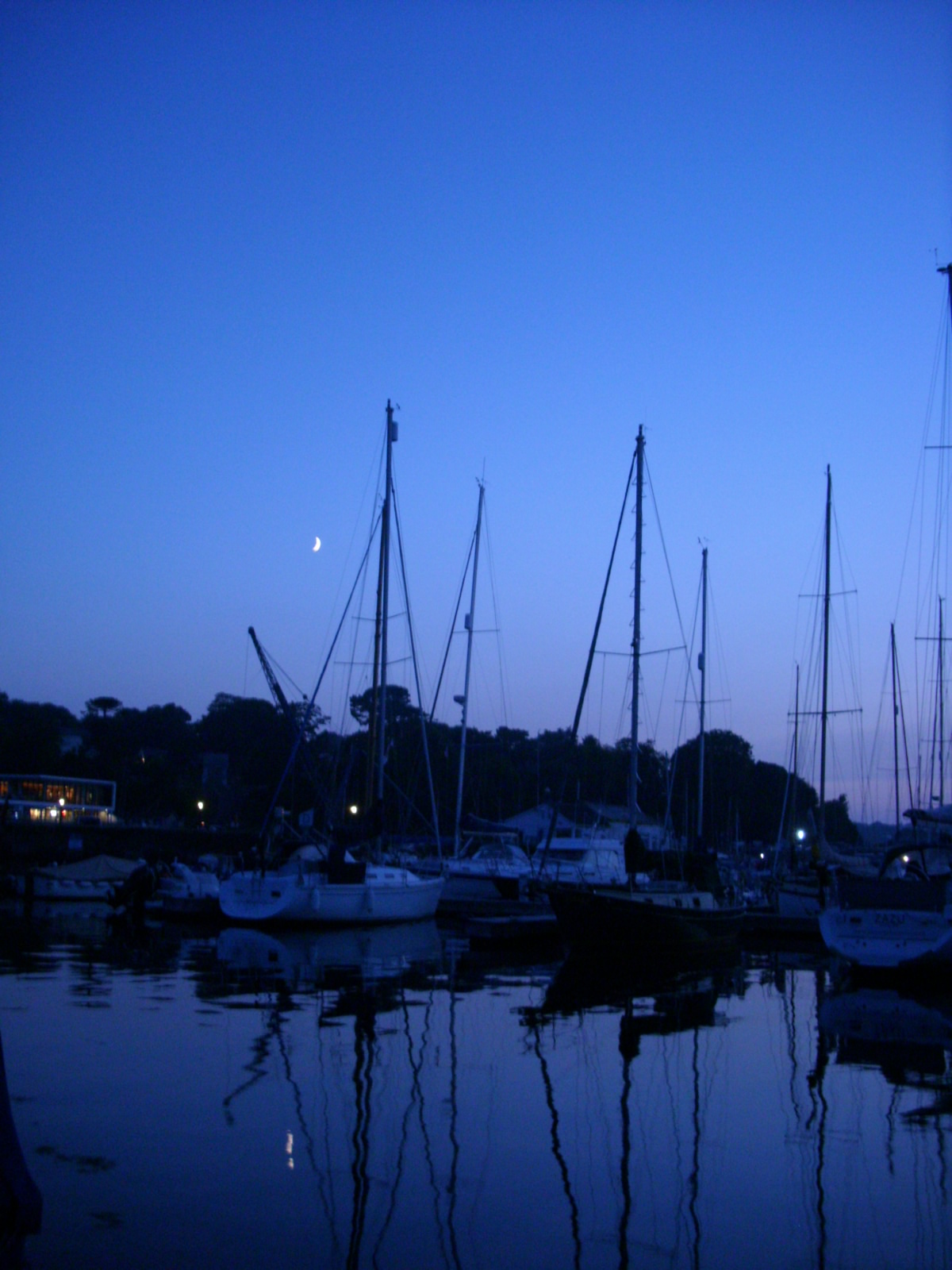
evening in Mylor
As it is important to see writing not just as a solitary activity, but also to appreciate the social aspects, there was some shared time away from the keyboard. On Saturday night we went on a little excursion, taking the train to Falmouth and then the water taxi to Mylor where we had a lovely meal followed by delicious ice cream.
On Sunday we started with another writing warm-up, where Pat got us to draw the journey of the day before, reflecting on our progress, and then draw the shape of our writing project. This was an ideal way to think about (and share with the group) what we had achieved so far, and gave a great starting point as to focusing on goal setting for the second day. In order to explore focus, Pat also did an exercise based on the image of a brick wall (with paper that had little brick walls on it, apparently wrapping paper she had found somewhere!): we were first invited to summarise the paper we were working on in two sentences… then one… then three words… then only one. I found this an incredibly useful exercise (and very hard), which really helps you to focus (and possibly question the focus you thought you had already sorted out!). Thus prepped we were ready for our second day of intense writing, broken up only by food and a little excursion to the Seasalt outlet shop, which is but a short walk away (and really it would have been rude not to go and support the cornish economy…)
Overall it was a very enjoyable weekend. And it also seemed quite productive. while I myself didn’t get much work done on my own writing, that probably would have been too much to ask for, as I was busy facilitating, but from my chats with the others it seems like a lot of progress has been made, and I think that the mix of focused time for work and creative loosening up and sharing activities was just right. All the retreaters have been invited as authors onto this blog, so hopefully we will get to read some updates on their work in due course!
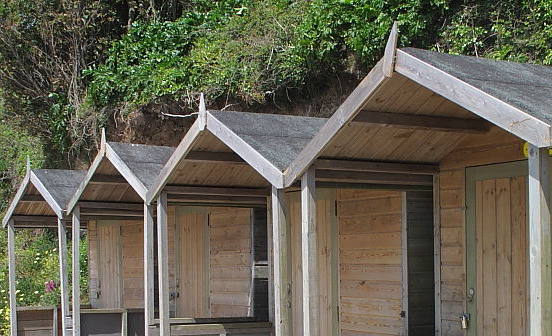
Swanpool beach huts, Falmouth, Cornwall

‘Shed’ as metaphor for the draft article/paper (courtesy Nancy de Freitas)

Coastline view from Pendennis Castle peninsula, Cornwall
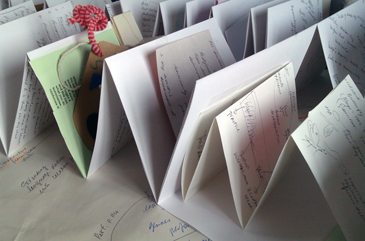
Concertina sketch books and reflective mind-map (Susan Ryland)

Professor Nancy de Freitas, AUT University, New Zealand / Editor-in-Chief: Studies in Material Thinking international journal.
During the Falmouth Writing Retreat (12th – 14th July 2013) I had the privilege of working with Nancy de Freitas, whose enthusiasm and wealth of experience was inspirational.
My task for the weekend was to plan an article, titled: A Cognitive Approach to Contemporary Art, for a new international Journal of Cognitive Humanities. I had already written an abstract based on my presentation at the inaugural Cognitive Futures of the Humanities conference at Bangor University (UK) in April this year. The first task Nancy and I tackled was turning my abstract into a ‘working abstract’ that would provide a structure for my journal article. We spent time discussing what the central focus of the article would be. This was like running a magnifying glass over the material and choosing which area to enlarge and which parts to retain as background information. The process helped me see how I could shift my focus for different audiences. I liked Nancy’s idea of using ‘signals and signposts’ to provide a guiding structure for the article, such as images/diagrams, keywords, titles and subtitles. It was reassuring to know that it was ‘okay’ to use this approach and made me realised that I was still inhibited by the notion that there was a ‘right way’ to do academic writing.
For me, as a predominantly visual thinker (trained in Fine Art Painting/Printmaking) I find images seem to tap into my subconscious. So, as I was reflecting on the weekend’s events I saw connections between my concertina sketchbooks, Nancy’s metaphor of the cobbled-together ‘shed ’ of an article (the stage when you can invite others to comment on your draft version), and Alke’s metaphor of the academic ‘ocean’. As I stood on the jagged Cornish coastline at Pendennis castle, the pitched roofs of Swanpool beach huts came to mind, and I wondered if the Falmouth experience was about building a ‘beach hut’ (as a variation on the ‘shed’ idea) – a temporary shelter, a place where you can keep your essentials (but not your whole thesis!) and a place where you can look out over the (academic) ocean. The ‘beach hut’ article gets you ‘out there’ in the public domain but not overly exposed to extreme weather events (it’s just an article, not a book!).
So, while metaphorically sitting in my beach hut I can view the (academic) ocean, reflect on my research and art practice and do a bit of snack writing. Perfect!
Susan Ryland (University for the Creative Arts)
After our December workshops had gone down quite well, Falmouth University invited Pat and myself back to this time put together a whole day as part of the Writing in Creative Practice series – Making Writing.
We started off with making name tags in order to explore the materials available for reflective bookmaking – and I don’t think we ever had as many feathers to use before!


Pat then started us off with an extended Writing Warm-up, which we used to explore writing on different textures ending up with writing about both objects and photographs. Again, a very rich experience to loosen us up (we didn’t really need to warm up as the weather was absolutely fantastic!).
Nancy de Freitas then shared her expertise of coming to writing from a material studies background, talking about Writing and Materiality (Falmouth_workshop2) – starting us off with blue sky thinking, introducing the importance of having a working abstract when doing any sort of research project, the usefulness of questions to prompt where you are going, the utilisation of images in both abstract ‘writing’ and planning structure as well as the differences between personal and academic writing (yes, there should be one!).
What I particularly loved was her use of the image of a shed to illustrate what a working draft of a piece of writing is like – yes, it might feel cobbled together (and the shed on the image she showed us really was…), but the important thing is that it is holding together! in a way this is the point when writing goes from a solitary to a social activity – now you can show it to somebody else, because it has enough structure to make sense. And from now on it can be worked on, carefully turning the precarious shed into a house with foundations, a solid structure, a roof that doesn’t leak, maybe even a conservatory… No, she didn’t actually mention conservatories, that is just what I was thinking, she did however go on to talk about the importance of editing as a social practice, because writing should work for the ‘other person’ – the reader! (An important fact that my students often don’t seem to be aware of.)
Nancy also shared some interesting thoughts on active documentation, and how that can be used to get students to think about structure and editing.


After lunch Oliver West took over sharing with us his journey of how he developed the Footnotes project out of his own struggle with writing as a dyslexic student and then practcioner. This is based around taking notes on a simple folded grid – allowing visuals to be recorded, annotated and then reordered. And of course we got to have a go – and I saw Nancy’s shed make an appearance on not just my grid!
I ended the official program with a gallop through the visual anaolgies and metaphors I use in order to engage my students with writing and particularly academic practice. Using the ‘mini’ quilt’ developed for the recent School of Education conference as a starting point, I introduced the framing of Kolb’s Experiential Learning cycle and then really briefly talked about The Land- and Seascape of Creative Practice, The Butterfly Challenge, ways of using objects, reflective bookmaking and poetic inquiry, The Dress-up Doll of Formality, visualising introduction/main body and conclusion of an essay as stages in journy planning, The Fishscale of Academicness, The Button Connection and The Winning Hand of Independence. And while I am not convinced all of them made sense with only a few sentences to explain them, I believe the gist of it came across – and I had some interesting feedback at the end of the session.
We ended with a discussion round wondering whether approaches are different for practitioners and teachers, people who see themselves as more comfortable with words rather than images – and how we can make sure to cater for different learning styles of out students.
It was a fantastic day full of interesting sharing, and some fabulous reflective books were made that will hopefully inspire things to come – and I hope that we can do it again sometime. (And then we immediately did with a Writing Retreat the following two days, about which I will blog soon!)


I experienced the Making the Textual Visual workshop at De Montford University on the 4th July as a wonderful sharing of ideas and coming together of different disciplines.
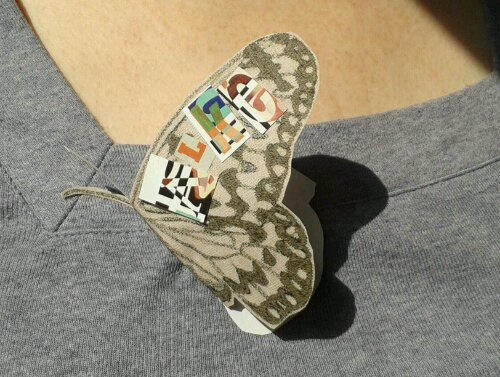
my butterfly name tag
Julia and Kaye not only had put together some lovely bright green bags for us, but also collected a lot of interesting and stimulating materials for collaging and to begin with making name badges. I found a lovely image of an embroidered butterfly, which not only reminded me of the Butterfly Challenge analogy I use with my students, but also of the idea of the quilt that I want to properly tackle this summer, so obviously I had to use that as my name badge!
Julia and Kaye then started the day – and it was a very full house, I understand there was a very long waiting list of people who didn’t get in – talking about new ways of seeing and how they engage their students in contextual research as well as library skills. I particularly loved the new approach to re-framing, based on Pat Francis’ contextual circles idea this idea uses an image, like a postcard, in the middle of a poster (flipchart paper) and then gets students to work outwards filling ‘frames’ with answers to the W questions – what is is? who made it? where was it made? how was it made? etc. until they come to the all important why? and get to design a frame that surrounds their investigation. Julia described the success they have had with using this to get students from the descriptive to the analytical. Very inspirational indeed.
Lisa Clughen then talked about writing as a social act – how important the conversations are, within your writing, about your writing, because really they are conversations about your thinking! She also gave us some examples of how she uses visuals to illustrate writing ‘problems’ to her students. My favourite of these was using the image of a cutlery drawer to get students to think about structure – a cutlery drawer is at its most effective when there are clear spaces designated for the knives, forks and spoons, just like as writing makes the most sense when the ideas that are linked are presented together and not in a jumble. I love this really simple idea of visualising structure… especially because most if not all students will be familiar with the concept of a cuterly drawer and also the annoying thing that sometimes happens if utensils are added that are an odd shape – haven’t we all needed to wriggle the potato masher so that we could open the drawer again? Well, in a way a writing problem can be just like that, and sometimes it just needs a little bit attention (the wriggle) to get it to fit the overall structure, so that we can close the drawer smoothly again!
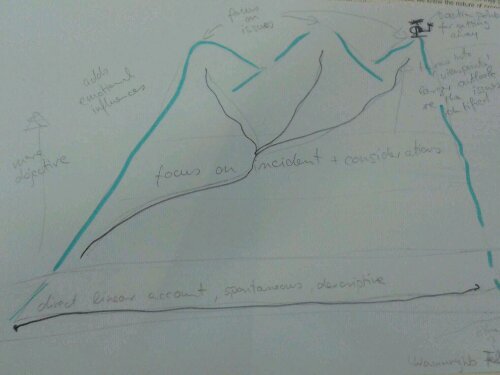
our group’s visualisation of the different levels of critical thinking in Jenny’s exercises
Jenny Moon then introduced one of her exercises to deepen critical thinking. We were transfered to a mountain walk through reading different forms of report about an incident, and had fun in group discussions figuring out how those reports differed, again reflecting on the descriptive to the analytical. Our table also started talking about mountains as a metaphor/analogy as a whole, and we ended up discussing Wainwright’s graphic descriptions of his walks, which seemed inevitable, but I wonder whether this happened at one of the other tables…
My own session was a brief talk about my use of post-its to organise reflection as a patchwork (as discussed on this blog under the ‘quilt’ tag). When agreeing to do this session I had hoped that this project would be much further along and that I could have brought a finished piece, but maybe the nature of it being in progress actually helped bring across the point… and a personal development mapping like this is, of course, never really finished. I was very aware that I hadn’t really looked at it for quite some time, and that it urgently needs updating before I continue working on it. However, it was nice to see how many of my dark green pieces, which I use to denote future plans, will need to be changed in colour, because I have achieved or at least further developed them! I got some great feedback and hope that I have inspired some of the attendees to start their own post-it patchwork as a tool for their personal reflection, maybe towards the HEA fellowship application. (And if you are one of these people, this blog wants to hear from you!) I will also try to write this up soon!
Through clever planning we then still had some time to do some making! So the tables made some posters using the strategies learned – and then shared what they thought had been most memorable. Here the collaging/reflective note-taking was mentioned a number of times and the (re)frames made a number of appearances, too.
Overall a very memorable and enjoyable day. Kaye and Julia have been talking about having more events, to which I can only say: yes, please!
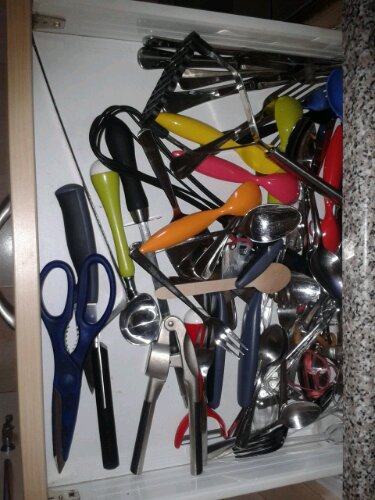
help! this is my cutlery drawer at the moment… not much structure at all!
P.S. on a slightly worrying note I have taken a new look at my own cutlery drawer. On my list of things to do since I moved into my new flat (almost four years ago) was making a cutlery tidy out of old tea towels. Suffice to say this hasn’t happened yet… is this rather unstructured way of keeping my cutlery indicative of the chaos my research/life feels in at the moment?
Today’s Writing in Creative Practice workshop led by Nancy de Freitas was a masterclass in how to combine a lot of information with plenty of discussion and trying out, while still fostering a relaxing atmosphere. Honestly, the only person running around like mad and a bit frazzled was myself (but then I had to worry about the caterers – not that they didn’t do a fantastic job again!).
The idea was to this time focus on our own writing rather than our students’, and specifically on that mysterious beast: writing for publication.
People were so eager to get started that everybody was present fairly soon after we opened registration (i.e. when the coffee had arrived), so we for once had the time to go around the room and introduce ourselves and talk a little about why we were there.
Nancy then started us off with an introductory lecture that very clearly set out the process of writing for academic publication – the thinking processes that go into finding focus, the putting together of a (working) abstract, the writing itself, the editing process, the rewriting of the abstract this time for publication, the submission – and what happened afterwards, i.e. some stages of the review process. As editor of Studies in Material Thinking she was able to share some valuable insights from ‘the other side’ of the submission process (and I wish somebody had told me about all this when I was starting out in academia).
Our first little exercise used Rowena Murray’s Ten Prompts for planning a paper – and we all got some time to have a go, and then discuss the usefulness of having prompts like this. The following conversation showed that while not all questions were helpful in all contexts, the activity of sitting down and thinking with focus about the writing we were about to embark on was seen as helpful all round. Nancy also introduced us to Robert Brown’s Eight Questions and her own provocations, which include the requirement of putting forward not just writing, but also pictures. During our conversation we also found out that one of the group used a similar method for getting started in her writing – imagining she was going to the pub and having a conversation about her writing with somebody there (apparently this Pub Method is helped by actually going to the pub during a break in the writing…).
We talked about a number of ways to get started with writing and developing projects, my favourite probably the term of ‘Snack Writing’ – little writing tasks that are done regularly to put together a portfolio/file of little pieces of writing that can then help develop/be the starting point of something bigger. This could be reviews of own or other’s work or free-writing exercises, for example. I already do this with my students – setting them regular tasks to get them writing regularly – so now having a good term (Snack Writing) is great to get across to them that these tasks are meant to be non-threatening.
After a lovely buffet lunch, I did a session on thinking about different ways that writing can be published. I tied it into the Fishscale activity that I do with my students (and if you are a regular reader of this blog you will know what this is about, if you are not, search Fishscale as a Category) and shared my own experiences with a particularly frustrating article, where I made the (all too common) mistake of trying to adapt an article written for one journal and rejected for submission to another journal and ended up with what must have read as a confused mixture of data. (I now call this the Frankenfish phenomenon, after Frankenstein’s monster. Beware of the Frankenfish and always carefully tailor your writing to the journal you are submitting to!) I also made delegates design some fish representing the different ways of presenting work (hopefully I will be able to put some of them up on here soon).
Nancy took over again, and we talked some more about clarifying our practice – for example thinking about the concept, context, focus and methods of your research… and then swapping them around – what happens if you see your methods as your concept or your context as you focus? Again there was a great discussion with people starting to think about how to tailor the same research for different journals/audiences and possibly also how to mine a PhD for publications.
We ended by analysing two abstracts and discussing their strengths and weaknesses – and in extension talked about the review process a bit more. Nancy shared the form the review report at Studies in Material Thinking takes, which was again really useful.
Overall I found it to be an enjoyable and informative day – and can’t wait to do it all again, only with a bit more time, at the forthcoming Writing Retreat in Falmouth (there are still places left… sign up here!)
A special thank you to the Higher Education Academy and the Institue of Applied Creative Thinking (I-ACT) at Staffordshire University for funding this event!
 Tactile Academia