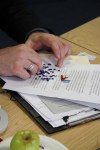
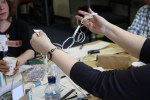
Just a short post to let all of you who couldn’t make it to yesterday’s workshop (and the weather was probably an important factor, although some people made it up from the south coast) know how it went. I didn’t take any photographs myself, but Michael Walls, a student, joined us to take some (when we could get him away from the craft materials – and thanks Mike, for doing such a fabulous job!).

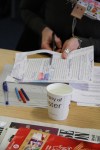
Elizabeth getting us startedAfter the by now traditional welcome of making our own name tags and having a look at lovely materials and books brought in for inspiration, Elizabeth Kealy-Morris, our host, gave a presentation on taking collage seriously, making some reference to how she gets her students to engage with text in a humument fashion – and allowing the table groups to start some discussions on the set text (a chapter by Stuart Hall).

Different groups were approaching different quotes from the text, discussing aspects they found particularly interesting and important – and finding ways to illustrate what the text was saying through changing the format from 2d to 3d (and flexible in some cases).

Sarah talking about collageThen Sarah Williamson talked about different types of Angela speakingknowledge and how that can be teased out and developed through using collage and layering as a tool. To finish off the morning session, book artist Angela Davies talked about her practice and work that inspires her – not only showing beautiful slides, but also bringing in some of her books so we could take a closer look. She also showed a work in progress, which was inspired by the reading for the workshop (and she has promised to let me have some photographs of how this work developed for this blog once she is done!).

During these three sessions there were already very lively discussions developing, which we at least partly were able to continue over lunch.

In the afternoon we had set an hour and a half aside just for making, and there was some very interesting explorations of layers going on.

By the end of this, we re-entered our discussion, but some of the energy was lost – or maybe people just wanted to continue making? At the end of the day there were some fascinating explorations of layers of meaning going on – some of which to be continued at home.


Jane's Tunnel Book

Jane’s Tunnel Book

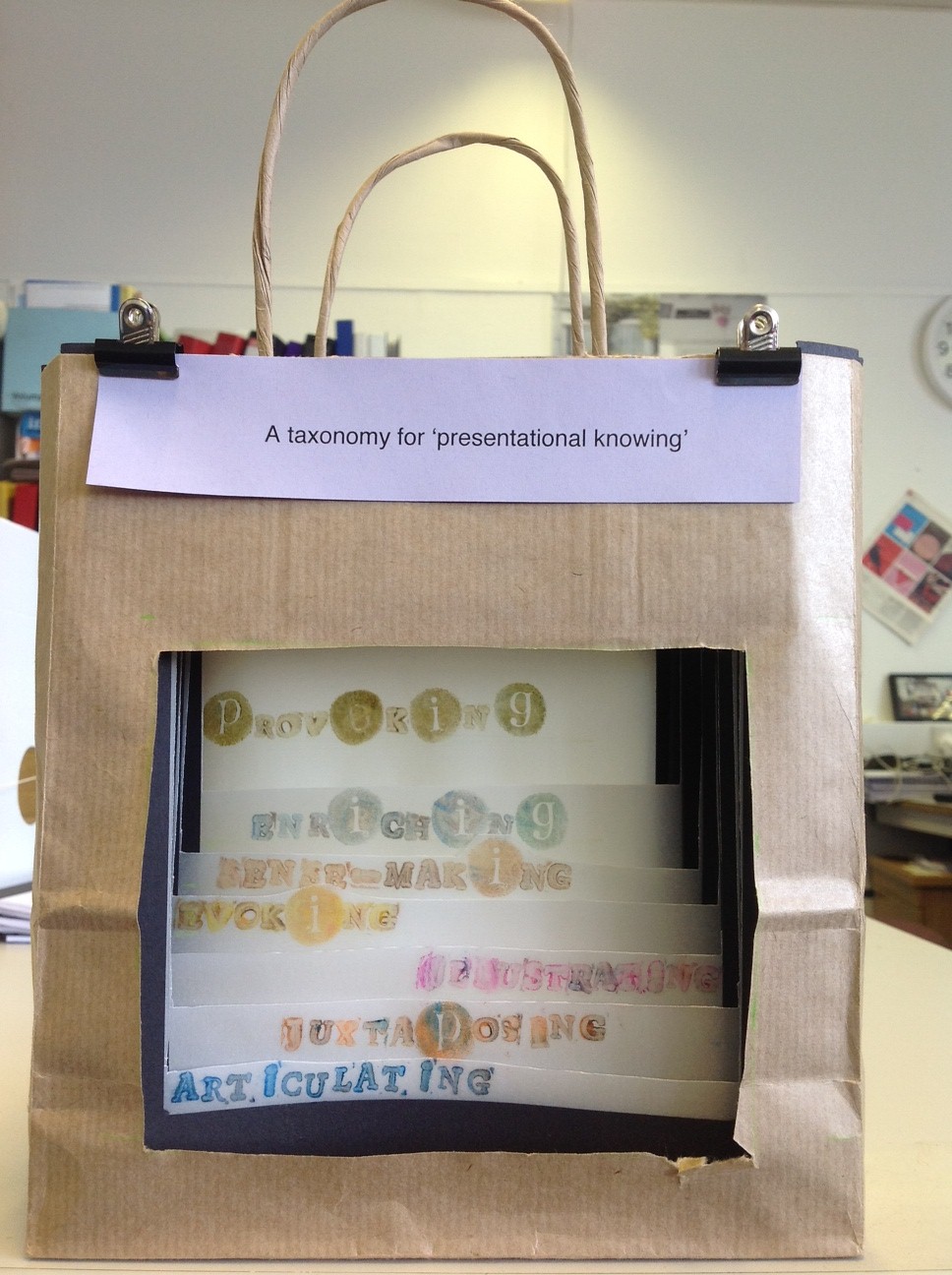
I have already been sent the image of one of the books made -exploring the taxonomy of presentational knowledge introduced in Sarah’s talk – and it also uses the structure of the tunnel book I was proposing as a simple way of exploring layers (If you want to make your own, download make your own tunnel book instructions here).

The official HEA post (including handouts and presentations) about this workshop can be found here.

Yesterday Elizabeth, Sarah, Angela and myself had a little meeting to sort out final details of the Chester workshop next week (and yes, there still seem to be places available, if you are interested). It was a really good meeting, and there will be some interesting stuff going on!

Inspired by getting together and talking about different ways of layering, I went home to protoype a ‘tunnel book in a bag’. I had been thinking of ways to easily facilitate a layered approach in book making and was thinking that it could be fairly straight forward to use a paper bag as a ‘container’ with little concertinas at the sides so that content could be ‘slotted’ in. I had had the idea some time ago, but hadn’t done anything about it (like so many ideas…), so it was really good that the meeting made me actually try to put this into practice. I aim to make a little how-to handout for the workshop!

Called The Underwater Iceberg, this particular book looks not at layers of meaning, but the different layers that should go into researching an academic essay. Hopefully I will be able to finish this soon, and then I will post about it some more.

Let me first say: apologies to all readers who this really doesn’t apply to. Because this is only tangentially tactileacademia related, and some of the lingo is probably very Staffs specific…

Part of the university plan at Staffordshire University is that everybody should be HEA accredited within 5 years, so a small group of people from my award group have decided to get together regularly to have a chat about the things we need to for our individual portfolios. As inevitably not everybody can make it to these sessions, I promised to put a short summary on this blog, which also will allow exchange of ideas. I will put them into a new category called ‘HEA accreditation’. Who knows, maybe we will even get some virtual group members from other universities…?

So today we focused on Area of Activity 1: Design and plan learning activities and/or programmes of study

This seemed really straight-forward. For our portfolio we need at least one piece of evidence that shows we design and plan learning activities. Suggested on the tick-list for Fellow were:

  • module handbook developed by you
  • session plan
  • evidence of involvement in a validation panel
  • learning resource pack
  • plans to integrate the Staffordshire Graduate attributes

Suggested on the tick-list for Senior Fellow were:

  • Award or module handbook developed by you
  • Award monitoring form completed by you
  • Evidence of driving forward the Staffordshire Graduate agenda within your area

In our discussion we wondered how old the evidence could be. Some of us have recently had a significant change in our module leadership duties due to a restructuring on the awards, so things have changed quite a bit. We figured that as long as not all the evidence was ancient it would probably be ok to put in something that showed good practice but wasn’t current at the moment – and obviously that could be mentioned as part of the annotation/overview.

We decided to all think about examples we could include in our portfolio (to be edited down at a later stage), and to bring them to the next session, so that we could use these get-togethers to share good practice as well as just put together our own portfolios.

Next session: A2: Teach and/or support learning (moved from 12 to 1)

On 12th April the University of the West of Scotland (Ayr Campus) will host the first Scotland-based workshop in the Writing in Creative Practice series, which is run in conjunction with Writing PAD and partly funded by the Higher Education Academy.

Titled Collage, Reflection and Writing, this workshop looks at collage’s potential as a method of inquiry through creative practice which seamlessly merges the making and the textual. We will explore the versatility collage offers as it allows one to find the words to express subjective experience through reflexivity and its (collage’s) intrinsic multiple interpretations of the ‘image’. We will take a look (and possibly have a go) at collage as a method of inquiry, reflective bookmaking, poetic inquiry and poem houses, as well as discussing ways of introducing students to structuring academic texts through collage.

Conceived as a hands-on day with lots of activities and discussion, this workshop will give participants the opportunity to explore collage in both a theoretical and practical way, but particularly as a way of engaging students in a reflective and analytical process that can prepare and support their writing tasks.

For more information on previous workshops in the Writing in Creative Practice series, please check the HEA events archive or https://tactileacademia.wordpress.com/?s=writing+in+creative+practice.


The attendance of this workshop is free of charge to all those interested in the workshop topic, with preference being given to staff working in HE institutions and HE in FE colleges from across the UK. Places will be allocated on a first come, first served basis. Lunch and refreshments will be provided, but travel expenses will not be covered. However, the HEA is currently running a funding scheme to support travel crossing national borders to attend events, which could be applied for independently.

For more information or to book a place, please get in touch with Dr Alke Gröppel-Wegener (tactileacademia@gmail.com) with ‘WiCP Ayr’ in the subject line.


Our current draft programme (subject to change)

11:00 registration and refreshments

11.30 welcome

11.45 Thinking through Collaging: Reflective bookmaking and poetic inquiry (Sarah Williamson)

13.00: Lunch

13.45: Collage as subjective experience: Transitioning, Relinquishing, Becoming (Alison Bell)

14.45: Collaging in three dimensions: the Poem House (Brigid Collins)

15.45: refreshments

16.00: Collaging the Context: Visual Ways of Collating a Literature Review (Alke Gröppel-Wegener)

16.30: Discussion

17.00: end


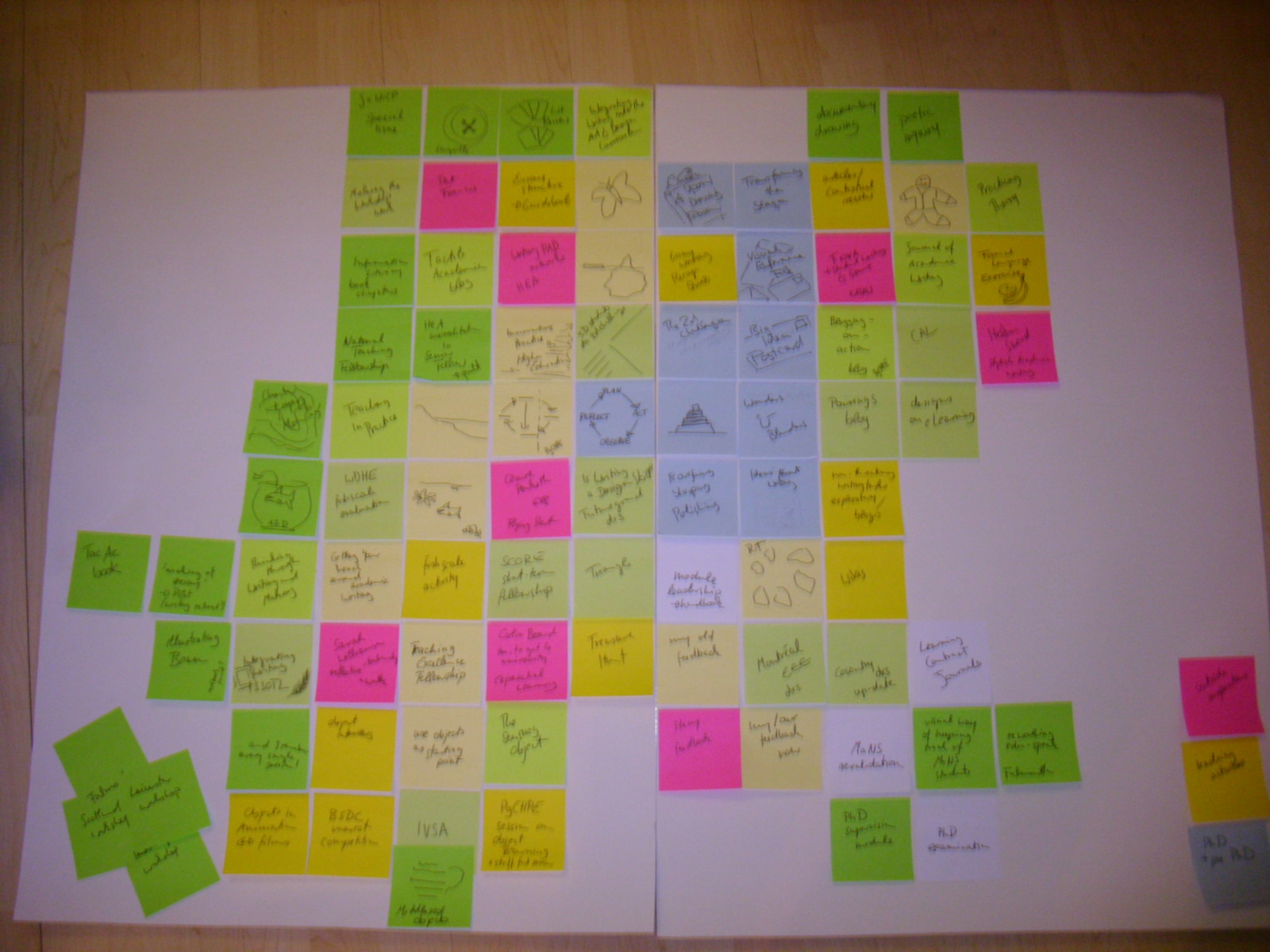
With the starting point of my quilt sorted, I want to started organising the next pieces in a spiral going outwards. As the first piece referenced my PhD, I thought the first round would be a good idea to represent important ideas that came out of the PhD which I still use or which have really influenced my understanding of learning and teaching.

Here some images of how these pieces might be represented in the quilt.

Roughing, Shaping, Polishing. This piece refers to a text by Barry Wellman (‘How to Write – and Edit – a Paper‘), which talks about the different stages of writing, roughing, shaping and polishing. I think that this is particularly apt, as this could really also represent the stages of designing, and I have used this to get students to link the process of writing to the design process ever since. And when I designed my first module introducing students to academic writing, I put in three workshop/seminars based around these three main stages.
Ideas about Writing. This was the title to one of my first lectures to second year students. On a handout I had four different descriptions of objects, really it was to make students think about what you can do with words and how you can frame your reader’s expectation and even build suspense by the way you are describing something. One is one of the best descriptions of an objects that I have ever come across – the fishbowl in Douglas Adams’ So long and thanks for all the fish; one was a description/review of Aalto’s Savoy vase from The Times by Hugh Pearman; one was an introduction to the usefulness of towels from The Hitchhiker’s Guide to the Galaxy and the last one was a section from Jasper Fforde’s Lost in a good book, where an art work is described, which turns out to be … I don’t want to give it away, shall we say an object commonly found in the kitchen.
Wonders and Blunders. The first non-threatening writing task I set my students was asking them to write about something they loved and something they hated – and explain why – inspired by the ‘Wonders and Blunders’ column in The Guardian. This was the first genre writing I asked students to do, including writing their own byline and short biography, as well as including pictures to mimic the examples as much as possible. The students came up with some amazing examples, the stand-out probably nominating ‘Christmas’ as a wonder and ‘January’ as a blunder.
The Big Idea Postcard. This was a task that I used to replace an outline students had to write for their proposed work (and report) at the beginning of their third (final) year. It was meant as a prop for a presentation as part of a group tutorial, but also gave them the opportunity to think about the larger context of what they wanted to achieve, before scaling down their projects into something that was ‘doable’ with the time and resources available. Using the postcard model prompted students to use both words and images to represent what they wanted to explore; it was non-threatening, because it was fairly small, so a manageable task; and it also made them focus, because of the limited space available. Feedback for this activity was good from both the students and staff (who found that the quality of the explored ideas went up), and I am (still) using this as a starting point for essay writing in my current teaching.
The 2d Challenge. This was probably the ‘biggest’ piece of work that I tested for the PhD. It was a task for second year students to imagine their work as a newspaper or magazine and produce a sample copy of it. There were certain elements that needed to be included, such as an element that described their own practice and an advertisement or review of something they had made on the course (and their ‘Wonders and Blunders’ task, although they could rewrite that), but overall it was a ‘blue sky’ project, i.e. students were encouraged not to feel restricted by ‘the real world’. I feel that this was a really successful task, not only did it get students to write in a rather sneaky way, because obviously they had to fill up their publication, it also made them really think about their aspirations (and made them discuss/share them with the staff). My favourite example was of a student who came into a tutorial to say that he had no idea what he could use, he wasn’t reading any magazines, and overall he seemed a bit lost on the course. So I asked him what he did in his spare time (skateboarding) and whether there were any publications related to that he sometimes read (yes, regularly) and I encouraged him to maybe use them as a starting point. By being given permission to include his hobby, he made the link between that and the course he was on (3 Dimensional Design) and produced a sample copy of a skater magazine that featured an article on the aesthetics of concrete in a half-pipe. In his third year he went on to use concrete as a material!
Writing PAD case study. During this time, I also came across the Writing-PAD network (at the time this was still a HEFCE funded project), and one of my first publications was writing the 2D Challenge up as a case study for their website.
Action Research Spiral. One of the most important concepts for both my PhD (where it provided me with the starting point of a structure for my thesis, see previous post on The Spiral) and my understanding of how research, writing and design can be modelled was the action research spiral. My initial encounter was through Swann’s ‘Action Research and the Practice of Design’ in Design Issues 18:2 (2002), who quoted Zuber-Skerritt’s Action Research in Higher Education: “In brief it is a spiral of cycles of action and research consisting of four major moments: plan, act, observe, and reflect. The plan includes problem analysis and a strategic plan; action refers to the implementation of the strategic plan; observation includes an evaluation of the action by appropriate methods and techniques; and reflection means reflecting on the results of the evaluation and on the whole action and research process, which may lead to the  identification of a new problem or problems and hence a new cycle of planning, acting, observing and reflecting.” (1992) A linked model is Kolb’s Experiential Learning Cycle, which will be referred to in future pieces of the quilt.
Futureground Conference. This was my first presentation at an international academic conference (and I was lucky enough to go to Australia for it). Held at Monash University, Melbourne, Futureground was one of the conferences of the Design Research Society. My paper was called ‘Is Writing a Design Discipline?’ and summarised the findings of my PhD.

This week I stumbled across poem houses. There they were, waiting in an article in a journal that had been on my shelf for the better part of the year. And I had no idea until I pulled out a number of these journals to give to a student and idly flicked through them. Luckily said poem houses caught my eye and consequently that one journal issue didn’t make it to my student’s bag, but my own instead.

As explained in ‘Sense making through poem houses: an arts-based approach to understanding leadership’ by Louise Grisoni and Brigid Collins (Visual Studies, Vol. 27, No. 1, March 2012, 35-47), poem houses have been developed by Brigid Collins as “three dimensional artefacts combining visual interpretation with poetic text and which hold a special significance for the maker.” (35) Using examples and testimonials from a workshop on leadership development, the article is a fascinating insight into using this format/genre as a focus for reflection. And of course I read this wondering how it could be applied in my learning and teaching. I will definitely try to make my own one of these days, but in the mean time, you can see some examples here.

I have also managed to find some more writing by both Collins and Grisoni, which might be more food for thought.

I have been doing some more work on the quilt – and have introduced a little more colour-coding…

quilt mock-up now with colour coding

quilt mock-up now with colour coding

I took it to my appraisal, and am happy to report that my line manager liked it (and the idea), although she pointed out that really I am talking about a patchwork… In one sense that may be true, but I will keep referring to this as a quilt, because even though this layer I am designing is a patchwork of sorts, the thing about the quilt is that it is thick, because it has that lovely layer inside. And this piece needs to be substantial, so once I am ready to join it to the subject specific side, there will be quilting contained to make it nice and warm.

But more than anything, I just really like ‘quilt’ as a word. It’s only one letter removed from ‘quill’, which could link it to the writing side of it. I feel the title of a paper coming on: “From quilt to quill, how a visual patchwork can organise and prepare reflective writing” – maybe not quite there yet…

P.S.: I also managed to find out that my university has a newly acquired textile/fabric printer, so making it doesn’t seem out of reach anymore (but let’s design it first). how exciting is that!

The Spiral - initial centrepoint of my quilt

The Spiral
initial centrepoint of my quilt

This piece represents the core of my PhD, which ended up being about The Role of Writing in undergraduate Design Education in the UK and was the first time I properly came in contact with Higher Education from the teaching side.

The spiral itself represents the structure I had in mind – I was trying to turn Kolb’s Experiential Learning Cycle into three dimensions, which represents the research process as well as both the design and writing process (one of the points I made in the PhD). I used little images of it to preface chapters, always highlighting where in the spiral the reader was at this point.

I like the idea of this, a spiral that gets tighter and comes to a point as the focus of the research becomes clearer, becoming the starting point of an outgoing spiral, as the (initial) centre point on my quilt. And while I didn’t end up in Higher Education for a couple of years, this was the spark that in the end did start my current career (and got me my job).

I realise this might not remain in the middle of the quilt, but for now I will work outwards in a spiral…